Introduction to Machine Learning
Introduction to Machine Learning
What is Machine Learning?
Machine learning is a way of teaching computers to find patterns. Instead of writing explicit instructions for every possible scenario, we let the computer learn from data. Think about how you learned to recognize a cat. No one gave you a long list of rules like "it must have pointy ears, whiskers, and a tail." You just saw lots of cats, and eventually, your brain figured out the pattern. Machine learning works in a similar way.
Machine Learning
noun
A field of artificial intelligence where computer systems learn and adapt through experience by using algorithms to analyze data, without being explicitly programmed.
This ability to learn from data is what makes machine learning so powerful. It's used everywhere, from recommending movies you might like to helping doctors diagnose diseases. The core idea is always the same: find patterns, make predictions. But how computers learn can be very different. There are four main approaches.
Learning With a Teacher
The most common type of machine learning is called supervised learning. The "supervised" part means the computer learns from data that has already been labeled with the correct answers. It's like studying with flashcards. You see a picture of an apple (the data) and the word "apple" on the back (the label). After seeing enough examples, you can identify an apple you've never seen before.
In machine learning, a model is trained on thousands or millions of labeled examples. An email is labeled "spam" or "not spam." A photo of a tumor is labeled "malignant" or "benign." The model's job is to learn the relationship between the data and its label so it can make accurate predictions on new, unlabeled data.
For example, a supervised learning model for a bank might learn from historical data of loans. Each past loan would be the data, labeled as either "paid back" or "defaulted." The model learns to predict which new applicants are likely to default.
Learning on Its Own
What if you don't have labeled data? That's where unsupervised learning comes in. Here, the computer is given a dataset without any explicit instructions or correct answers. Its task is to find the hidden structure or patterns all by itself. It's like being handed a box of mixed LEGO bricks and asked to sort them into piles. You might group them by color, size, or shape. You're creating the categories as you go.
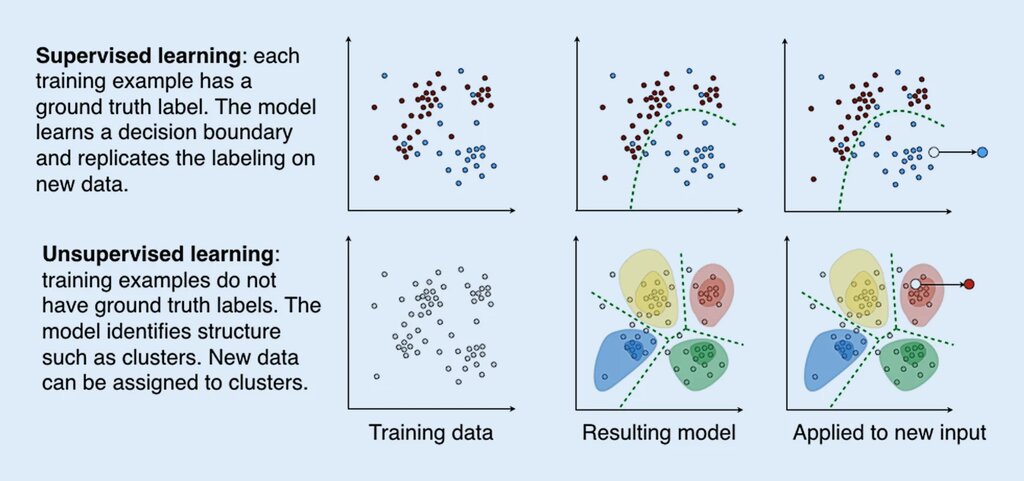
Unsupervised learning is great for exploring data and discovering relationships you didn't know existed. Online stores use it to group customers with similar shopping habits for marketing campaigns. Biologists use it to find patterns in genetic data that might point to a common ancestry.
A Little of Both
Semi-supervised learning is a middle ground. It uses a small amount of labeled data and a large amount of unlabeled data. The idea is to use the labeled data to get a head start, and then use the underlying structure of the unlabeled data to improve the model's accuracy.
Imagine you have a million family photos. Labeling every person in every photo would be impossible. With semi-supervised learning, you could label a few photos of your sister. The model then looks through the rest of the photos, finds others that look very similar, and labels them as your sister, too. It's a practical approach when getting labeled data is expensive or time-consuming.
Learning From Mistakes
Finally, there's reinforcement learning. This method is inspired by how animals learn through trial and error. The computer, or "agent," learns by interacting with an environment. It receives rewards for good actions and penalties for bad ones. The goal is to maximize the total reward over time.
Think of training a dog. When it sits on command, you give it a treat (a reward). When it chews on the furniture, you say "No!" (a penalty). Over time, the dog learns that sitting leads to good things and chewing furniture leads to bad things.
Reinforcement learning is the secret behind AI that can master complex games like Go or chess. The agent plays millions of games against itself, slowly learning which moves lead to a higher chance of winning. It's also used in robotics, where a robot might learn to walk or pick up objects by trying different motions and getting rewarded for successful ones.
| Learning Type | Main Idea | Data Used | Real-World Example |
|---|---|---|---|
| Supervised | Learn from labeled examples | Labeled data | Email spam detection |
| Unsupervised | Find hidden patterns | Unlabeled data | Customer segmentation |
| Semi-supervised | Use a little labeled data to guide learning on unlabeled data | Mix of labeled and unlabeled | Face recognition in photo apps |
| Reinforcement | Learn via trial and error with rewards and penalties | No pre-existing data; generated through interaction | AI playing a video game |
These four types of learning are the building blocks of modern AI. Each one offers a different way to unlock insights from data and create intelligent systems that shape our world.