Introduction to Machine Learning
Introduction to Machine Learning
What Is Machine Learning?
Imagine trying to teach a computer to recognize a cat. With traditional programming, you'd have to write an exhaustive set of rules: if it has pointy ears, and whiskers, and fur, and a certain eye shape, then it's a cat. This is incredibly difficult and brittle. What if the cat's ears are folded? What if the picture is dark? The rules quickly fall apart.
Machine learning takes a different approach. Instead of giving the computer rules, you give it data. You show it thousands of pictures of cats, and you tell it, "These are all cats." The computer then learns the patterns on its own, creating its own internal rules for what makes a cat a cat. It learns from experience, much like a human does.
Machine Learning
noun
A field of artificial intelligence where computer systems learn and improve from experience without being explicitly programmed.
This ability to learn from data is what makes machine learning so powerful. It allows us to solve complex problems where the rules are either unknown or too complicated to write down by hand. From recommending movies to detecting diseases, machine learning is the engine behind many of today's most advanced technologies.
Three Main Flavors
Machine learning isn't just one single technique. It's a broad field with several different approaches. The three main types are supervised, unsupervised, and reinforcement learning. Think of them as different ways of teaching the machine.
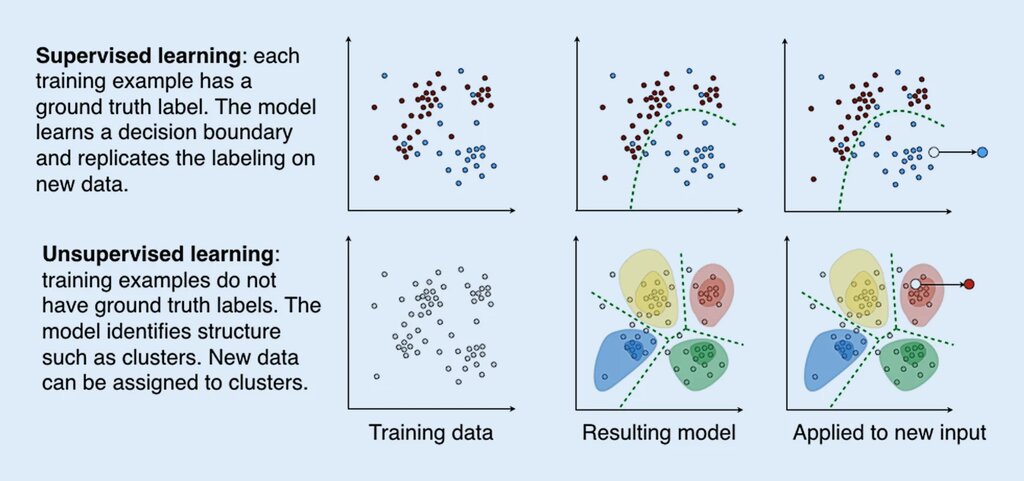
Supervised learning is like studying with flashcards. Each card has a question (the data) and an answer (the label). For example, you might show the model an email along with a label telling it whether the email is "spam" or "not spam." After seeing enough labeled examples, the model learns to predict the label for new, unseen emails. This is the most common type of machine learning.
Unsupervised learning is like being given a huge pile of assorted LEGO bricks and asked to sort them. Nobody tells you what the groups should be. You look for patterns on your own and decide to group them by color, shape, or size. In the same way, unsupervised learning finds hidden structures and relationships in data without any labels. This is useful for tasks like customer segmentation, where a business might want to find natural groupings within its customer base.
Reinforcement learning works like training a pet. The model, often called an "agent," learns by performing actions and receiving rewards or punishments in return. A self-driving car's AI might get a positive reward for staying in its lane and a negative one for swerving. Over many trials, it learns the best sequence of actions to maximize its total reward. This approach is powerful for teaching machines to master complex tasks, like playing games or controlling robots.
| Learning Type | How it Learns | Common Use Case |
|---|---|---|
| Supervised | From labeled data | Predicting house prices |
| Unsupervised | Finding patterns in unlabeled data | Customer segmentation |
| Reinforcement | Trial and error with rewards | Game-playing AI |
Machine Learning in the Wild
You likely interact with machine learning every day without realizing it. It’s the technology that powers many of the services you use.
When Netflix or Spotify suggests a new movie or song you might like, that’s machine learning. The system analyzes your past behavior and compares it to millions of other users to find patterns and make personalized recommendations.
Your email's spam filter is a classic example of supervised learning. It learns from emails that you and others have marked as spam to get better at catching unwanted messages.
Navigation apps like Google Maps use machine learning to predict traffic and estimate your arrival time. They analyze historical traffic data and current conditions to find the fastest route for you.
In healthcare, machine learning helps doctors detect diseases earlier and more accurately. Models can be trained on medical images, like X-rays and MRIs, to spot signs of conditions like cancer that might be subtle to the human eye.
These applications are just the beginning. As we gather more data and develop better algorithms, machine learning will continue to transform industries and change the way we live and work.
What is the primary difference between machine learning and traditional programming?
A developer is building a system to identify spam emails. They have a large dataset of emails, each already marked as 'spam' or 'not spam'. Which type of machine learning is most suitable for this task?