Introduction to Machine Learning
Introduction to Machine Learning
What Is Machine Learning?
Machine learning is a way of teaching computers to learn from data, find patterns, and make decisions on their own, much like we do. Instead of writing explicit, step-by-step instructions for every possible scenario, we give the computer examples and let it figure out the rules for itself.
Think about how you learned to recognize a cat. No one gave you a strict set of rules like "if it has pointy ears, whiskers, and a long tail, it's a cat." Instead, you saw many different cats and your brain gradually learned to identify the key features. Machine learning works in a similar way, but on a massive scale. It can analyze millions of data points to uncover patterns that would be impossible for a human to spot.
At its core, machine learning is about using data to answer questions. It's the engine behind everything from your spam filter to movie recommendations and medical diagnoses.
Three Ways Machines Learn
While the goal is always for the machine to learn, there are different strategies for teaching it. These strategies, or learning paradigms, fall into three main categories: supervised, unsupervised, and reinforcement learning.
Supervised Learning
other
The machine learns from data that is already labeled with the correct answers. It's like studying for a test with an answer key.
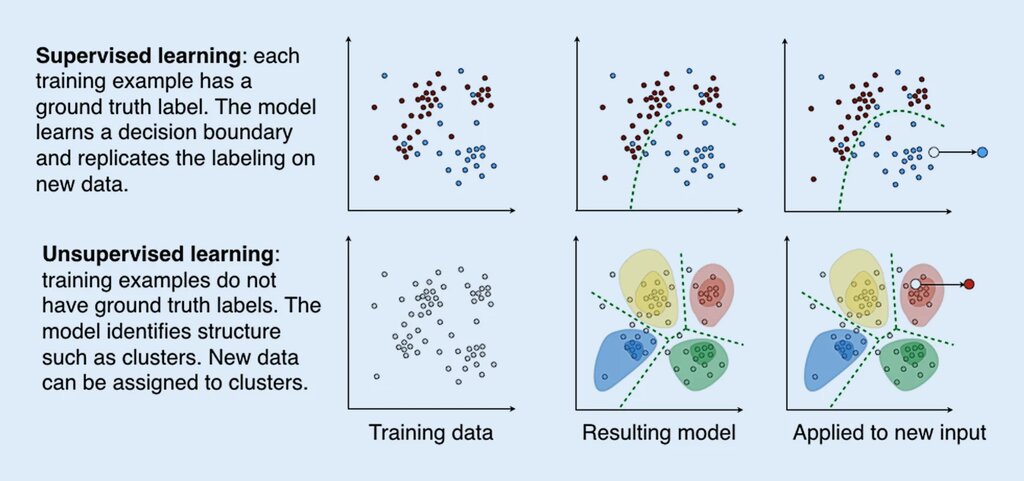
In supervised learning, we give the model a dataset where we already know the outcomes. The model's job is to find the connection between the inputs and the corresponding outputs. After training on these labeled examples, it can then make predictions about new, unlabeled data.
For example, to train a model to predict house prices, you would feed it data on thousands of houses, including features like square footage and number of bedrooms (the inputs), along with their final sale prices (the correct outputs). The model learns the relationship between these features and the price, allowing it to estimate the value of a house it has never seen before.
Unsupervised Learning
other
The machine learns from data that is not labeled or classified. It must find patterns and structure on its own.
With unsupervised learning, we don't provide an answer key. The algorithm explores the data and tries to identify underlying structures or groups without any guidance. It’s like being given a box of mixed-up photos and asked to sort them into piles that make sense, without being told what the categories are. You might group them by the people in them, the location, or the time of year.
This method is powerful for tasks like customer segmentation, where a company wants to group similar customers together for marketing campaigns, or for identifying anomalous activity in a computer network that could signal a security threat.
Reinforcement Learning
other
The machine learns by performing actions and receiving rewards or penalties. It's a process of trial and error.
Reinforcement learning is about learning to make the best decisions to achieve a goal. An agent (the learner) interacts with an environment and receives feedback in the form of rewards or punishments for its actions. The agent’s goal is to maximize its total reward over time.
Imagine training a dog to do a trick. You reward it with a treat for a correct action and withhold the treat for an incorrect one. Over time, the dog learns which actions lead to a reward. Reinforcement learning is used to train robots to perform complex tasks, develop self-driving car navigation systems, and create AI that can master strategic games.
Putting It All Together
These three learning paradigms form the foundation of modern AI. Each is suited to different types of problems, but they all share the common goal of enabling systems to learn from experience. Here’s a quick summary of how they compare:
| Learning Type | Input Data | Goal | Example Application |
|---|---|---|---|
| Supervised | Labeled | Predict outcomes for new data | Spam detection |
| Unsupervised | Unlabeled | Discover hidden patterns or groups | Customer segmentation |
| Reinforcement | No predefined data | Maximize a reward signal through actions | Game-playing AI |
From optimizing your daily commute to helping doctors detect diseases earlier, machine learning is already a significant part of our world. Understanding these fundamental concepts is the first step toward appreciating how it works and where it's headed next. Let's review these key ideas.
Ready to check your understanding? Let's see if you can identify which type of learning fits different scenarios.
What is the primary difference between machine learning and traditional programming?
You are building a system to identify fraudulent credit card transactions. You have a massive dataset of past transactions, each marked as either 'legitimate' or 'fraudulent'. Which learning paradigm is best suited for this task?
By grasping the differences between supervised, unsupervised, and reinforcement learning, you now have a framework for understanding how machines can tackle a vast range of complex problems.