Introduction to Machine Learning
Introduction to Machine Learning
What is Machine Learning?
Machine learning is a way to get computers to learn and improve from experience, without being explicitly programmed for every single task. Think about how you learned to ride a bike. No one gave you a giant instruction manual with precise physics equations. You learned through trial and error—you got on, you wobbled, you fell, and eventually, you figured out how to balance.
Machine learning gives computers a similar ability: they learn by analyzing data and identifying patterns.
Instead of a programmer writing step-by-step rules, they feed a machine learning model a large amount of data. The model then builds its own logic to make predictions or decisions. This is the engine behind many things you use every day, from email spam filters that learn to spot junk mail to the recommendation systems that suggest what you should watch next.
A Quick History
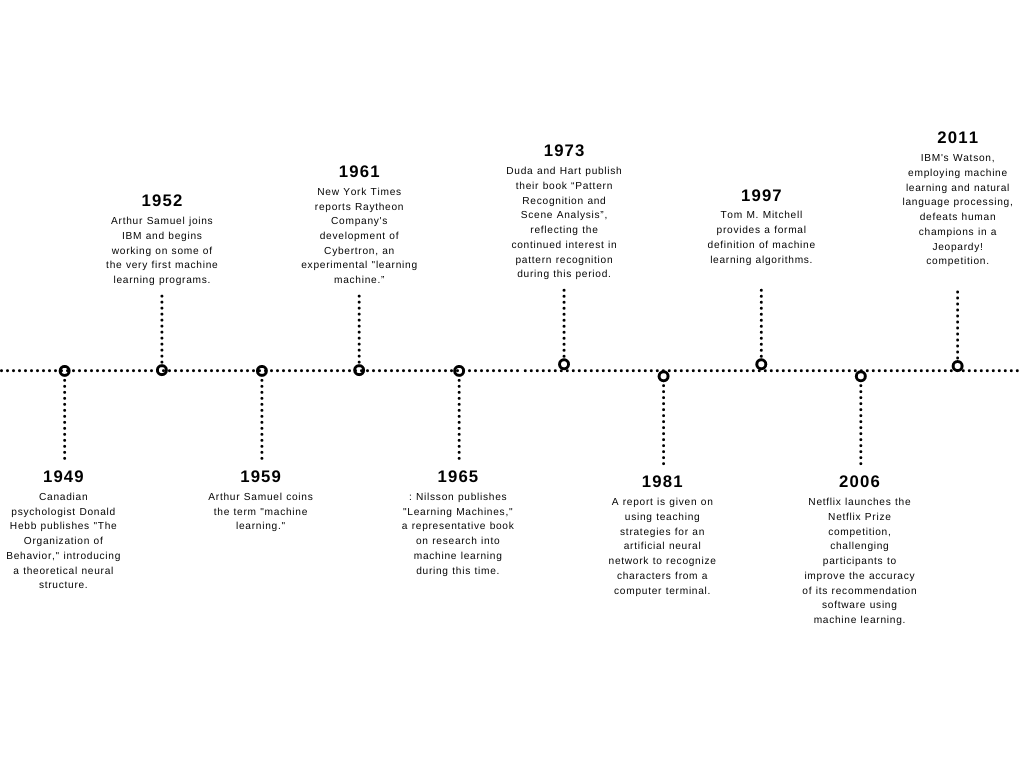
The idea isn't new. The term "machine learning" was coined back in 1959 by Arthur Samuel, an IBM pioneer who created a checkers program that could learn from its own mistakes and improve its game. Early machine learning was limited by computing power and the amount of available data.
Over the decades, as computers became more powerful and massive datasets became available, the field exploded. What started as simple pattern recognition has evolved into complex systems that can understand language, drive cars, and discover new medicines.
Types of Learning
Machine learning isn't a single technique. It's a broad field with several different approaches, or paradigms. The best approach depends on the problem you're trying to solve and the kind of data you have. Let's look at the four main types.
Supervised Learning
noun
The machine learns from data that has already been labeled with the correct answers.
Imagine showing a child flashcards of animals. You show them a picture of a cat and say "cat." You show them a picture of a dog and say "dog." After enough examples, the child learns to identify cats and dogs on their own.
Supervised learning works the same way. The model is trained on a dataset where the inputs (the pictures) are linked to the correct outputs (the labels "cat" or "dog"). The model's job is to learn the relationship between the inputs and outputs so it can make accurate predictions on new, unseen data.
Unsupervised Learning
noun
The machine learns from data that has not been labeled or categorized.
Now, imagine giving that same child a box of mixed-up toys and asking them to organize it. Without any instructions, they might start grouping the toys by color, size, or type (cars in one pile, blocks in another). They are finding patterns on their own.
Unsupervised learning models do this with unlabeled data. They look for hidden structures or relationships. This is useful for tasks like grouping similar news articles together or identifying distinct customer segments in a marketing database.
Semi-Supervised Learning This is a hybrid approach. It uses a small amount of labeled data along with a large amount of unlabeled data. The idea is to use the labeled data to get a head start, and then use the structure of the unlabeled data to improve the model's accuracy. A good example is a photo service that asks you to identify a person once, then it automatically finds that person in all your other photos.
Reinforcement Learning Reinforcement learning is about learning to make decisions through trial and error. The model, often called an "agent," learns by interacting with an environment. It receives rewards for good actions and penalties for bad ones. The goal is to learn the best strategy, or "policy," to maximize its cumulative reward over time.
This is how AI models learn to play complex games like chess or Go, and it's also used in robotics, where a robot might learn to walk or pick up an object by being rewarded for successful movements.
Ready to check your understanding?
Which statement best describes the core idea of machine learning?
You are given a dataset of thousands of customer reviews for a product, but none of them are labeled as 'positive' or 'negative'. You want to discover naturally occurring groups or themes within the reviews. Which approach is most appropriate?
These learning paradigms are the building blocks of machine learning. Understanding them is the first step toward seeing how computers can tackle complex problems by learning from data.