Introduction to Large Language Models
Introduction to NLP
What is Natural Language Processing?
Natural Language Processing, or NLP, is a field of artificial intelligence that gives computers the ability to understand, interpret, and generate human language. It's the bridge between how we communicate and how computers process information.
You interact with NLP every day. When your email sorts spam, your phone autocorrects a typo, or you ask a virtual assistant for the weather, that's NLP at work. The goal is to make our interactions with technology feel less like talking to a machine and more like talking to a person.
Early NLP systems from the 1950s were mostly rule-based. Programmers would write countless rules to cover grammar and vocabulary. For example, a rule might say "an article like 'the' is usually followed by a noun or an adjective." This approach was brittle and couldn't handle the endless exceptions and nuances of real language.
Over time, the field shifted toward statistical methods and machine learning. Instead of hand-writing rules, developers began training models on huge amounts of text. By analyzing patterns in the data, these models learned the rules of language on their own, making them far more flexible and powerful.
Breaking Language Down
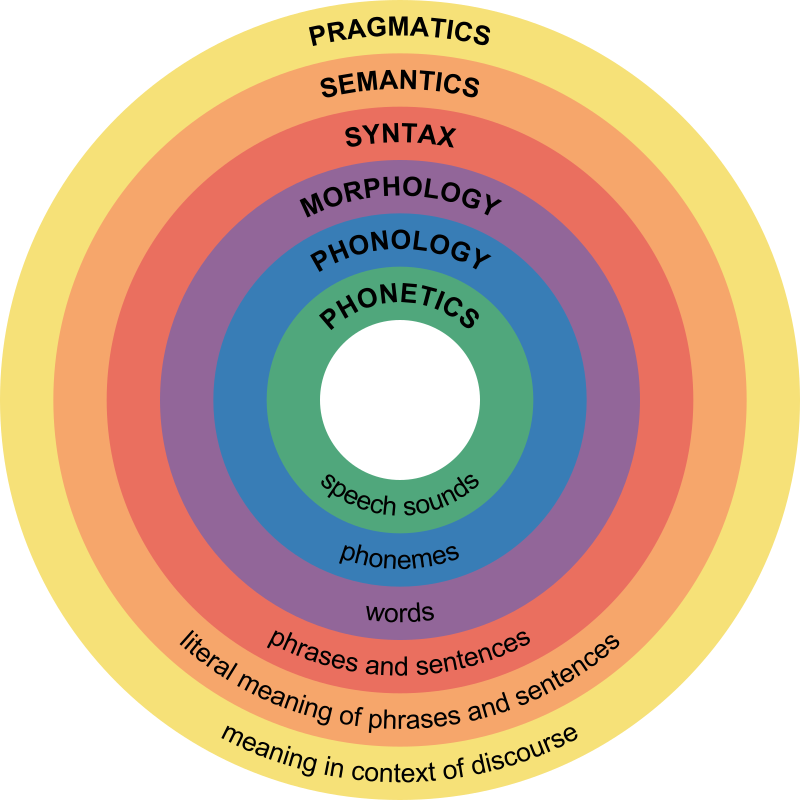
To process language, computers need to analyze it on multiple levels. Linguists often think about language in terms of syntax, semantics, and pragmatics. NLP systems do the same.
syntax
noun
The set of rules that govern the structure of sentences in a language.
Syntax is all about grammar and word order. It's the reason "Dog bites man" means something entirely different from "Man bites dog." A sentence can have perfect syntax but still be nonsense.
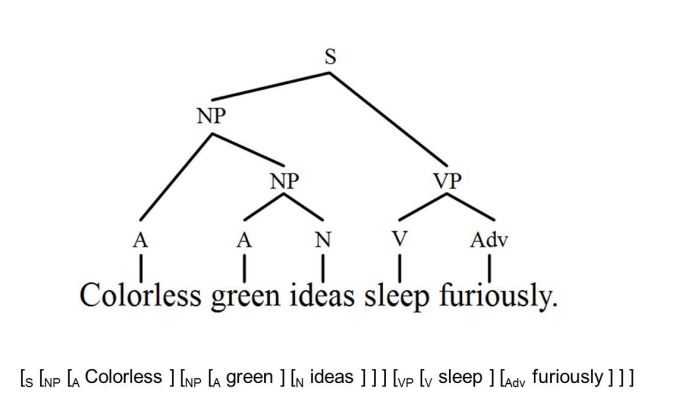
The classic example is "Colorless green ideas sleep furiously." The grammar is flawless—adjective, adjective, noun, verb, adverb—but the sentence is meaningless. That's where semantics comes in.
semantics
noun
The study of meaning in language. It deals with the literal meaning of words, phrases, and sentences.
Semantics focuses on the dictionary definition of words. It helps a computer understand that "apple" can refer to a fruit or a technology company. While syntax gives us the structure, semantics provides the literal meaning.
But literal meaning isn't always enough.
pragmatics
noun
The study of how context contributes to meaning.
Pragmatics is about the hidden meaning—the intent, implication, and real-world knowledge that colors our words. If you ask, "Do you have the time?" you're not asking a yes-or-no question. You want to know what time it is. Pragmatics helps an NLP system figure that out from the context of the conversation.
Preparing Text for Machines
Before a computer can analyze syntax or semantics, it needs to break our messy human language into a clean, structured format. This process is called preprocessing, and it involves a few key steps.
The first step is tokenization. This simply means splitting a chunk of text into smaller pieces, or tokens. Usually, tokens are words, but they can also be punctuation marks or parts of words.
For example, the sentence "It's raining, so let's go inside!" would be tokenized into a list like this:
["It", "'s", "raining", ",", "so", "let", "'s", "go", "inside", "!"]
Notice how contractions and punctuation are separated into their own tokens. This makes the text easier for a machine to handle.
After tokenization, we often need to simplify the words themselves. Computers see "run," "runs," and "running" as three completely different words, even though they share the same core meaning. To handle this, we use techniques like stemming and lemmatization.
| Technique | Goal | How It Works | Example ('studies') |
|---|---|---|---|
| Stemming | Reduce words to their root form. | Chops off prefixes/suffixes. | studi |
| Lemmatization | Reduce words to their dictionary form (lemma). | Uses vocabulary and grammar analysis. | study |
Stemming is a faster, cruder method that works by following simple rules to cut off the ends of words. This can sometimes result in non-existent words like "studi."
Lemmatization is smarter. It considers the word's part of speech and uses a dictionary to find the root word, or lemma. It knows that the lemma of "studies" is "study." Lemmatization is more accurate than stemming but requires more computational power.
These foundational concepts—from understanding linguistic structure to prepping text for analysis—are the first steps in teaching a computer to understand us. They are the building blocks upon which more complex models, like the ones that power today's AI, are built.
What is the primary goal of Natural Language Processing (NLP)?
The sentence "Colorless green ideas sleep furiously" is grammatically correct but nonsensical. Which linguistic concept does this sentence primarily demonstrate a failure of?