Introduction to Large Language Models
Introduction to LLMs
What Are Large Language Models?
A Large Language Model, or LLM, is a type of artificial intelligence designed to understand and generate human language. Think of it as a vast digital brain that has been trained on an immense library of text and code—far more than any person could read in a lifetime. By processing all this information, it learns the patterns, rules, grammar, context, and nuances of language.
At its core, an LLM is a prediction engine. Its main job is to guess the next word in a sequence, given the words that came before it. This simple-sounding task, when performed on a massive scale, unlocks powerful abilities.
The significance of LLMs comes from this predictive power. Unlike older AI that followed rigid, pre-programmed rules, LLMs can handle ambiguity and generate fluid, creative, and contextually relevant text. This leap has fundamentally changed how we interact with computers, moving us from clicking buttons and typing specific commands to having natural conversations.
Large Language Models (LLMs) are machine learning models trained on vast amount of textual data to generate and understand human-like language.
A Brief History
The idea of teaching machines language isn't new. Early attempts, dating back decades, relied on statistical methods. These models would look at a short sequence of words (an "n-gram") and calculate the probability of the next word. For example, after seeing "the cat sat on the," the model might know that "mat" is a highly probable next word. This worked for simple tasks but lacked a deeper understanding of context.
The next big step came with neural networks, which are computing systems inspired by the human brain. These models could process more context than their statistical predecessors, leading to better predictions. However, they still struggled with long-term dependencies—connecting a word at the beginning of a paragraph to one at the end.
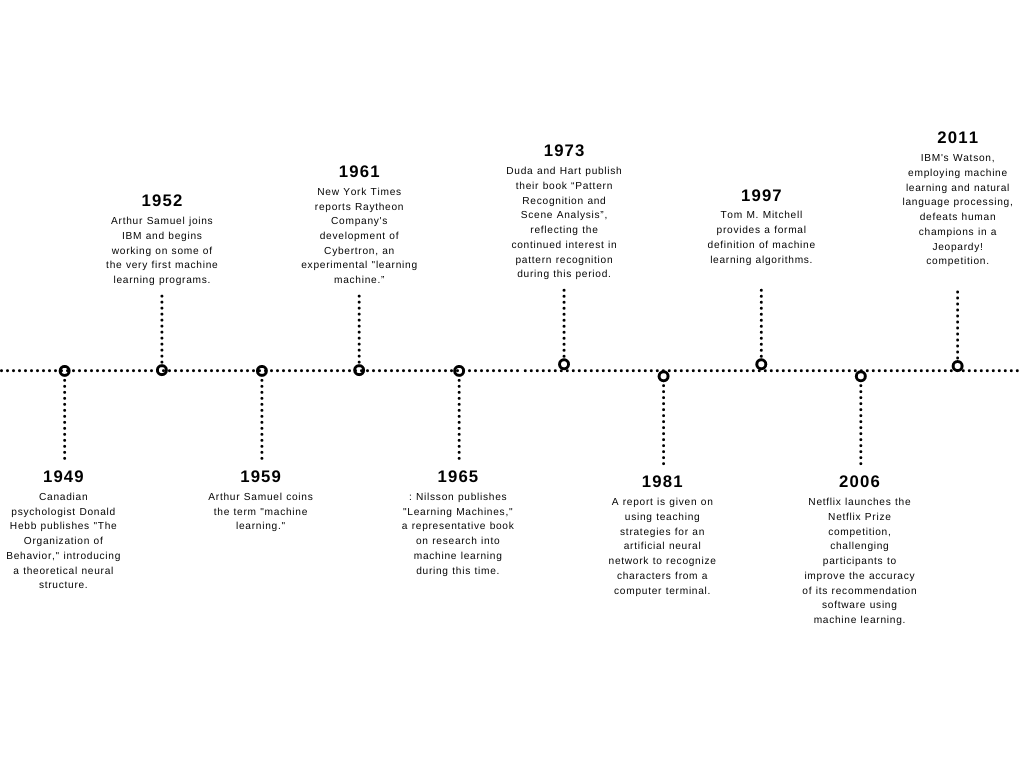
The true revolution began with the development of the Transformer architecture in 2017. This new design allowed models to weigh the importance of different words in the input text, no matter how far apart they were. This was the key to understanding complex sentences and paragraphs.
The Transformer made it possible to build much larger and more powerful models. Researchers realized that as they increased the size of the model (the number of parameters) and the amount of training data, the model's capabilities improved dramatically. This scaling effect is what gives us the "Large" in Large Language Models.
What Can They Do?
By repeatedly predicting the next word, LLMs develop a sophisticated grasp of language that allows them to perform a wide range of tasks. Here are some of their key capabilities:
| Capability | Description |
|---|---|
| Text Generation | Writing original text, from emails and essays to poetry and scripts. |
| Summarization | Condensing long articles, reports, or conversations into key points. |
| Translation | Translating text between different languages with high accuracy. |
| Question Answering | Providing direct answers to questions based on the information in their training data. |
| Code Generation | Writing computer code in various programming languages based on natural language descriptions. |
These aren't separate skills the model is taught one-by-one. Instead, they are emergent abilities that arise from the single, fundamental task of predicting text. The model doesn't "know" it's translating; it just knows that when it sees a sentence in French, the most probable next sequence of words is its English equivalent.
Challenges and Limitations
Despite their impressive abilities, LLMs are not without their flaws. Understanding their limitations is crucial for using them responsibly.
One major challenge is the problem of "hallucinations." Because LLMs are designed to generate plausible-sounding text, they can sometimes invent facts, sources, or details that are completely wrong. The model doesn’t have a concept of truth; it only knows what is statistically likely to come next.
Bias is another significant issue. LLMs learn from human-written text from the internet, which contains a wide range of human biases. The models can absorb and reproduce these biases in their responses, reinforcing stereotypes related to gender, race, or culture.
Finally, LLMs lack true understanding or common-sense reasoning. They can manipulate language with incredible skill, but they don't comprehend it in the way a human does. They don't have experiences, beliefs, or intentions. They are pattern-matching machines, and their knowledge is frozen at the time their training data was collected, making them unaware of recent events.
What is the fundamental task an LLM is trained to perform, which gives rise to its diverse abilities like translation and summarization?
What architectural innovation was a major breakthrough for LLMs by allowing them to effectively handle long-term dependencies in text?
These models are powerful tools that are rapidly evolving. By understanding their core function, history, and limitations, you're better equipped to navigate the changing landscape of artificial intelligence.