Introduction to Kashmir Shaivism Trika Philosophy
Introduction to Non-Dualism
The Idea of Oneness
At its heart, non-dualism is the understanding that reality is a single, unified whole. The term itself comes from the Sanskrit word Advaita, which literally means “not two.” It proposes that the separation we perceive between ourselves and the world, between mind and matter, or between subject and object, is an illusion.
Imagine the ocean and its waves. We see individual waves, each with its own shape and movement, but they are never separate from the ocean. They are simply the ocean expressing itself in a particular way. Non-dualism suggests we are like the waves, and ultimate reality is the ocean.
Two Ways of Seeing
This idea stands in contrast to dualism, a more common way of viewing the world. Dualism draws lines, separating a creator from creation, the mind from the body, and the self from everything else. Most of us naturally operate from a dualistic perspective in our daily lives. It's practical, but non-dual philosophies argue it's not the ultimate truth.
| Concept | Dualistic View | Non-Dualistic View |
|---|---|---|
| Reality | Made of separate, distinct parts (e.g., God and world, spirit and matter). | A single, undivided whole. |
| The Self | An individual, separate entity (the ego). | Identical with the whole of reality. |
| The World | An external object, separate from the observer. | A manifestation of the one reality, not separate from the observer. |
| Goal | To connect the self with a separate higher power or truth. | To realize the self is already and always has been the one reality. |
Non-dualism isn't about destroying the individual self, but about recognizing its true, boundless nature. It's a shift in perspective from seeing yourself as a drop in the ocean to seeing yourself as the entire ocean in a drop.
Traditions of Non-Dualism
Many spiritual and philosophical traditions within Indian thought explore non-duality. The most well-known is Advaita Vedanta, famously systematized by the philosopher Adi Shankaracharya. This school teaches that the individual soul (Atman) is identical to the ultimate reality (Brahman).
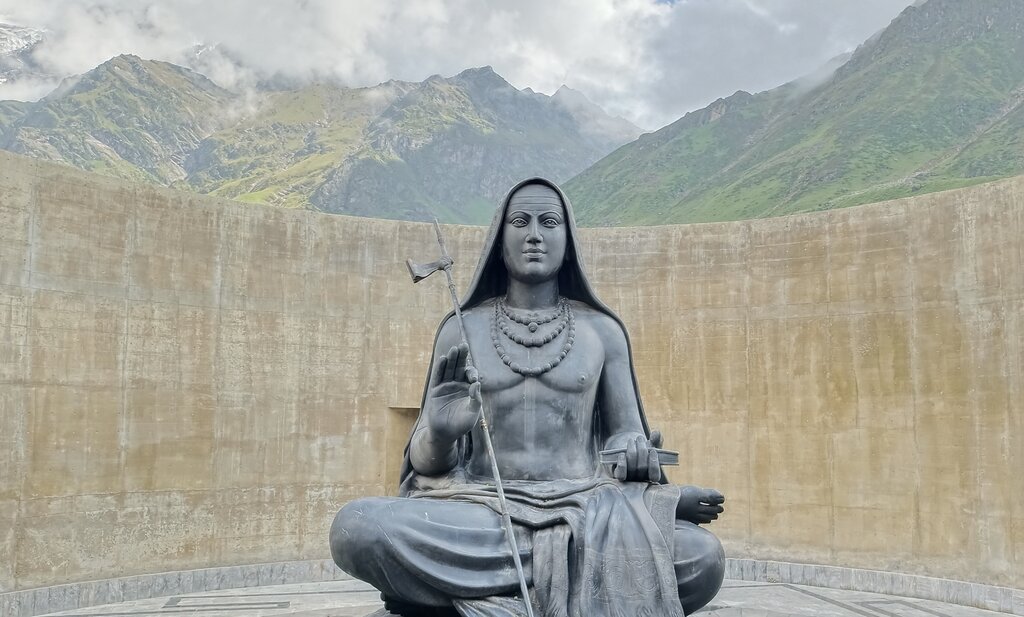
Other traditions, like certain schools of Buddhism and Sikhism, also contain strong non-dual currents. Another profound and distinct non-dual philosophy is Kashmir Shaivism, which offers its own unique perspective on the nature of reality.
The Shaivist View
Kashmir Shaivism shares the core non-dual premise that everything is one. However, it has a different take on the nature of the world we experience.
Kashmir Shaivism teaches that Consciousness is the only reality.
While Advaita Vedanta can sometimes describe the physical world as an illusion (maya) that obscures the one reality, Kashmir Shaivism sees the world as a real, vibrant, and conscious manifestation of that single reality. The universe isn't something to be dismissed or seen through; it is the creative play of universal Consciousness.
The world is not an illusion (as advaita vedanta teaches), but the illusion is the perception of a duality (since duality does not exist).
In this view, the problem isn't the world itself, but our limited perception of it. The goal is to recognize our own identity with the universal Consciousness that is expressing itself as everything, including us.