Introduction to Jazz Guitar
Basic Jazz Chords
Beyond Basic Chords
Jazz harmony adds new layers of color to the basic major and minor chords you might already know. The secret ingredient is often the 7th note of the scale. By adding this one extra note, we create richer, more complex sounds that are signatures of jazz music.
There are three foundational 7th chords that open up the world of jazz: major 7th, minor 7th, and dominant 7th. Each has a distinct personality and function within a song. Let's break them down.
Major 7th Chords
A major 7th chord is built from the first, third, fifth, and seventh notes of a major scale. Think of it as a standard major triad with the major 7th note added on top. This chord has a dreamy, relaxed, and sophisticated sound. It’s the sonic equivalent of a warm, sunny afternoon.
For example, to build a C major 7th chord (Cmaj7), we take the C major scale (C, D, E, F, G, A, B) and use the 1st, 3rd, 5th, and 7th notes.
C (1st), E (3rd), G (5th), B (7th)
On the guitar, we don't always play the notes in that exact order. We use different voicings—arrangements of the same notes—to make chords easier to play and to create different musical textures. Here's a common way to play a Cmaj7 chord.
Minor 7th and Dominant 7th
Minor 7th chords have a different mood. They sound mellow, soulful, and are a staple in jazz, R&B, and funk. To build one, you take a minor triad and add a flattened 7th note (a minor 7th interval from the root).
The formula uses the 1st, flattened 3rd, 5th, and flattened 7th notes of the major scale. For an A minor 7th chord (Am7), we start with the A major scale (A, B, C♯, D, E, F♯, G♯) and adjust the 3rd and 7th notes.
A (1st), C (♭3rd), E (5th), G (♭7th)
Next up is the dominant 7th chord, often just called a "7th chord" (like G7). This one is special because it creates musical tension. It has a bluesy, restless quality that makes your ear expect a resolution to a more stable chord.
A dominant 7th combines a major triad with a flattened 7th. Its formula is 1-3-5-♭7. So for a G7 chord, you'd use the notes G, B, D, and F. The clashing interval between the 3rd (B) and the ♭7th (F) is what gives the chord its signature bite.
| Chord Type | Formula (from Major Scale) | Sound | Example (in C) |
|---|---|---|---|
| Major 7th | 1 - 3 - 5 - 7 | Dreamy, relaxed | Cmaj7 (C-E-G-B) |
| Minor 7th | 1 - ♭3 - 5 - ♭7 | Soulful, mellow | Cm7 (C-E♭-G-B♭) |
| Dominant 7th | 1 - 3 - 5 - ♭7 | Tense, bluesy | C7 (C-E-G-B♭) |
Navigating the Fretboard
Learning these chords is one thing, but being able to play them all over the neck is what makes you a versatile guitarist. You don't want to be stuck in one position.
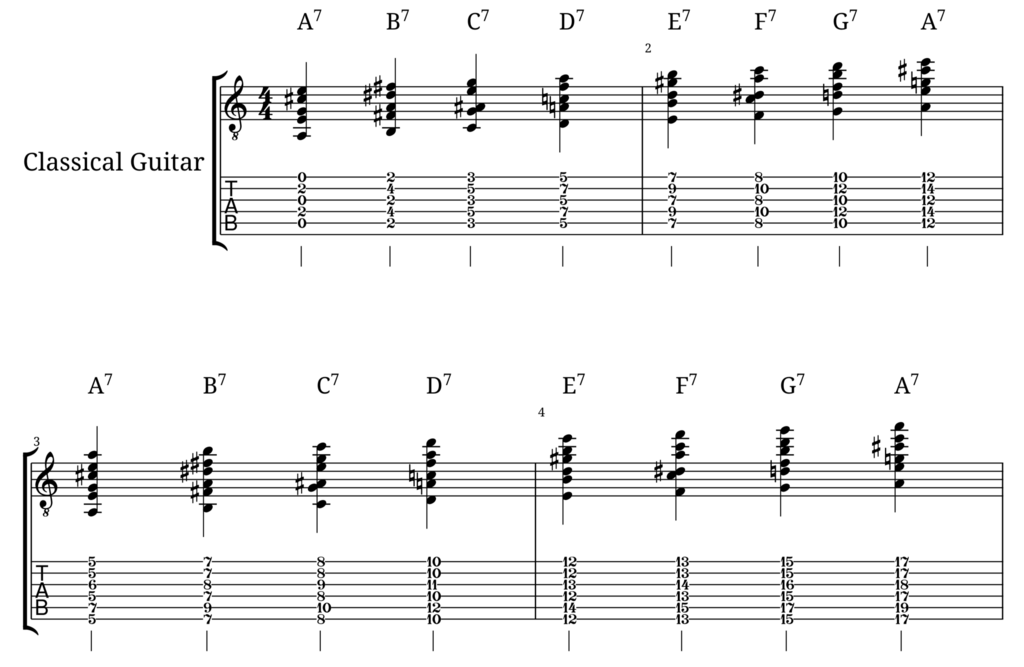
Many jazz chord shapes are "movable," meaning you can slide the same hand shape up or down the fretboard to play the chord in a different key. The key is to identify the root note of the shape. If you move a shape so the root note is on a G, you're playing a G chord. If you slide it up so the root is on an A, it becomes an A chord.
Let's look at a common movable shape for a dominant 7th chord, with the root on the thickest string (the low E string).
In this G7 voicing, the root note (R) is on the 3rd fret of the low E string. If you slide this entire shape up two frets, the root becomes an A, and you're playing an A7 chord. This concept applies to countless chord shapes.
Practicing these three core chord types in different positions is the first major step toward playing jazz guitar. It gives you the vocabulary you need to start playing standards and improvising.
Time to check your understanding of these core jazz chords.
Which interval combination is responsible for the 'tense' and 'restless' quality of a dominant 7th chord?
Which of the following sets of notes forms an E minor 7th (Em7) chord?
Mastering these shapes and understanding their sounds will unlock your ability to play countless jazz tunes.