Introduction to Japanese Language
Hiragana
The Foundation of Japanese
Japanese uses three distinct scripts: Hiragana, Katakana, and Kanji. The best place to start is with Hiragana (ひらがな). Think of it as the bedrock of the written language. It's a syllabary, which means each character represents a syllable, like "ka" or "mo".
Hiragana is used for native Japanese words, grammatical particles, and verb endings. You can write entire sentences using only Hiragana, making it essential to master first.
The characters have a flowing, cursive look that sets them apart from the more angular Katakana and the complex Kanji. Learning them unlocks the sounds of Japanese.
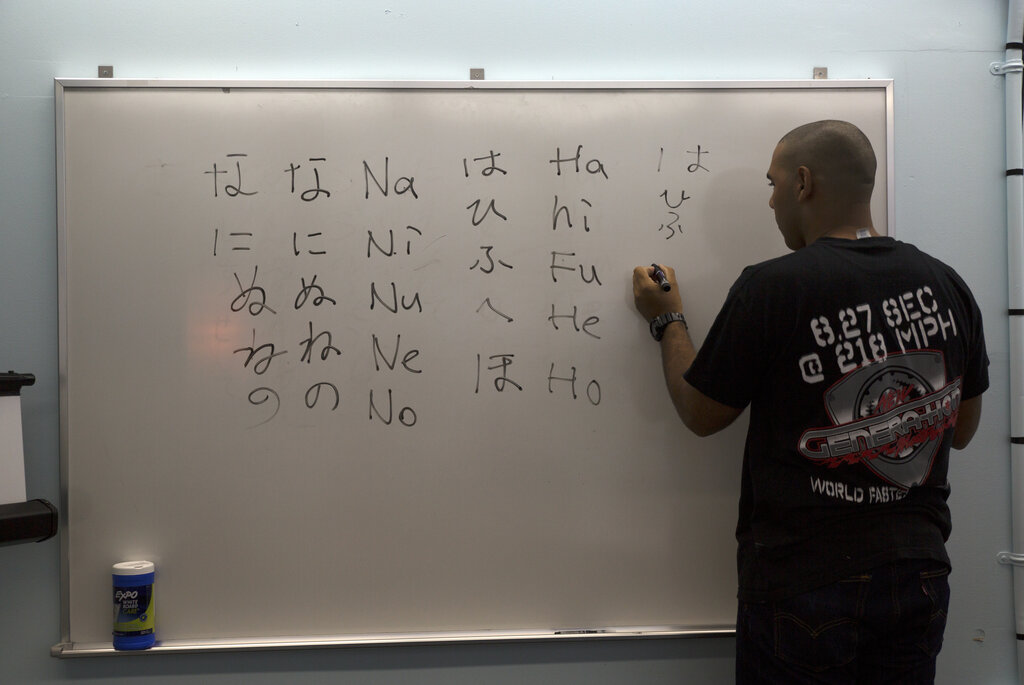
The 46 Basic Characters
There are 46 basic characters in Hiragana, organized in a grid called the gojūon (五十音), which translates to "fifty sounds." The grid is organized by the five main vowel sounds: a (あ), i (い), u (う), e (え), and o (お). Consonants are paired with these vowels to form the rest of the sounds.
| a | i | u | e | o | |
|---|---|---|---|---|---|
| Vowels | あ (a) | い (i) | う (u) | え (e) | お (o) |
| k | か (ka) | き (ki) | く (ku) | け (ke) | こ (ko) |
| s | さ (sa) | し (shi) | す (su) | せ (se) | そ (so) |
| t | た (ta) | ち (chi) | つ (tsu) | て (te) | と (to) |
| n | な (na) | に (ni) | ぬ (nu) | ね (ne) | の (no) |
| h | は (ha) | ひ (hi) | ふ (fu) | へ (he) | ほ (ho) |
| m | ま (ma) | み (mi) | む (mu) | め (me) | も (mo) |
| y | や (ya) | ゆ (yu) | よ (yo) | ||
| r | ら (ra) | り (ri) | る (ru) | れ (re) | ろ (ro) |
| w | わ (wa) | を (wo/o) | |||
| Special | ん (n) |
Notice the empty spots in the grid. The sounds "yi", "ye", and "wu" don't exist in modern Japanese. Also, pay attention to the unique pronunciations for し (shi), ち (chi), and つ (tsu).
The character を (wo) is a particle and is almost always pronounced like お (o). Finally, ん (n) is the only character that is a single consonant sound, not a full syllable.
Writing and Pronunciation
Japanese pronunciation is very consistent. Unlike English, where 'a' can sound different in 'apple', 'father', and 'late', the Japanese 'a' sound, あ, is always the same. This holds true for all the hiragana characters.
When writing hiragana, stroke order is very important. Following the correct order helps you write the characters quickly, accurately, and legibly. Each character has a specific sequence of strokes.
Once you know the characters, you can form words. Hiragana characters are combined in sequence to create the sounds of a word.
cat
Here, ね (ne) and こ (ko) combine to form "neko."
dog
Similarly, い (i) and ぬ (nu) make "inu."
Hiragana is also used for particles, which are small grammatical words that indicate a word's function in a sentence. For example, は (ha) is used as a topic marker, and を (wo) is used to mark the object of a verb.
わたしはねこをみる。 (Watashi wa neko o miru.)
This translates to "I see a cat." Here, は marks "I" as the topic, and を marks "cat" as the object.
Memorizing the hiragana chart is the first major step in learning Japanese. Practice reading and writing them daily until they become second nature.
What is the primary characteristic of the Hiragana script?
The Hiragana chart is called the gojūon (五十音), which means "fifty sounds". Why are there only 46 basic characters?