Introduction to Japanese Language
Hiragana
What is Hiragana?
Japanese uses a fascinating mix of three different scripts. The first and most essential one you'll learn is Hiragana (ひらがな). Think of it as the foundational building block for reading and writing Japanese.
Hiragana is a syllabary, which means each character represents a syllable—like ka, shi, or mu—rather than a single letter like in English. It has a flowing, rounded appearance, which makes it easy to spot.
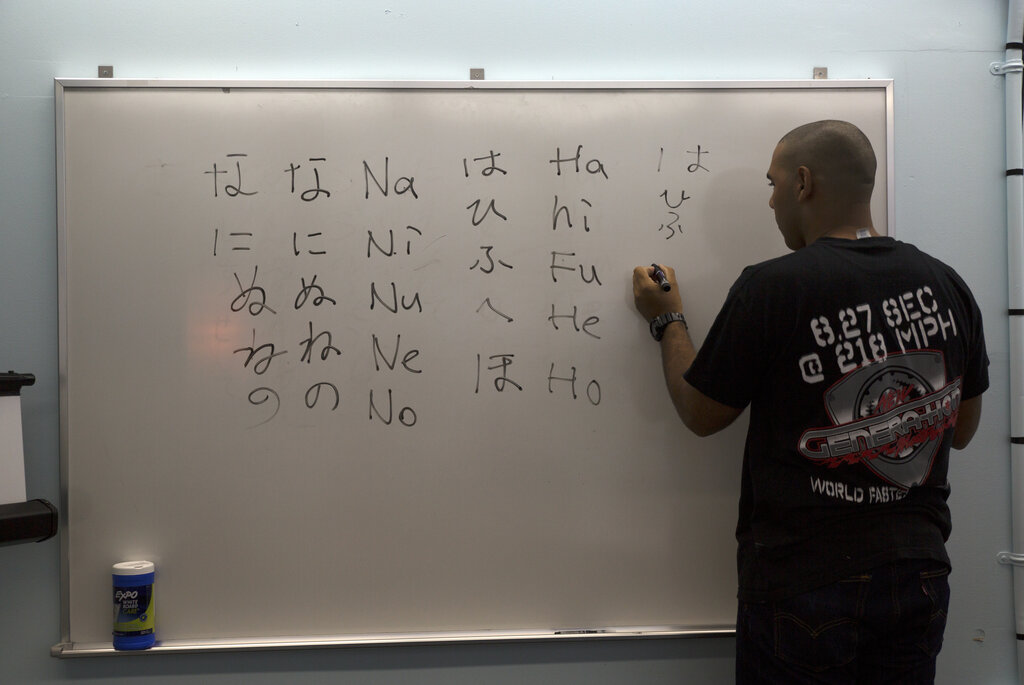
This script is used for several key things:
- Native Japanese words: Words that don't have a kanji (Chinese character) representation are written in hiragana.
- Grammatical parts: Little words called particles, which mark the function of words in a sentence, are always hiragana.
- Verb and adjective endings: Hiragana characters are attached to the base of verbs and adjectives to change their tense or form.
Basically, you can't form a complete Japanese sentence without it.
Hiragana is the most fundamental script used in Japanese writing.
The 46 Basic Characters
The core of hiragana consists of 46 characters. Almost all of them are a combination of a consonant and one of five vowels. These five vowels are the cornerstone of Japanese pronunciation.
| Hiragana | Pronunciation | Example |
|---|---|---|
| あ | a | like the 'a' in 'father' |
| い | i | like the 'ee' in 'see' |
| う | u | like the 'oo' in 'moon' |
| え | e | like the 'e' in 'get' |
| お | o | like the 'o' in 'open' |
Every other basic character is based on these vowel sounds. The entire set is organized in a chart called the gojūon (literally "fifty sounds"). Here is the full set of basic characters. Don't worry about memorizing them all at once; just get familiar with the sounds and shapes.
| a | i | u | e | o | |
|---|---|---|---|---|---|
| (vowels) | あ (a) | い (i) | う (u) | え (e) | お (o) |
| k | か (ka) | き (ki) | く (ku) | け (ke) | こ (ko) |
| s | さ (sa) | し (shi) | す (su) | せ (se) | そ (so) |
| t | た (ta) | ち (chi) | つ (tsu) | て (te) | と (to) |
| n | な (na) | に (ni) | ぬ (nu) | ね (ne) | の (no) |
| h | は (ha) | ひ (hi) | ふ (fu) | へ (he) | ほ (ho) |
| m | ま (ma) | み (mi) | み (mu) | め (me) | も (mo) |
| y | や (ya) | ゆ (yu) | よ (yo) | ||
| r | ら (ra) | り (ri) | る (ru) | れ (re) | ろ (ro) |
| w | わ (wa) | を (o) | |||
| n | ん (n) |
You might notice a few odd ones out. The character し is pronounced shi (not si), ち is chi (not ti), and つ is tsu (not tu). The character ふ (fu) sounds like a soft 'f' made by blowing air through your lips, not by touching your teeth. Finally, を is pronounced just like お (o) and is only used as a grammatical particle.
The only standalone consonant is ん (n). It can sound like 'n', 'm', or 'ng' depending on the sound that follows it.
Writing Hiragana
Learning to write hiragana is all about muscle memory. The key is stroke order—the sequence and direction in which you write the lines that make up each character. Following the correct stroke order isn't just about tradition; it makes your writing faster, neater, and more recognizable.
Here are some basic principles:
- Top to bottom: Write strokes from the top of the character downwards.
- Left to right: Write strokes from the left side of the character to the right.
- Horizontal before vertical: When strokes cross, draw the horizontal one first.
Let's look at the character あ (a) as an example. It has three strokes. First, the horizontal line. Second, the vertical curved line. Third, the final loop. Practice this a few times. Getting the flow right is more important than making it look perfect at first.
Reading Your First Words
Once you can recognize a few hiragana, you can start reading actual Japanese words. This is where it all starts to click. Let's try a few common words written entirely in hiragana.
Yes
This is a simple one. The characters are は (ha) and い (i). Put them together and you get hai.
Cat
Here we have ね (ne) and こ (ko). Together, they form the word neko.
Sushi
This word combines す (su) and し (shi). You've probably heard this one before!
Try to sound out other combinations yourself. For example, what would い (i) + え (e) sound like? It's the word for 'house', ie.
Ready to test your knowledge of these new characters?
What type of writing system is Hiragana?
In a typical Japanese sentence, Hiragana is most often used for which of the following?
Hiragana is your entry point into the Japanese language. As you get comfortable with these characters, you'll find it much easier to learn grammar, vocabulary, and the other writing systems.