Introduction to Islam
Introduction to Islam
The Birth of a Faith
Islam began in the 7th century on the Arabian Peninsula, a region of vast deserts and bustling trade routes. At the time, the city of Mecca was a major hub for commerce and religion. Most people in the area were polytheistic, worshipping many gods and idols. Society was organized around tribes, with loyalty to one's clan being paramount.
The Final Prophet
The story of Islam revolves around a man named Muhammad. He was born in Mecca around the year 570 CE. Orphaned at a young age, he was raised by his uncle, Abu Talib. As a young man, Muhammad became a merchant known for his integrity and trustworthiness, earning him the nickname al-Amin, or "the Trustworthy."
He worked for a wealthy widow named Khadijah, who was impressed by his character. She proposed marriage, and they had several children together. Muhammad was a reflective person who often retreated to a cave on Mount Hira, near Mecca, to meditate and pray.
It was during one of these retreats, when Muhammad was about 40 years old, that he received his first revelation.
According to Islamic tradition, the angel Gabriel appeared to him and commanded him to recite. The words he was told to repeat were the first verses of what would become the Quran. The central message was revolutionary for its time: there is only one God, Allah, and people should submit to His will.
The Word of God
This event marked the beginning of a series of revelations that continued for the next 23 years, until Muhammad's death. These divine messages form the Quran, Islam's holy book. The word Quran itself means "the recitation."
Muslims believe the Quran is the literal word of God, revealed to Muhammad through the angel Gabriel. It was not written by Muhammad, but rather recited by him and transcribed by his followers. The original language of the Quran is Arabic, and Muslims consider translations to be interpretations of the original text, not the holy book itself.
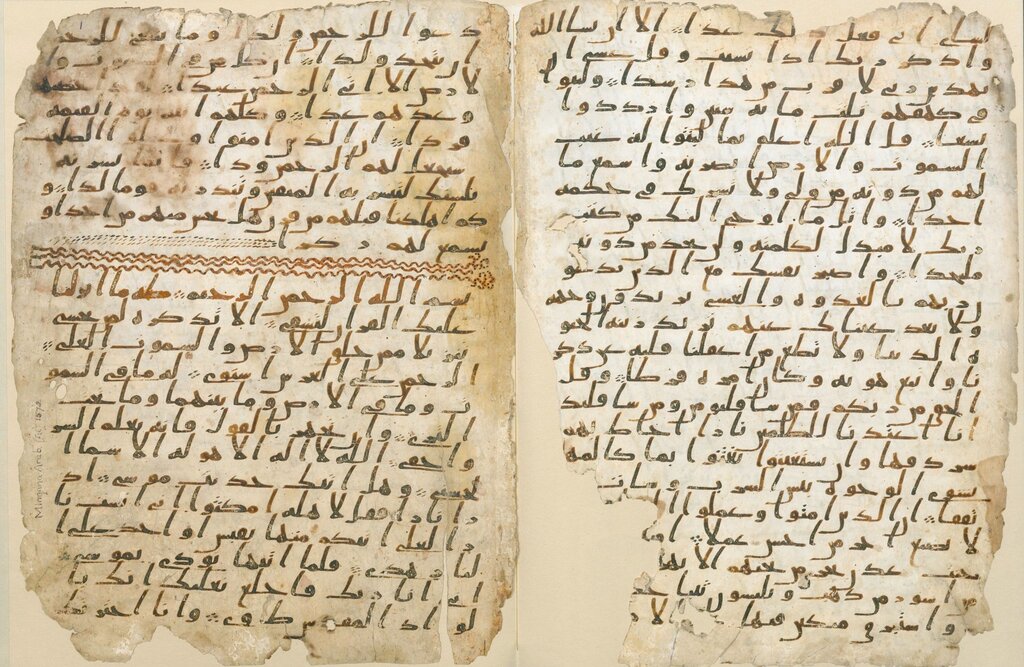
The Quran is divided into 114 chapters, called surahs. These chapters vary in length and are arranged generally from longest to shortest, rather than chronologically. Together, they provide guidance on all aspects of life, from matters of faith and worship to ethics and law.
Allah
noun
The Arabic word for God, used by Muslims as well as Arabic-speaking Christians and Jews. It refers to the one, all-powerful creator.
Muhammad began preaching the message of monotheism in Mecca. Initially, he faced fierce opposition from the city's leaders, who profited from the polytheistic pilgrimages to the Kaaba shrine. This resistance eventually led Muhammad and his small group of followers to migrate to the city of Medina in 622 CE. This event, known as the Hijra, marks the beginning of the Islamic calendar.
In Medina, the Muslim community grew. Muhammad's life and teachings, known as the Sunnah, became the second most important source of guidance in Islam, after the Quran. He passed away in 632 CE, but the faith he established had already begun to spread across the Arabian Peninsula and beyond.