Introduction to Integral Calculus
Introduction to Integrals
The Idea of Accumulation
Differentiation is about finding a rate of change, like the speed of a car at a specific moment. Integration, on the other hand, is about the opposite: accumulation. If you know a car's speed at every moment of a trip, integration can tell you the total distance traveled.
Visually, we can think of this as finding the area under a curve. Imagine a graph where the x-axis is time and the y-axis is the car's speed. The area under the speed curve between two points in time represents the total distance covered.
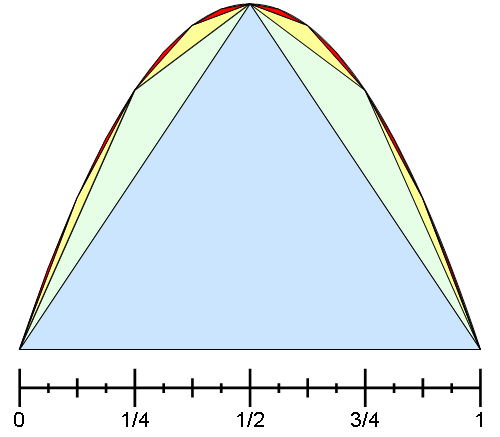
How do we find this exact area? We can start by approximating it with a bunch of thin rectangles packed under the curve. The more rectangles we use, and the thinner we make them, the closer our approximation gets to the true area. Integration is the process of summing up an infinite number of these infinitesimally thin rectangles to find the exact area.
The Fundamental Theorem of Calculus states that differentiation and integration are inverse operations.
This means that if you take a function, integrate it to find the area under its curve, and then differentiate the result, you get back to the original function. They undo each other, just like addition and subtraction or multiplication and division.
Integral Notation
The notation for an integral can look intimidating at first, but each part has a specific meaning. It's a concise way to describe the process of finding the area under a function's curve.
Let's break this down piece by piece.
The symbol is called the integral sign. It's an elongated 'S' which stands for 'sum'. It tells us we're about to perform an integration.
The function is the integrand. This is the function whose curve we are finding the area under. It represents the height of each of our infinitesimally thin rectangles.
The is the differential. It tells us which variable we are integrating with respect to, in this case, . It represents the infinitesimally small width of each rectangle we are summing up along the x-axis.
Together, means "the sum of the products of height () and width () for all the tiny rectangles under the curve."
Now that you understand the core concepts, let's test your knowledge.
What is the primary purpose of integration in calculus?
Visually, the process of integration is equivalent to finding the area under a curve by summing up an infinite number of infinitesimally thin _________.
Understanding integrals is about grasping the idea of accumulation and how it relates to finding the area under a curve. This concept is a cornerstone of calculus, with applications far beyond simple geometry.