Introduction to Integers
Introduction to Integers
Beyond Counting Numbers
When you first learned to count, you probably started with 1, 2, 3, and so on. These are called the natural numbers, and they're perfect for counting things like apples or friends. But what happens when we need to describe concepts like debt, temperatures below freezing, or a location below sea level?
Suddenly, the numbers we use for counting aren't enough. We need a way to talk about values that are less than zero. This is where a bigger, more complete set of numbers comes in.
integer
noun
A whole number that can be positive, negative, or zero.
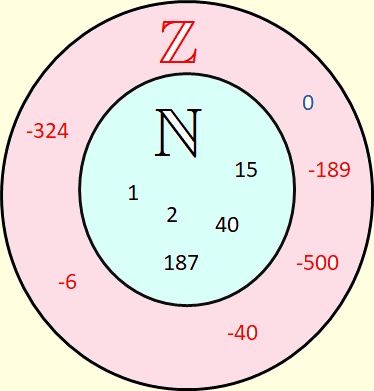
Integers are the set of all whole numbers and their opposites. Think of them in three parts:
- Positive Integers: These are the familiar counting numbers: 1, 2, 3, 4, ... They are greater than zero.
- Negative Integers: These are the opposites of the positive integers: -1, -2, -3, -4, ... They are less than zero.
- Zero: The number 0 is also an integer. It’s special because it is neutral—neither positive nor negative.
Visualizing Integers
One of the best ways to understand integers is to see them on a number line. A number line is a straight line with numbers placed at equal intervals along its length. It gives us a map of where every integer lives in relation to the others.
As you can see, zero sits right in the middle. The positive integers stretch out to the right, getting larger as they move away from zero. The negative integers stretch out to the left, getting smaller.
This visual also helps us understand the idea of "opposites." Notice how 3 and -3 are the same distance from zero, just on opposite sides. The same is true for any integer and its negative counterpart. They are mirror images of each other with zero as the reflection point.
By including negative numbers and zero, the integers give us a much more powerful system for describing the world. They form a foundation for more advanced math you'll encounter later.
Time to check your understanding.
Which of the following best describes the set of integers?
On a standard number line, which direction represents increasingly smaller values?
Now that you can define and visualize integers, you have a solid base for working with them in new and interesting ways.