Introduction to IFRS
Introduction to IFRS
A Common Language for Business
Imagine trying to compare two books written in different languages. Without a translation, you wouldn't be able to tell which story is more compelling or which author is more skilled. The world of business faces a similar challenge. Companies in different countries historically used their own local accounting rules, making it difficult for investors to compare one company's financial health against another's.
International Financial Reporting Standards (IFRS) solve this problem. They are a single set of high-quality, understandable, and enforceable accounting standards used by companies around the globe. Think of IFRS as a common language for business. When everyone speaks the same language, communication becomes clearer.
The main goal of IFRS is to bring transparency, accountability, and efficiency to financial markets. By ensuring that company financial statements are consistent and comparable, IFRS helps investors and other market participants make informed economic decisions. This builds trust and encourages global investment and commerce.
The Story of IFRS
The journey toward a single global standard began in 1973 with the formation of the International Accounting Standards Committee (IASC). This group, founded by professional accounting bodies from nine countries, issued a set of rules called International Accounting Standards (IAS). While a good start, the IASC lacked the authority to require companies to use its standards.
By the late 1990s, the need for a more robust and independent standard-setting body became clear as globalization accelerated. In 2001, the structure was reformed, leading to the creation of the IFRS Foundation and its standard-setting body, the International Accounting Standards Board (IASB). The IASB took over from the IASC and adopted all the existing IAS, renaming the new standards it developed as IFRS. This marked a major step forward in creating a mandatory and globally accepted set of accounting rules.
Who Makes the Rules?
The development and promotion of IFRS is managed by two key organizations: the IFRS Foundation and the International Accounting Standards Board (IASB). They work together in a structured way to ensure the standards are high-quality and globally relevant.
The IFRS Foundation is a not-for-profit, public interest organization. Its primary role is to oversee the entire process. The Foundation governs the IASB, secures its funding, and ensures the independence of the standard-setting process. It's like the guardian of the mission, making sure the IASB has the resources and freedom to do its job properly.
The International Accounting Standards Board (IASB) is the independent group of experts that actually develops and publishes the IFRS Standards. Its members come from diverse professional and geographical backgrounds, bringing a wealth of experience to the table. The IASB is responsible for the technical work of writing and maintaining the standards that companies follow.
IFRS Around the World
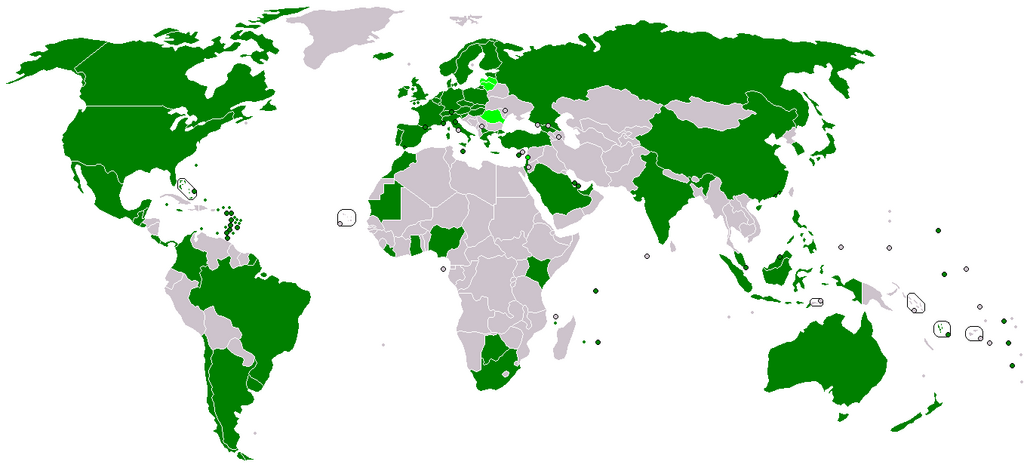
The adoption of IFRS has been a major success story in global finance. Today, more than 160 jurisdictions have committed to IFRS Standards. Out of those, over 140 jurisdictions require all or most publicly listed companies to use them.
This widespread adoption means that an investor in Brazil can analyze the financial statements of a company in South Africa using the same accounting framework they are familiar with. This consistency simplifies analysis, reduces costs for multinational companies, and improves the flow of capital across borders.
The map below highlights the extensive network of countries participating in international financial and tax forums, which often work to promote transparency and common standards like IFRS.
The increasing use of IFRS has fundamentally changed financial reporting. It has created a global benchmark that enhances the quality and comparability of financial information, ultimately leading to more stable and efficient global markets.