Introduction to ICT Trading
Introduction to ICT in Trading
From Shouts to Clicks
At its core, trading is about buying and selling. For centuries, this happened in crowded rooms filled with people shouting orders and using frantic hand signals. This method, known as open outcry, was the heart of financial markets. But today, the trading floor is mostly silent, replaced by the hum of servers and the glow of screens. This transformation was driven by Information and Communication Technology, or ICT.
ICT (Information and Communication Technology)
noun
A broad term that includes all technologies for the communication of information. In trading, it refers to the computers, networks, software, and other digital infrastructure used to execute and manage financial transactions.
Think of ICT as the entire digital ecosystem that powers modern finance. It's not just one thing, but a combination of hardware like servers and personal computers, software like trading platforms and algorithms, and the networks like the internet that connect them all.
The Trading Pit
For a long time, if you wanted to trade stocks or commodities, you had to go through someone on the trading floor. These floors were chaotic, energetic places where fortunes could be made or lost in a flurry of paper and shouts. Traders in brightly colored jackets would use a complex system of hand signals to communicate buy and sell orders across a crowded room, or "pit."
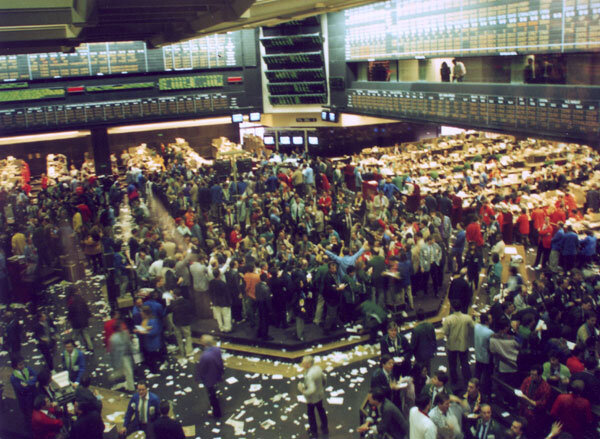
This system relied entirely on human interaction. It was physical, loud, and limited by the number of people who could fit in the room and how fast they could communicate. While it worked for its time, it was also prone to errors, slower transaction times, and was inaccessible to the general public.
The Digital Transformation
The arrival of powerful computers and the internet changed everything. The shouts of the trading pit were gradually replaced by the clicks of a mouse. This shift to electronic trading wasn't just about replacing people with machines; it fundamentally altered the structure and nature of financial markets.
ICT's impact on financial markets can be broken down into three main areas: speed, efficiency, and accessibility.
Speed: Transactions that once took minutes or even hours to confirm in the pit can now be executed in microseconds (millionths of a second). This incredible speed allows for strategies like high-frequency trading (HFT), where algorithms buy and sell assets in fractions of a second.
Efficiency: Automation reduces the potential for human error in entering and confirming trades. It also drastically lowers transaction costs, as fewer intermediaries are needed to complete a trade. Digital records make tracking and auditing transactions simpler and more reliable.
Accessibility: This might be the most significant change. Trading is no longer confined to a physical location or an exclusive club of professionals. With an internet connection and a computer or smartphone, anyone can access global markets and trade from anywhere in the world.
Once the domain of large financial institutions, advances in technology have democratized access, allowing individual traders to explore automated trading strategies.
This new landscape, built on a foundation of ICT, is faster, more interconnected, and more competitive than ever before.
What does Information and Communication Technology (ICT) encompass in the context of modern financial markets?
Which of the following was a primary characteristic of the open outcry trading system?
Understanding this technological shift is the first step in learning about modern trading. The principles of buying and selling remain, but the tools and the environment have been completely reshaped by technology.