Introduction to Hydrogeology
Introduction to Hydrogeology
The Water Beneath Our Feet
Much of Earth's fresh water is hidden from view, tucked away underground. This hidden resource, called groundwater, is a critical part of the planet's water system. It doesn't exist in underground rivers or lakes as you might imagine. Instead, it resides in the tiny spaces between grains of sand, soil, and within the cracks of solid rock.
To understand groundwater, we first need to look at the bigger picture: the hydrologic cycle. This is the continuous journey water takes, cycling from the oceans to the atmosphere, to the land, and back again. It's a massive, solar-powered engine that moves water all over the globe.
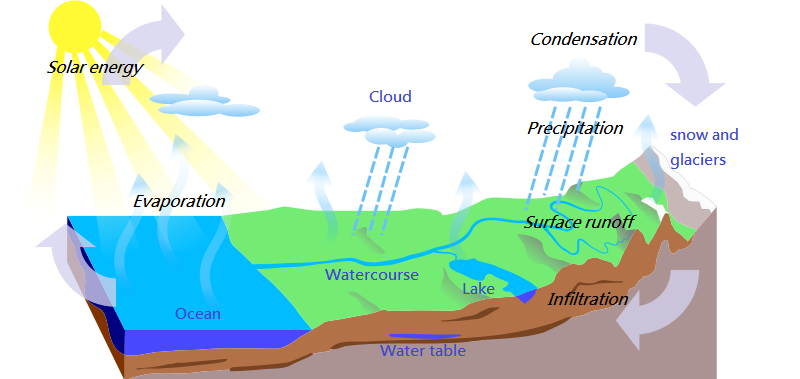
The cycle begins when the sun's energy causes water from oceans, lakes, and rivers to evaporate, turning from a liquid to a gas (water vapor). This vapor rises into the atmosphere, where it cools and condenses into tiny droplets, forming clouds. When these droplets become heavy enough, they fall back to Earth as precipitation—rain, snow, or hail.
Once on the ground, some of this water flows over the land as runoff, collecting in rivers and eventually returning to the ocean. But a significant portion soaks into the ground through a process called infiltration. This is where the story of groundwater begins.
Where Groundwater Lives
As water seeps downward, it first passes through the unsaturated zone. Here, the pore spaces in the soil and rock contain both air and water. Deeper down, it reaches a point where all the spaces are completely filled with water. This is the saturated zone.
The boundary between these two zones is called the water table. The water table isn't flat; it often mimics the shape of the land surface, rising under hills and dropping in valleys.
A geologic formation that can store and transmit a usable amount of water is called an aquifer. Aquifers are like natural sponges. They can be vast, stretching for hundreds of miles, or small and localized. They are our primary source of groundwater, which we access by drilling wells.
aquifer
noun
A body of permeable rock or sediment that can contain or transmit groundwater.
How Aquifers Work
Two key properties determine how well an aquifer can hold and move water: porosity and permeability.
Porosity is the amount of empty space within a material. Think of a jar filled with marbles. The gaps between the marbles represent the pore space. A material with high porosity, like sand or gravel, can hold a lot of water. Solid granite, on the other hand, has very low porosity.
A simple way to think about it: porosity is about how much water a material can store.
Permeability is a measure of how well those empty spaces are connected, allowing water to flow through them. Our jar of marbles has high permeability because the spaces are well-connected. Water can easily pass through. Now imagine a jar filled with clay. It might have high porosity (lots of tiny spaces), but these spaces aren't well-connected. Water gets trapped, so the clay has low permeability.
An ideal aquifer, like one made of sand and gravel, has both high porosity and high permeability. It can hold a lot of water and allow it to move freely.
The Slow Journey of Groundwater
Unlike rivers that flow quickly over the surface, groundwater moves very slowly—often just a few feet per year, or even per decade. This movement is driven primarily by gravity.
Water infiltrates the ground in what are called recharge areas, which are typically at higher elevations. From there, it flows underground, pulled downward by gravity, towards discharge areas at lower elevations, like streams, lakes, or the ocean. This difference in elevation creates a pressure gradient that pushes the water along.
Sound decisions about the use and protection of our water resources require a fundamental understanding of the basic processes of the hydrologic cycle and how water circulates in the land and atmosphere.
The path groundwater takes is not always straight. It follows the path of least resistance through the most permeable layers of rock and sediment. This slow, steady flow is vital for maintaining the health of ecosystems and providing a reliable water supply, especially during dry periods when surface water is scarce.
Ready to test your knowledge?
Where is most of Earth's groundwater stored?
The process by which precipitation soaks into the ground to become groundwater is called: