Introduction to HVAC Systems
HVAC Basics
The Goal of HVAC
HVAC stands for Heating, Ventilation, and Air Conditioning. At its core, an HVAC system is designed to control the environment inside a building. Its purpose is twofold: to maintain the thermal comfort of the people inside and to ensure the air they breathe is clean and safe.
An HVAC system is a mechanical framework designed to regulate indoor environments by controlling temperature, humidity, and air quality.
Think about it. On a sweltering summer day, air conditioning provides a cool refuge. During a freezing winter, heating keeps us warm and safe. But it's not just about temperature. Ventilation is the process of replacing stale, indoor air with fresh, outdoor air. This is crucial for removing pollutants, allergens, and odors, which directly impacts our health and well-being.
Every building, from a small home to a massive skyscraper or a sterile hospital, relies on these systems to create a comfortable and healthy indoor space.
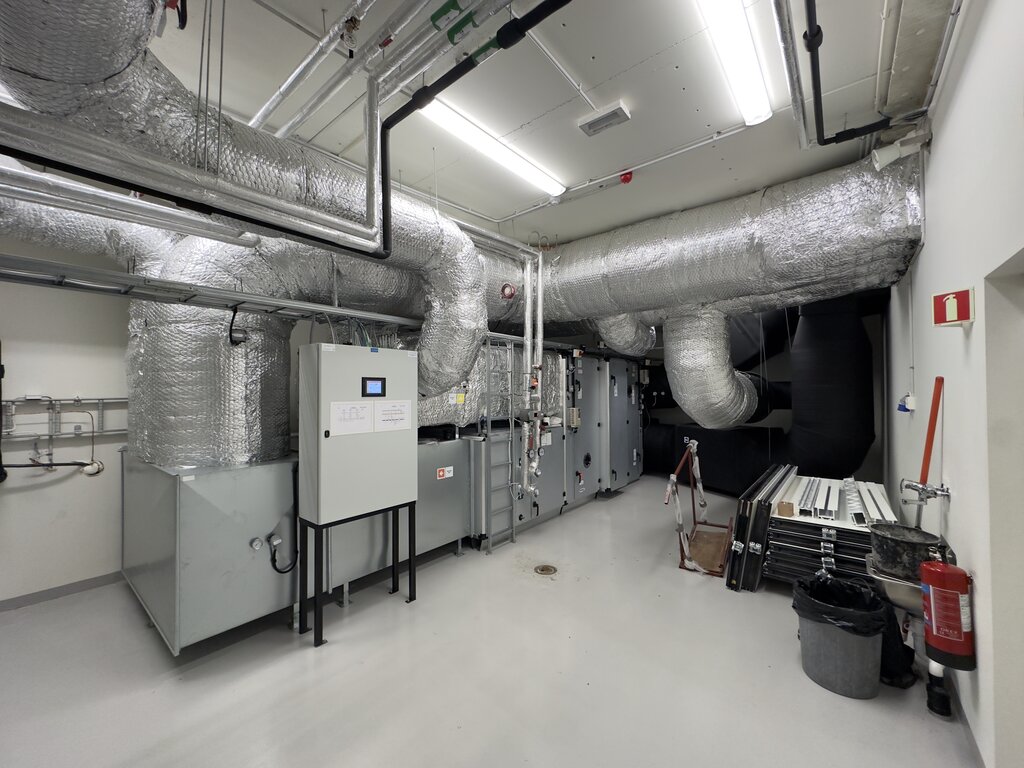
How Heat Moves
To understand how HVAC systems work, you first need to understand how heat behaves. Heating and cooling are really just about moving heat energy. To cool a room, you move heat from inside the room to the outside. To heat it, you do the opposite. Heat naturally moves from warmer areas to cooler areas, and it does so in three distinct ways: conduction, convection, and radiation.
Conduction
noun
The transfer of heat through direct contact between objects or substances.
If you've ever grabbed the metal handle of a hot pan, you've felt conduction. The heat from the pan travels directly into your hand. In a building, heat can conduct through walls, windows, and the roof, moving from the warmer side to the cooler side.
Convection
noun
The transfer of heat through the movement of fluids (liquids or gases).
Convection is heat transfer in motion. When you boil a pot of water, the water at the bottom heats up, becomes less dense, and rises. The cooler, denser water at the top sinks to take its place, creating a circular flow. Most forced-air furnaces and air conditioners use convection, pushing warm or cool air through ducts to circulate it throughout a space.
Radiation
noun
The transfer of heat through electromagnetic waves, which can travel through empty space.
This is how you feel the warmth of a campfire even from a distance, or how the sun heats the Earth. The heat travels as infrared radiation and doesn't require any direct contact or fluid movement. In a home, you might feel radiant heat from a sunny window or a radiant floor heating system.
Why Efficiency Matters
Controlling the temperature of an entire building requires a lot of energy. In fact, HVAC systems are one of the biggest energy consumers in both residential and commercial buildings.
Heating, Ventilation, and Air Conditioning (HVAC) systems account for approximately 38% of building energy consumption globally, making them one of the most energy-intensive services.
Because they use so much power, the efficiency of an HVAC system is incredibly important. An energy-efficient system uses less electricity or fuel to achieve the same level of heating or cooling. This has two major benefits.
First, it saves money. Lower energy consumption means lower utility bills. Over the lifespan of an HVAC system, the savings from an efficient model can be substantial.
Second, it reduces environmental impact. By using less energy, efficient systems decrease the demand on power plants, which helps lower greenhouse gas emissions. Improving HVAC efficiency is a key strategy in making buildings more sustainable.
Let's review the main ideas we've covered.
Now, test your understanding of these fundamental concepts.
What does the "V" in the acronym HVAC stand for?
A forced-air furnace that pushes warm air through ducts primarily uses which method of heat transfer to heat a room?
Understanding these core principles—the purpose of HVAC, the three modes of heat transfer, and the importance of efficiency—is the foundation for learning about how specific systems and components work together to keep us comfortable.