Introduction to Hindi
Devanagari Script
The Devanagari Script
Hindi is written using a script called Devanagari (देवनागरी). It's an elegant system with roots in ancient India, and it's used for several other languages like Sanskrit, Marathi, and Nepali. At first glance, the characters might look complex, but they follow a very logical and consistent pattern.
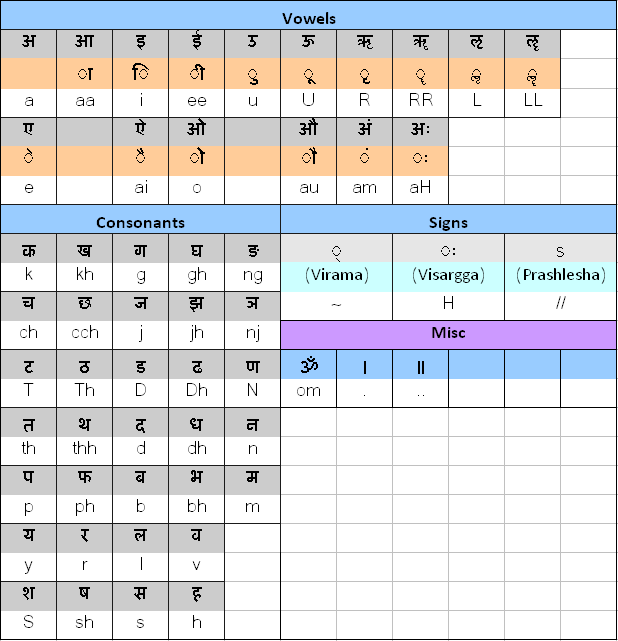
One of the best things about Devanagari is that it's almost entirely phonetic. This means that once you learn the sound for each character, you can pronounce any word you see. There are very few exceptions, unlike in English where letters can have many different sounds.
Devanagari is phonetic: what’s written is what’s read.
Devanagari is a type of script called an abugida. This is a fancy term for a simple idea: each consonant has a built-in, or inherent, vowel sound. In Hindi, this sound is a short 'a' (like the 'u' in 'but'). To make other vowel sounds, we add special marks to the consonants. Let's start by looking at the vowels themselves.
Vowels (स्वर)
Hindi has 14 vowels. Each vowel has two forms: an independent form used when the vowel starts a word, and a dependent form (called a mātrā) used when it's attached to a consonant. For now, we'll focus on the independent forms to learn their sounds.
| Vowel | Romanization | Sound (like in...) |
|---|---|---|
| अ | a | abut |
| आ | ā | father |
| इ | i | pin |
| ई | ī | feet |
| उ | u | put |
| ऊ | ū | rule |
| ऋ | ṛ | river (short) |
| ए | e | cafe |
| ऐ | ai | aisle |
| ओ | o | go |
| औ | au | house |
| अं | aṃ | song (nasal) |
| अः | aḥ | ah (breathy) |
| अँ | an | chant (nasalized vowel) |
Learning these distinct sounds is the first major step. Practice saying them out loud to get a feel for how they're produced.
Consonants (व्यंजन)
There are 33 core consonants in Hindi. As we mentioned, each one has an inherent 'a' sound. So, the character क is not just 'k', it's pronounced 'ka'. The consonants are brilliantly organized in the script based on where in the mouth they are pronounced, starting from the back of the throat and moving forward to the lips.
| Group | |||||
|---|---|---|---|---|---|
| Velar (throat) | क (ka) | ख (kha) | ग (ga) | घ (gha) | ङ (ṅa) |
| Palatal (palate) | च (ca) | छ (cha) | ज (ja) | झ (jha) | ञ (ña) |
| Retroflex (roof of mouth) | ट (ṭa) | ठ (ṭha) | ड (ḍa) | ढ (ḍha) | ण (ṇa) |
| Dental (teeth) | त (ta) | थ (tha) | द (da) | ध (dha) | न (na) |
| Labial (lips) | प (pa) | फ (pha) | ब (ba) | भ (bha) | म (ma) |
Notice the pattern in the table. The first column has unaspirated sounds (like 'k', 'p'), while the second column has aspirated sounds (like 'kh', 'ph'), which are pronounced with an extra puff of air. The third and fourth columns follow a similar pattern for voiced sounds, and the last column contains nasal sounds.
An easy way to feel the difference between aspirated and unaspirated sounds is to hold your hand in front of your mouth. You should feel a puff of air when saying 'kha' (ख) but not when saying 'ka' (क).
Besides those organized in the grid, there are a few more semi-vowels and other consonants:
| Category | ||||
|---|---|---|---|---|
| Semi-vowels | य (ya) | र (ra) | ल (la) | व (va) |
| Sibilants | श (śa) | ष (ṣa) | स (sa) | |
| Other | ह (ha) |
Putting It Together
All Devanagari words are written with a horizontal line drawn across the top of the letters, called a shirorekha (शिरोरेखा). This line connects the letters in a word, making them flow together.
This example shows how the independent vowel इ (i) becomes the mātrā ि when combined with the consonant क (ka) to make कि (ki). Every vowel except the first one, अ (a), has its own mātrā. Learning these will be your next step after you're comfortable with the individual characters.
Ready to test your knowledge? See if you can recognize the sounds of these characters.
The Devanagari script is classified as an "abugida." What is the defining characteristic of this type of script?
What is the name of the horizontal line drawn across the top of letters, connecting them into a word?
Becoming familiar with a new script takes time and practice. Start by writing the characters yourself, focusing on a few each day. The logical structure of Devanagari makes it one of the more straightforward scripts to master.