Introduction to Hebrew
Hebrew Alphabet
The Hebrew Aleph-Bet
The Hebrew alphabet, or Aleph-Bet, is the foundation of the language. It consists of 22 consonants. One of the first things you'll notice is that Hebrew is written and read from right to left, the opposite of English.
Remember: Always read from right to left!
Let's look at all the letters together before we break them down. Each letter has a name, a shape, and a sound.
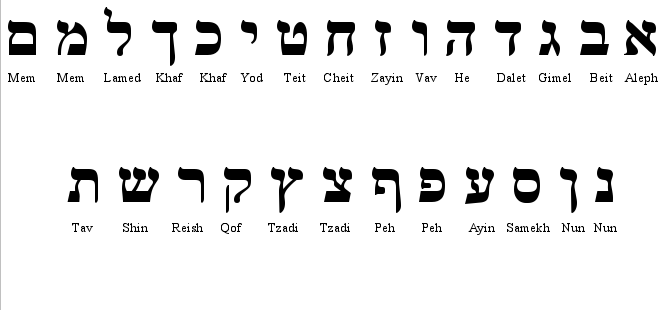
Learning all 22 letters at once can be a lot, so we'll go through them in smaller groups. Here are the first seven letters of the Aleph-Bet.
| Letter | Name | Sound |
|---|---|---|
| א | Aleph | Silent (acts as a vowel carrier) |
| ב | Bet | B (as in 'ball') |
| ג | Gimel | G (as in 'go') |
| ד | Dalet | D (as in 'dog') |
| ה | Heh | H (as in 'hay') |
| ו | Vav | V (as in 'vine') |
| ז | Zayin | Z (as in 'zoo') |
Notice that Aleph is silent. Its sound depends on vowel markings, which we'll cover later. For now, just recognize its shape and name. Let's continue with the next group of letters.
| Letter | Name | Sound |
|---|---|---|
| ח | Chet | Ch (a guttural sound like 'Bach') |
| ט | Tet | T (as in 'top') |
| י | Yud | Y (as in 'yes') |
| כ | Kaf | K (as in 'king') or Ch (like Chet) |
| ל | Lamed | L (as in 'love') |
The letter Kaf has two possible sounds. Don't worry about when to use which for now. The key is to learn the shape and the possible sounds it can make. Now for the next set.
| Letter | Name | Sound |
|---|---|---|
| מ | Mem | M (as in 'mom') |
| נ | Nun | N (as in 'no') |
| ס | Samekh | S (as in 'see') |
| ע | Ayin | Silent (a guttural sound from the throat) |
| פ | Pe | P (as in 'pen') or F (as in 'fun') |
| צ | Tzadi | Tz (like the 'ts' in 'cats') |
| ק | Qof | K (as in 'kite') |
Like Aleph, the letter Ayin is technically silent. It represents a sound made deep in the throat that doesn't exist in English. We're almost there! Here is the final group of letters.
| Letter | Name | Sound |
|---|---|---|
| ר | Resh | R (a rolled R, as in Spanish) |
| ש | Shin | Sh (as in 'shoe') or S (as in 'sun') |
| ת | Tav | T (as in 'ten') |
Final Forms
Five Hebrew letters have a special sofit, or final form. This means they look different when they appear at the very end of a word. The sound of the letter doesn't change, only its shape.
| Letter | Name | Standard Form | Final Form (Sofit) |
|---|---|---|---|
| כ/ך | Kaf | כ | ך |
| מ/ם | Mem | מ | ם |
| נ/ן | Nun | נ | ן |
| פ/ף | Pe | פ | ף |
| צ/ץ | Tzadi | צ | ץ |
Look closely at the final forms. The final Kaf, Nun, and Pe have a long tail that drops down. The final Mem is a closed square, unlike its open standard form. The final Tzadi's right leg straightens out. Recognizing these final forms is key to reading Hebrew words correctly.
Ready to test your knowledge? This quiz will help you practice identifying the letters you've just learned.
Hebrew is written and read from left to right, just like English.
How many letters are in the Hebrew alphabet (Aleph-Bet)?
Great work! You've taken the first and most important step in learning Hebrew. Getting comfortable with the Aleph-Bet is the foundation for everything that comes next.