Introduction to Guitar Playing
Guitar Basics
Know Your Instrument
Before you can play the guitar, it helps to know your way around it. Guitars might look a little different, but they all share the same basic parts. Let's take a look.
Here’s a quick rundown of the most important parts:
- Body: The large, hollow part of an acoustic guitar. It amplifies the sound from the strings.
- Neck: The long part you hold with your fretting hand. The front of the neck is the fretboard.
- Frets: The metal strips on the fretboard. Pressing a string against a fret changes its pitch.
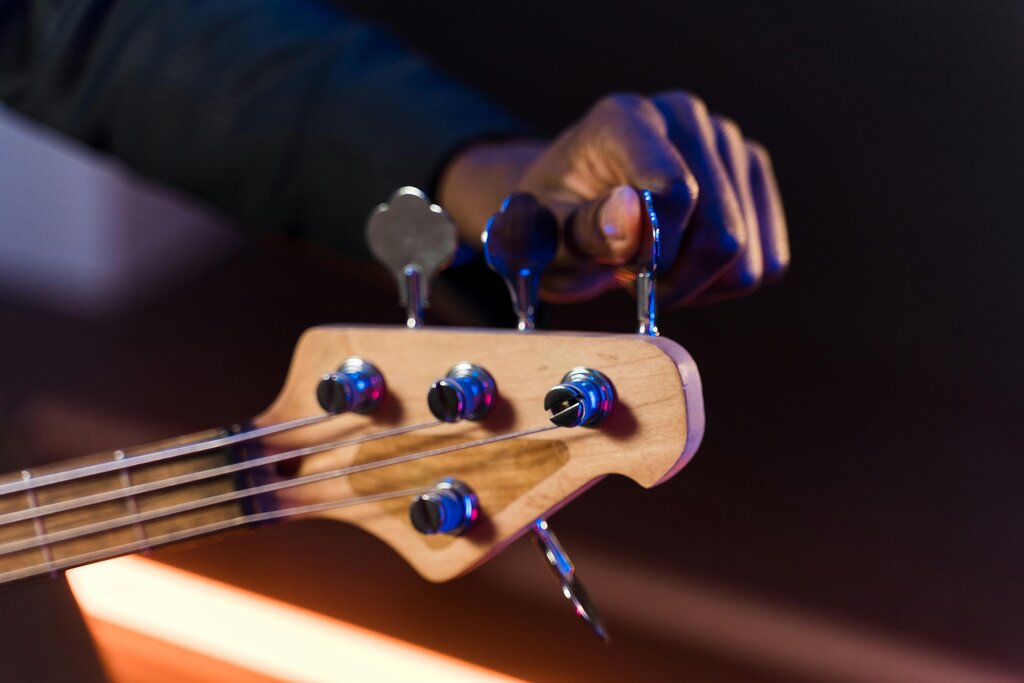
- Headstock: Located at the top of the neck, it holds the tuning pegs.
- Tuning Pegs: You turn these to tighten or loosen the strings, which changes their pitch and gets the guitar in tune.
- Bridge: This piece on the body holds the strings in place.
How to Hold Your Guitar
Getting comfortable is key. Bad posture can lead to strain and make playing feel harder than it needs to be.
Sit on a chair without arms, and keep your back straight but relaxed. Most people rest the guitar on the leg that matches their strumming hand. If you're right-handed, you'll strum with your right hand and rest the guitar's body on your right thigh.
Your fretting hand supports the neck. The thumb should rest gently on the back of the neck, giving your fingers the freedom to curve over the fretboard and press down on the strings. Your strumming arm should rest over the top of the guitar's body, letting your hand naturally fall over the soundhole.

Avoid letting the guitar's neck drop down. Try to keep it parallel to the floor or angled slightly upward. This will give you better access to the frets.
Getting in Tune
An out-of-tune guitar will never sound right, no matter how well you play. Tuning should be the first thing you do every time you pick it up.
Standard guitar tuning, from the thickest string (closest to you) to the thinnest, is E-A-D-G-B-E. A good way to remember this is with a mnemonic like "Eddie Ate Dynamite, Good Bye Eddie."
| String Number | Note | Description |
|---|---|---|
| 6 | E | Thickest string |
| 5 | A | |
| 4 | D | |
| 3 | G | |
| 2 | B | |
| 1 | E | Thinnest string |
The easiest way to tune is with an electronic tuner. You can use a clip-on tuner that attaches to the headstock or a smartphone app.
Pluck a single string, and the tuner will tell you if the note is sharp (too high) or flat (too low). Turn the corresponding tuning peg to adjust it. A small turn can make a big difference, so go slowly until the tuner indicates the note is correct.
Your First Strum
Strumming is the rhythmic backbone of most guitar music. It involves sweeping your pick or fingers across the strings.
There are two basic motions: the downstroke and the upstroke. A downstroke is when you strum from the thickest string down to the thinnest. An upstroke is the opposite, moving from thin to thick.
Hold your pick loosely between your thumb and index finger. Your wrist should be relaxed, not stiff. Most of the strumming motion comes from a slight rotation of your forearm and wrist, not your whole arm.
Let's try a simple, common pattern. We'll count to four for each measure: "1 and 2 and 3 and 4 and..."
- On the numbers (1, 2, 3, 4), you'll play a downstroke.
- On the "ands," you'll play an upstroke.
Try this slowly and evenly without playing any chords yet. Just mute the strings by lightly touching them with your fretting hand and focus on the rhythm. Down, up, down, up. This pattern is the foundation for countless songs.
When learning how to play guitar, the first strumming pattern you need to understand is the simple eighth-note downstroke/upstroke pattern.
Once you're comfortable with the parts of the guitar, how to hold it, tuning it, and this basic strum, you're ready to start learning chords.