Introduction to Guitar Playing
Guitar Basics
Meet Your Guitar
Before you can play a single note, it helps to know your way around the instrument. Think of it like learning the names of kitchen tools before you start cooking. Knowing what each part does makes everything else easier.
Let’s break down the main parts:
- Body: The large, hollow part of an acoustic guitar that amplifies the sound. On an electric guitar, it's solid and holds the electronic components.
- Neck: The long piece of wood you hold with your fretting hand. It connects the body to the headstock.
- Fretboard: The flat surface on the front of the neck where you press the strings down. The metal strips across it are called frets.
- Headstock: Located at the top of the neck, it holds the tuning pegs.
- Tuning Pegs: You turn these to change the pitch of the strings.
- Nut: A small grooved piece that guides the strings from the headstock onto the fretboard.
- Bridge: This sits on the body and holds the saddle, which is where the strings make contact. It anchors the strings to the body.
Getting in Tune
An out-of-tune guitar doesn't sound good, no matter how well you play. Tuning is a crucial first step every time you pick up your instrument. Guitars have six strings, and in standard tuning, they are set to specific notes. From the thickest string (closest to you) to the thinnest, the notes are E, A, D, G, B, E.
A popular mnemonic to remember this is: Eddie Ate Dynamite, Good Bye Eddie.
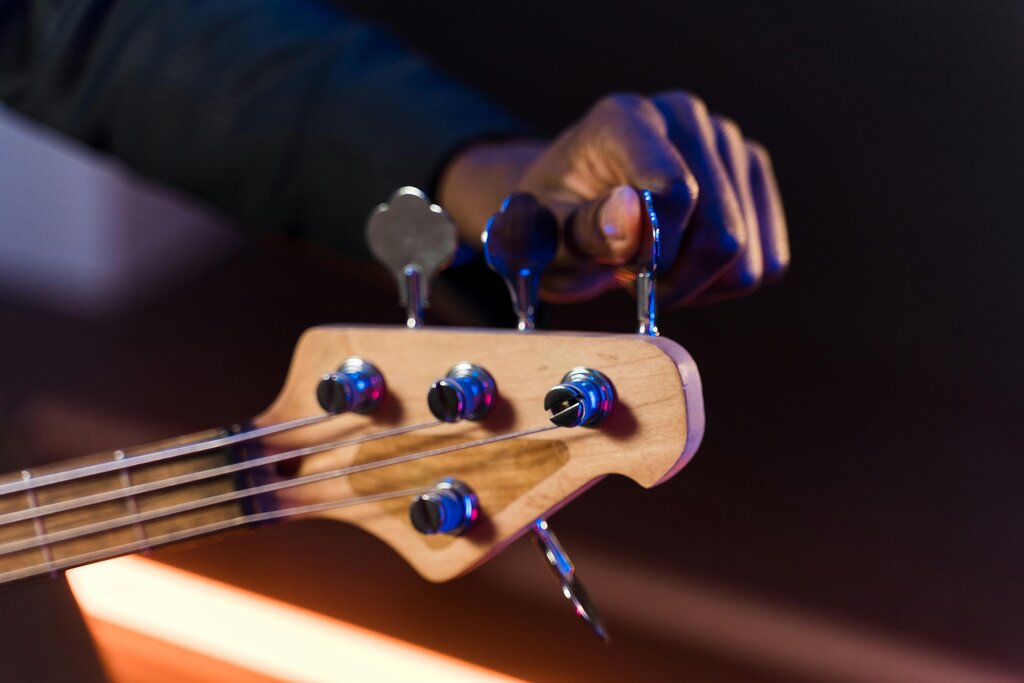
The easiest way to tune is with an electronic tuner. You can get a clip-on tuner that attaches to the headstock or use a smartphone app. The process is simple:
- Pluck a single open string.
- The tuner will show you what note the string is currently playing.
- Turn the corresponding tuning peg to adjust the pitch. Tightening the string makes the pitch higher; loosening it makes it lower.
- Adjust until the tuner indicates the note is correct, usually by turning green or showing a needle in the center.
Do this for all six strings, and you're ready to play.
How to Hold It
How you hold the guitar affects your comfort and your ability to play cleanly. Bad habits can lead to strain or injury, so it's worth getting right from the start.
Position and Posture are essential for learning to play an instrument.
Sit in a comfortable chair without arms. Your back should be straight but relaxed. For a right-handed player, the curve in the guitar's body should rest on your right thigh. The guitar should be angled slightly upward, not lying flat in your lap.
Your fretting arm (your left arm, if you're right-handed) should be relaxed, with your elbow away from your body. Your thumb should rest on the back of the neck, roughly opposite your index or middle finger. This gives you the leverage to press down on the strings without squeezing too hard.
Your strumming arm rests over the top of the guitar's body, allowing your hand to hover over the strings near the soundhole. This position keeps you from getting tired and gives you control over your playing.

The goal is to feel balanced and comfortable. If you feel any pinching or straining, adjust your position. A guitar strap can also help support the instrument, even when you're sitting down.
What is the primary function of the tuning pegs on a guitar?
In standard guitar tuning, the notes from the thickest string to the thinnest are E, A, D, G, B, and ____.
With these fundamentals in place, you have a solid foundation to build upon. Next, you'll be ready to start making some music.