Introduction to Guitar Playing
Guitar Basics
Know Your Instrument
Before you can play a single note, it helps to know your way around the guitar. Think of it like learning the names of the players on a team. Every part has a job to do.
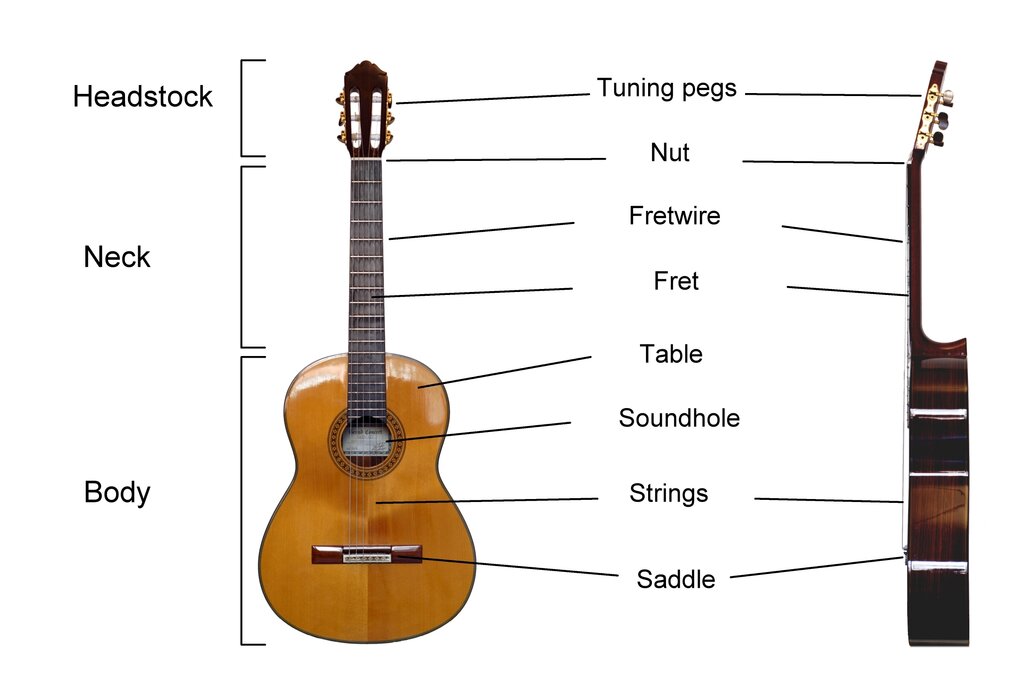
The big wooden part is the body. It acts like an amplifier for the sound. Attached to it is the long neck, which is where you'll do most of the work with one of your hands. The top of the neck is the headstock, where you'll find the tuning pegs. You turn these to tighten or loosen the strings and change their pitch.
The metal bars running across the neck are called frets. They are the secret to playing different notes. The strings are held in place by the bridge on the body and the nut at the top of the neck.
Getting in Tune
Playing an out-of-tune guitar is like trying to sing with a sore throat. It just doesn't sound right. The most common tuning, called standard tuning, sets the strings to specific notes. From the thickest string (closest to the ceiling) to the thinnest (closest to the floor), the notes are E, A, D, G, B, E.
A good way to remember the string names is with a mnemonic: Eddie Ate Dynamite, Good Bye Eddie.
The easiest way to tune is with an electronic tuner. You can get a clip-on tuner that attaches to your headstock, or simply download a tuner app on your phone.
Pluck a single string, and the tuner will tell you if it's sharp (too high) or flat (too low). If it's flat, turn the tuning peg to tighten the string. If it's sharp, loosen it. Keep adjusting until the tuner gives you the green light for the correct note.

Posture and Positioning
How you hold the guitar affects how comfortably and easily you can play. Sit on a chair without arms, and keep your back straight. The guitar should rest on your lap, with the body tucked in close to you.
Your fretting hand, the one that goes on the neck, should have a relaxed, C-shaped grip. Your thumb should rest on the back of the neck, roughly opposite your middle finger. Keep your wrist straight and your fingers curved, like you're holding a ball. This lets your fingertips press down on the strings cleanly.

Your other hand is the picking or strumming hand. Let it rest gently over the sound hole (on an acoustic) or the pickups (on an electric). Whether you use a pick or your fingers, the motion should come from a relaxed wrist and elbow, not your whole arm.
Making Notes
To play a note, you need to do two things at once: fret the string with one hand and pick it with the other.
Fretting: Use the tip of your finger, not the flat part, to press a string down. The goal is to press the string just behind the metal fret, not on top of it. This takes less effort and produces a much cleaner sound. Don't press too hard, just enough so the string makes firm contact with the fret. If you hear a buzzing sound, you might need to press a little harder or adjust your finger position.

Picking: If you're using a pick, hold it between your thumb and the side of your index finger. Only a small tip of the pick should stick out. Strike the string with a simple downstroke. For now, focus on hitting just one string at a time. The movement should be small and controlled.
Try this: with your fretting hand, press the 1st fret of the thinnest string (the high E string). With your other hand, pick that string. Now move to the 2nd fret and pick. Then the 3rd, and the 4th. Congratulations, you're playing notes.