Introduction to Guitar
Guitar Basics
Know Your Instrument
Before you can play the guitar, it helps to know your way around it. Guitars come in many shapes and sizes, but most share the same basic parts. Let's break down the anatomy of a standard guitar.
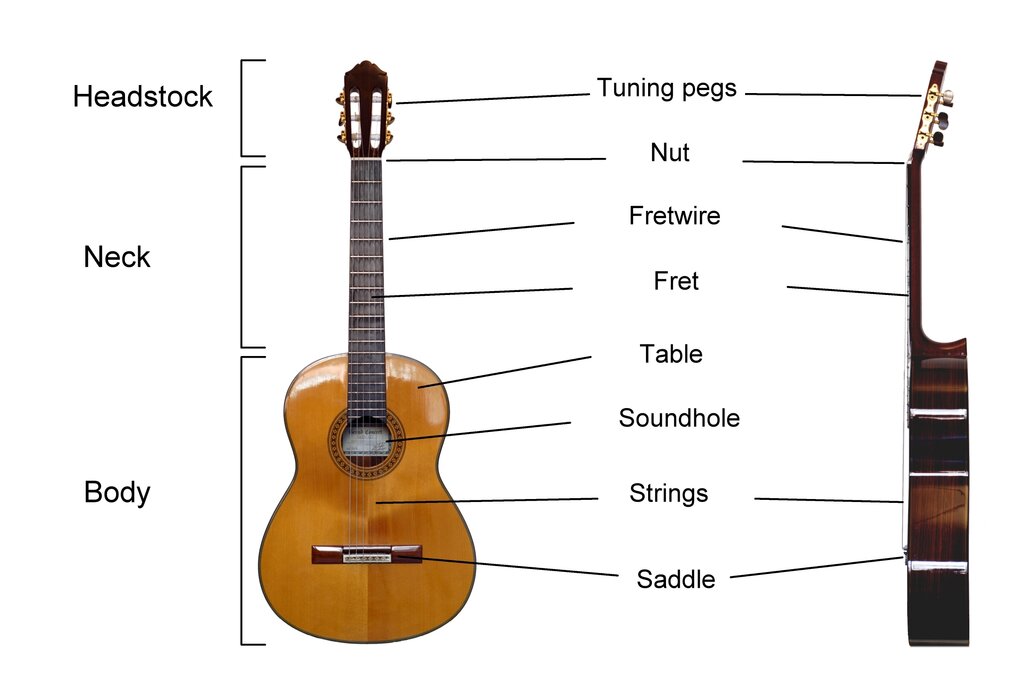
The guitar is made of three main sections: the body, the neck, and the headstock.
The body is the largest part and creates the instrument's sound. On an acoustic guitar, the soundhole helps project the sound outwards. The strings are anchored to the bridge, which sits on the body.
The neck is the long piece you hold with your fretting hand. The top of the neck is the fretboard, which has metal strips called frets embedded in it. Pressing a string against a fret changes its pitch.
The headstock is at the far end of the neck. It holds the tuning pegs (or tuners), which you turn to tighten or loosen the strings, changing their pitch.
fret
noun
A raised element on the neck of a stringed instrument. Frets divide the neck into fixed segments at intervals of a semitone.
Meet the Strings
The standard guitar has six strings. Each string has a name and a number. The thickest, lowest-sounding string is the 6th string, and the thinnest, highest-sounding string is the 1st string. In standard tuning, the notes are E, A, D, G, B, and E, starting from the thickest string.
A common mnemonic to remember the string names is: Eddie Ate Dynamite, Good Bye Eddie.
| String Number | Note Name | Description |
|---|---|---|
| 6 | E | Thickest, lowest pitch |
| 5 | A | |
| 4 | D | |
| 3 | G | |
| 2 | B | |
| 1 | E | Thinnest, highest pitch |
Notice that both the thickest and thinnest strings are an E note, just two octaves apart. Understanding these string names is the first step to navigating the fretboard.
On the guitar, understanding these 12 notes and how they repeat across the fretboard is the absolute first step towards demystifying the instrument and any music theory concept.
Getting in Tune
A guitar needs to be in tune to sound right. Tuning means adjusting the pitch of each string to match its correct note. The most common method for beginners is using an electronic tuner.

Electronic tuners are simple to use. You can get them as clip-on devices, pedals, or apps on your phone. To use one, pluck a single string. The tuner will show you what note you're playing and whether it's sharp (too high) or flat (too low). Turn the corresponding tuning peg to adjust the pitch until the tuner indicates the note is correct.
Start with the low E string (6th) and work your way to the high E string (1st). Pluck one string at a time.
- If the note is flat, turn the tuning peg to tighten the string, raising the pitch.
- If the note is sharp, turn the tuning peg to loosen the string, lowering the pitch.
Make small adjustments. Guitar strings are sensitive. Tuning your guitar every time you play is a good habit to build.
Posture and Hand Position
How you hold the guitar is just as important as how you play it. Good posture helps you play comfortably, prevents injuries, and makes it easier to fret notes and strum.
Sit in a comfortable chair without arms. Keep your back straight and your shoulders relaxed. Rest the waist of the guitar on your right thigh (if you're right-handed).
Your fretting hand—the one that goes on the neck—should be relaxed. Your thumb should rest on the back of the neck, roughly opposite your index or middle finger. Keep your fingers curved like you're holding a ball. This allows you to press the strings down cleanly without touching adjacent strings.
Your strumming arm should rest on the top of the guitar's body, with your hand positioned over the soundhole. Whether you use a pick or your fingers, your wrist should be loose and relaxed.

These fundamentals—knowing the parts, the string names, how to tune, and how to hold the instrument—are your foundation. Mastering them will make learning chords, scales, and songs much smoother.