Introduction to Geology
Earth's Structure
A Layered Planet
If you could slice the Earth in half, you wouldn't find a solid ball of rock. Instead, you'd see a series of distinct layers, a bit like a giant geological onion. For centuries, we could only guess what lay beneath our feet. But by studying how earthquake waves travel through the planet, scientists have pieced together a detailed picture of Earth's interior.
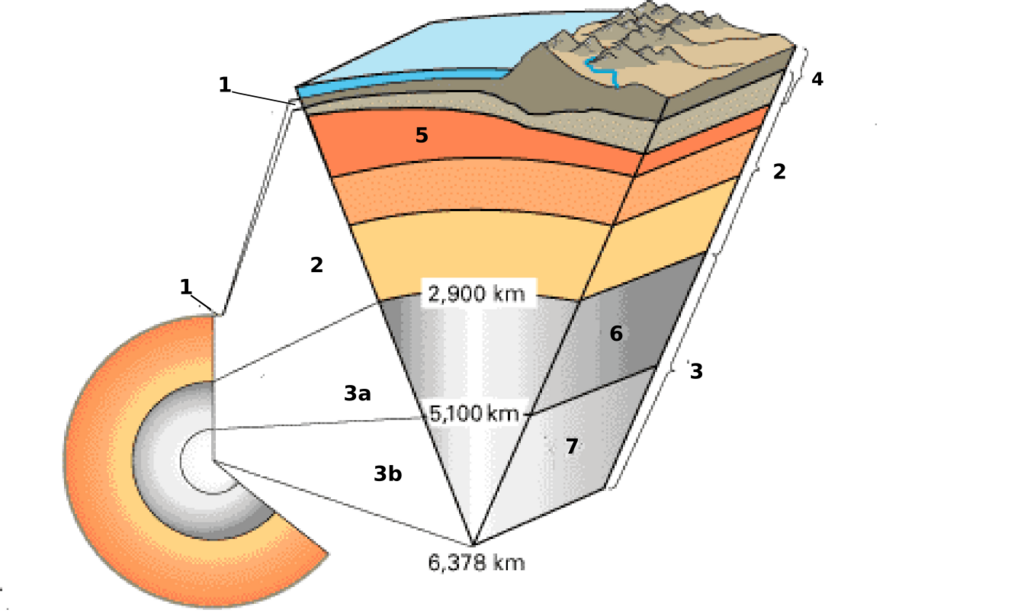
We can group these layers in two main ways: by their chemical makeup (what they're made of) and by their physical properties (how they behave). Let's start with the chemical ingredients.
The Chemical Recipe
When we look at Earth's composition, we see three main layers: the crust, the mantle, and the core. Each has a unique chemical signature.
The three compositional layers are the Crust, Mantle, and Core.
The Crust: This is the thin, rocky outer layer where we live. It's the thinnest of all the layers, comparable to the skin on an apple. There are two types. Continental crust is thicker, less dense, and makes up the landmasses. Oceanic crust is thinner, denser, and lies beneath the oceans.
The Mantle: Below the crust lies the mantle, a thick layer of hot, solid rock that makes up about 84% of Earth's volume. It's composed mostly of silicate rocks, which are rich in silicon, oxygen, magnesium, and iron. While it's technically solid, it can flow very slowly over millions of years.
The Core: At the planet's center is the core, a sphere made almost entirely of iron and nickel. It's divided into two parts. The outer core is a liquid metal layer, and its churning motion generates Earth's magnetic field. The inner core is a solid ball of metal. Despite being even hotter than the outer core, the immense pressure at the center of the Earth is so great that it forces the iron and nickel atoms into a solid state.
How Earth Behaves
Besides what they're made of, geologists also classify layers based on how they act. This gives us a mechanical or physical view of the planet's interior, focusing on properties like rigidity and flow. This perspective introduces two key layers that are crucial for understanding the planet's dynamic surface.
Lithosphere
noun
The rigid outer part of the earth, consisting of the crust and upper mantle.
The lithosphere isn't just the crust. It's the crust plus the very top, rigid, solid part of the mantle. Think of it as Earth's brittle outer shell. It's not one continuous piece; it's broken up into large, interlocking slabs.
Beneath this rigid shell is a much weaker layer.
Asthenosphere
noun
The upper layer of the earth's mantle, below the lithosphere, in which there is relatively low resistance to plastic flow and convection is thought to occur.
The asthenosphere is a hot, semi-solid part of the upper mantle just below the lithosphere. It's not liquid, but it's much softer and can flow like extremely thick taffy or honey over geological time. This property is incredibly important.
The rigid, brittle plates of the lithosphere float and move upon the soft, flowing asthenosphere.
Understanding these two ways of looking at Earth's structure, by what it's made of and by how it behaves, is the foundation for exploring the most powerful forces that shape our planet.
A geologist describes a layer of the Earth based on its rigidity and its ability to flow over long periods. Which classification system are they using?
Which layer of the Earth is a liquid metal that generates the planet's magnetic field?
These layers, from the thin crust to the solid iron core, work together in a dynamic system that has shaped the world we know over billions of years.