Introduction to Generative AI
Introduction to Generative AI
What Is Generative AI?
Artificial intelligence has been around for a while, but it used to be mostly about analyzing information that already exists. Think of an AI that sorts your emails into "spam" and "not spam." It's smart, but it's not creating anything new. It's just organizing.
Generative AI is different. It's a type of artificial intelligence that can create brand-new, original content. This content can be text, images, music, or even code. Instead of just sorting information, it generates it from scratch, based on the patterns it learned from massive amounts of data.
Generative AI refers to a type of artificial intelligence whose core function is to create new content—text, audio, images, video, or data—based on patterns it has learned from existing data.
This ability to create is a huge leap forward. It moves AI from being a tool for understanding the world to a tool for adding to it. This shift opens up entirely new possibilities for creativity, problem-solving, and automation.
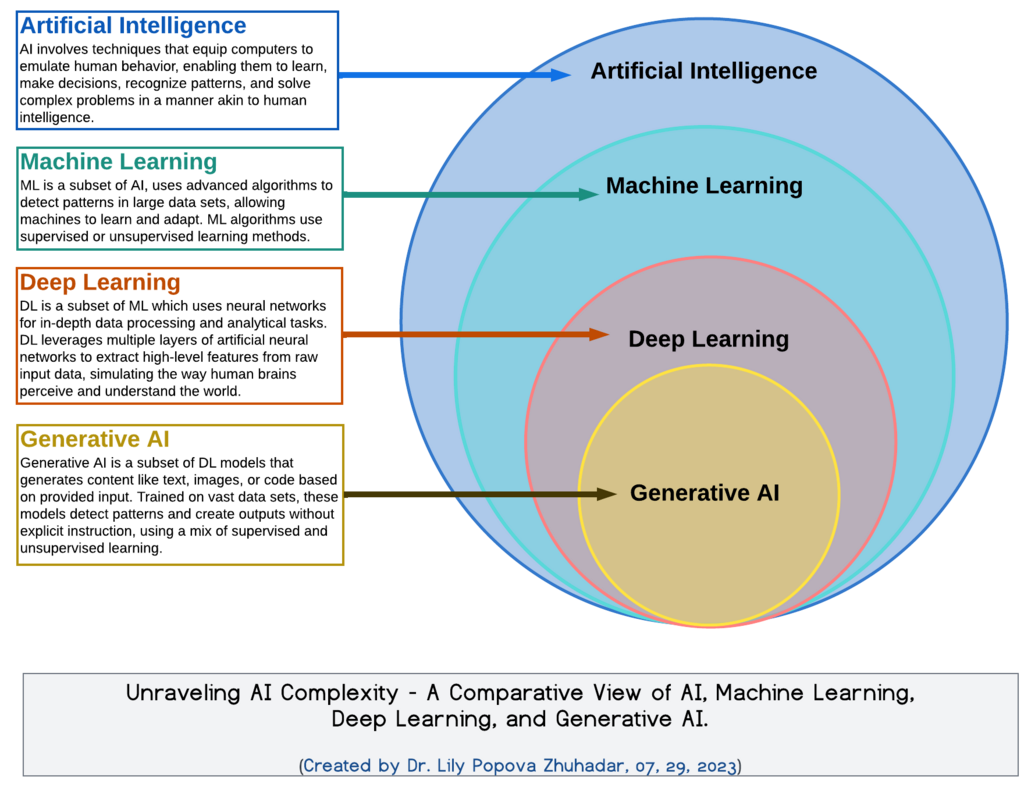
From Analyzing to Creating
Early AI systems were primarily analytical. Their main job was to look at data, find patterns, and make predictions. For example, an AI could analyze thousands of housing sales to predict the price of a specific house. This is incredibly useful, but it's fundamentally about interpreting existing data.
These systems worked by learning rules and relationships from the information they were trained on. They could classify images, translate languages, or forecast weather. But they couldn't dream up a new image, write a poem, or compose a melody. Their intelligence was reactive and analytical.
Generative AI marks an evolution from this analytical phase. It still learns from data, but its goal is different. After learning what a cat looks like from thousands of pictures, it doesn't just want to identify more cats. It wants to create a picture of a cat that has never existed before. It's a shift from recognition to generation.
Two Ways AI Learns
To understand what makes generative AI special, it helps to know about two fundamental approaches in machine learning: discriminative and generative models. They learn in very different ways.
A discriminative model is like a student learning to tell the difference between two things. Imagine showing a student thousands of pictures of cats and dogs. A discriminative model learns the dividing line—the specific features that separate a cat from a dog. Its goal is to classify. When you show it a new picture, it can confidently say, "That's a dog."
Discriminative models learn the boundary between data categories. They answer questions like, "Is this a cat or a dog?"
A generative model, on the other hand, goes deeper. Instead of just learning the boundary between cats and dogs, it tries to understand the essence of what makes a cat a cat, and a dog a dog. It learns the underlying patterns and characteristics of each category.
Once it has this deep understanding, it can do something magical: it can generate a completely new example. It can create a new image of a cat or a dog that is unique but still looks realistic because it has learned the fundamental rules of what a cat or dog should look like.
Generative models learn the distribution of the data itself. They can fulfill requests like, "Create a picture of a cat."
Both types of models are useful, but for different tasks. Discriminative models are great for classification, while generative models excel at creation.
The Tech Behind the Magic
Generative AI isn't a single technology but a combination of several powerful components. Three key ingredients make it possible:
-
Massive Datasets: Generative models need to learn from vast amounts of examples. For an AI that generates images, this means seeing millions of pictures. For a text generator, it means reading a huge portion of the internet.
-
Powerful Computers: Training these models requires immense computational power. Modern graphics processing units (GPUs) are essential because they can perform the many parallel calculations needed to process these large datasets efficiently.
-
Advanced Algorithms: The
The "brains" of these systems are sophisticated algorithms, often based on neural networks. These are complex mathematical systems inspired by the human brain that can learn patterns from data. Architectures like the Transformer model have been particularly crucial in the development of today's powerful generative AI.
Together, these elements allow AI to move beyond simple analysis and into the realm of creation.
What is the primary difference between traditional AI and generative AI?
An AI model is trained to distinguish between pictures of cats and dogs. When given a new image, its only job is to label it as 'cat' or 'dog'. What kind of model is this?