Introduction to Generative AI
Introduction to Generative AI
What is Generative AI?
At its heart, generative artificial intelligence is a creator. Unlike other forms of AI that might classify data or make predictions, generative AI makes something new. It could be an essay, a piece of music, a realistic image, or a line of code.
Generative AI refers to a type of artificial intelligence whose core function is to create new content—text, audio, images, video, or data—based on patterns it has learned from existing data.
Think of it like this: if you listen to thousands of songs from a certain musician, you start to understand their style—their typical chord progressions, lyrical themes, and rhythm. You could then try to write a song that sounds like them. Generative AI does something similar, but on a massive scale. It analyzes enormous datasets of text, images, or sounds to learn the underlying patterns and structures. Then, it uses that knowledge to generate brand new, original content that fits those patterns.
Generative vs. Traditional AI
The key difference lies in the goal. Most traditional AI systems are discriminative. Their job is to distinguish between different types of data. A classic example is an email spam filter. It reads an email and decides: is this spam or not spam? It's making a judgment based on patterns it has learned.
Generative AI, in contrast, is about creation. Instead of just identifying a cat in a photo, a generative model could create an image of a cat that doesn't exist. It's not discriminating between options; it's generating a new reality.
| Feature | Traditional (Discriminative) AI | Generative AI |
|---|---|---|
| Primary Goal | Classify or predict | Create new content |
| Question It Answers | "What is this?" | "What could this be?" |
| Example | Identifying spam emails | Writing a poem |
| Output | A label or a number (e.g., 'spam') | New data (text, image, etc.) |
A Quick History
The idea of machines creating content isn't new, but the technology has evolved dramatically. Early attempts in the mid-20th century used simple statistical methods like Markov chains to generate text. The results were often grammatically correct but lacked real meaning or coherence.
The game changed with the rise of machine learning and neural networks. These systems, inspired by the structure of the human brain, allowed for much more sophisticated pattern recognition. But for a long time, getting them to generate high-quality, believable content was a huge challenge.
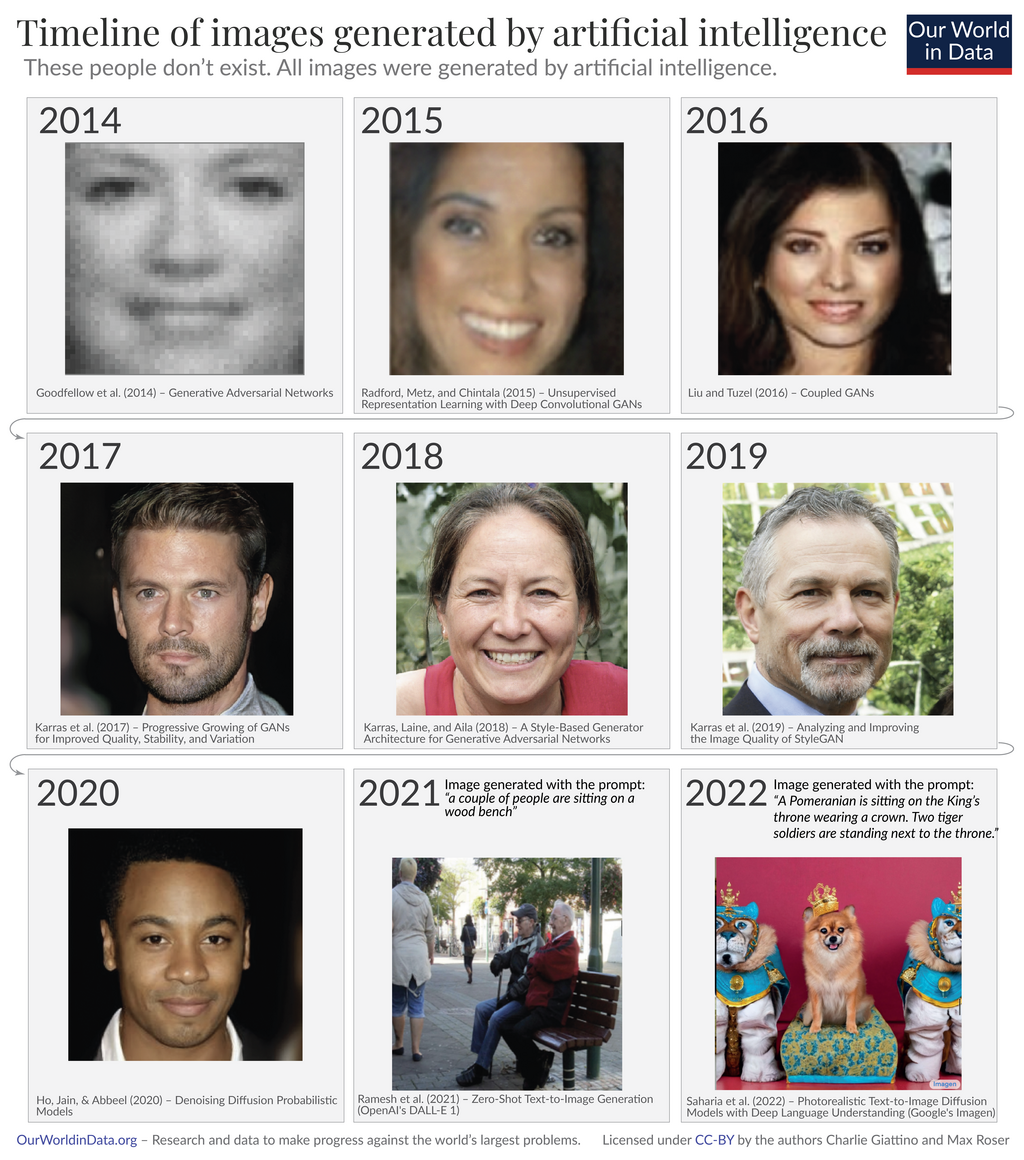
A major breakthrough came in 2014 with the invention of Generative Adversarial Networks (GANs). This was a clever setup involving two competing neural networks: one that generates content (the "generator") and another that tries to tell if the content is real or fake (the "discriminator"). By pitting them against each other, the generator got progressively better at creating realistic outputs.
More recently, new architectures like Transformers and diffusion models have pushed the boundaries even further, leading to the powerful tools we see today.
The Technology Behind the Magic
So how does it actually work? Three key technologies are central to modern generative AI.
Transformer
noun
A neural network architecture that excels at handling sequential data, like text or music, by weighing the importance of different input elements.
Transformers: This architecture, introduced in 2017, was a game-changer for processing language. Its key innovation is the "attention mechanism," which allows the model to focus on the most relevant parts of the input data when producing an output. This is why modern language models can keep track of context over long paragraphs and generate coherent, relevant text.
Generative Adversarial Networks (GANs): As mentioned, GANs use a competitive process to refine their output. The generator creates images, and the discriminator judges them. This back-and-forth pushes the generator to produce incredibly realistic results. While they've been largely surpassed for image generation, the concept was foundational.
Diffusion Models: This is the technology behind many of today's top image generators. The process starts with a clear image and gradually adds digital "noise" until it's pure static. The model then learns how to reverse this process. To generate a new image, it starts with random noise and carefully removes it, step-by-step, until a coherent image that matches a text prompt emerges.
These core technologies, powered by massive datasets and powerful computers, are what enable generative AI to create such a wide range of new and interesting content.