Introduction to Generative AI
Introduction to Generative AI
Creating, Not Just Copying
Most artificial intelligence you encounter is designed to recognize patterns or make predictions. It can identify a cat in a photo, translate a sentence, or forecast sales. This is incredibly useful, but it's fundamentally about analyzing existing data.
Generative AI is different. Its purpose isn't just to understand the world, but to create new things within it.
Generative AI models produce original content—like text, images, or music—that is similar to, but not a direct copy of, the data they were trained on.
Think of it like the difference between a student who can ace a multiple-choice test and one who can write a compelling essay. The first recognizes correct answers from a given set of options. The second synthesizes knowledge to generate something entirely new.
This ability to create makes Generative AI a powerful tool for everything from drafting emails and writing code to composing music and designing products.
Building on a Foundation
While tools like ChatGPT might seem like an overnight sensation, they stand on the shoulders of decades of research. The core ideas behind Generative AI are part of a larger story about how we teach machines to learn.
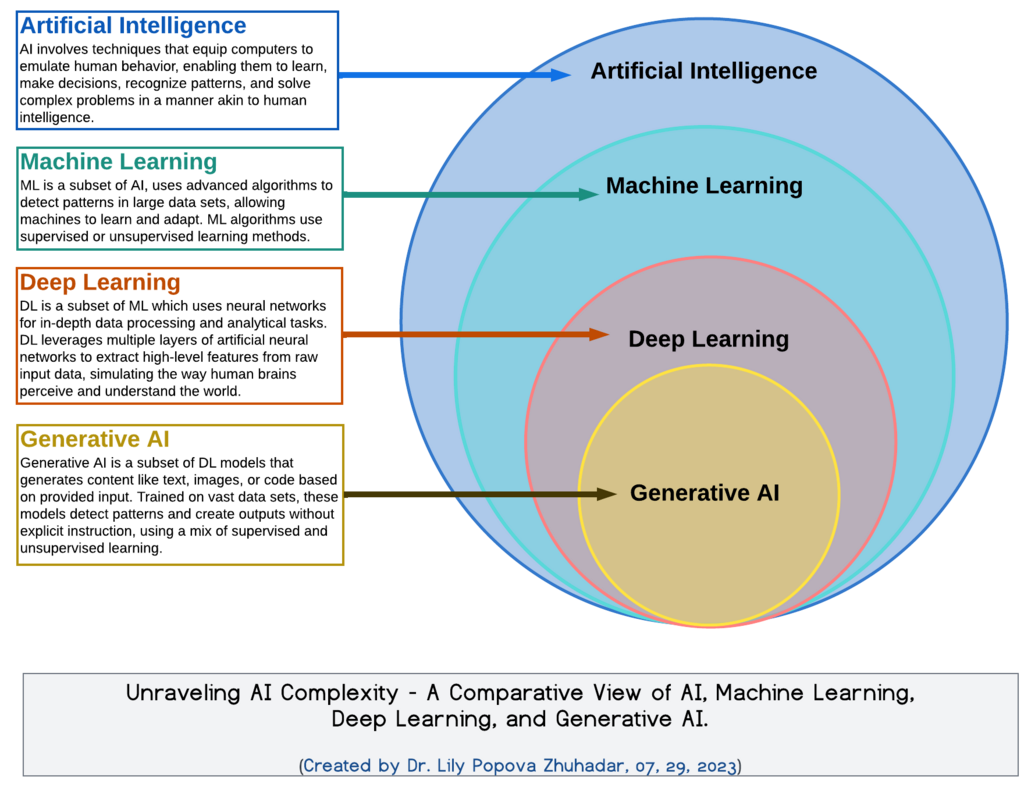
To understand Generative AI, we need to look at its building blocks:
- Artificial Intelligence (AI): The broadest concept, covering any technique that enables computers to mimic human intelligence. This includes everything from simple rule-based systems to complex learning models.
- Machine Learning (ML): A subset of AI where systems learn from data. Instead of being explicitly programmed for a task, an ML model identifies patterns in large datasets and uses them to make predictions. This is the engine that powers most modern AI.
- Deep Learning: A specialized type of machine learning that uses structures called neural networks. Inspired by the human brain, these networks have multiple layers that allow them to learn very complex patterns from vast amounts of data. Most advanced AI, including Generative AI, is powered by deep learning.
Generative vs. Discriminative AI
Within machine learning, models are often separated into two camps: discriminative and generative. Understanding this distinction is key to grasping what makes Generative AI unique.
| Model Type | Primary Goal | Example Question |
|---|---|---|
| Discriminative | Classify or predict | Is this image a cat or a dog? |
| Generative | Create new data | Generate an image of a cat. |
Discriminative models are trained to find the boundary between different types of data. A spam filter is a classic example; it learns the features that separate spam from legitimate email and then uses that boundary to classify new messages.
Generative models take a different approach. They learn the underlying distribution of a dataset. Instead of just learning the line between 'cat' and 'dog' images, a generative model learns what cat images look like in general. With that knowledge, it can then generate a brand new image that fits the 'cat' category.
In short, discriminative AI labels the world, while generative AI creates new parts for it.
This foundational shift from classifying to creating is what has unlocked the recent explosion in AI's creative capabilities.
What is the primary function that distinguishes Generative AI from most other forms of artificial intelligence?
An AI model is trained to identify whether an email is spam or not. What kind of model is this most likely to be?