Introduction to Generative AI
Introduction to Generative AI
What is Generative AI?
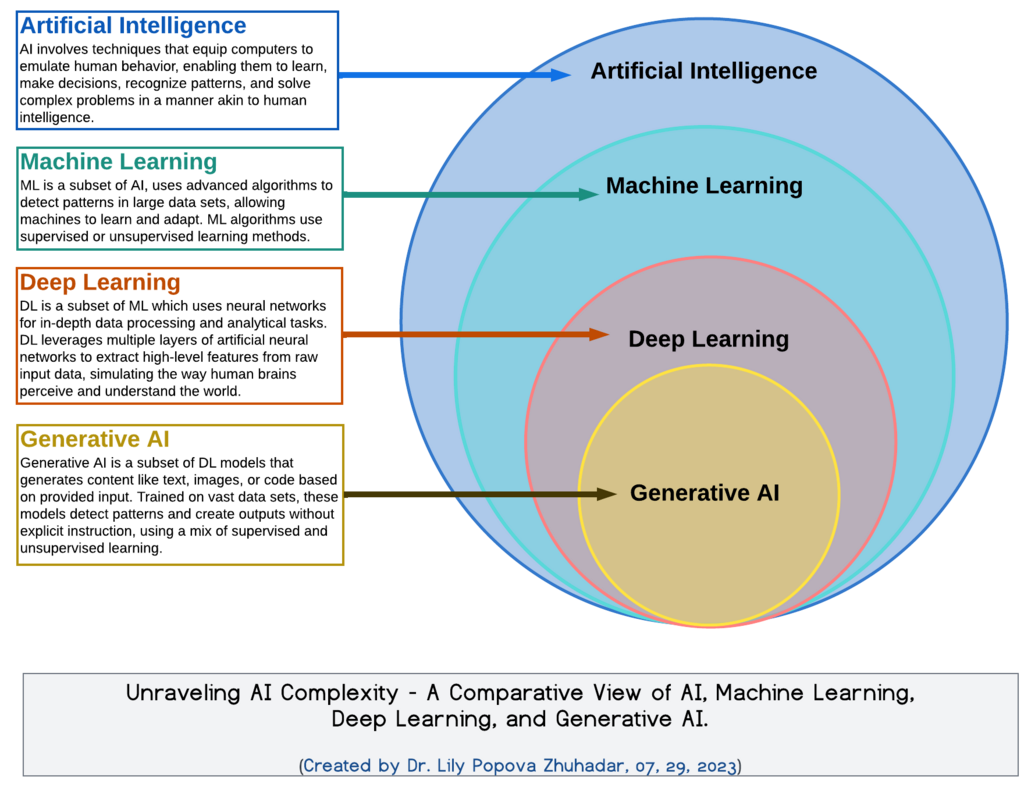
Artificial intelligence comes in many flavors. Some AI is designed to analyze existing information—to spot patterns, classify data, or make predictions. Think of an AI that identifies spam emails or predicts stock prices. It's working with what's already there.
Generative AI is different. Its core function is to create something new. Instead of just analyzing data, it learns the underlying patterns and structures within a dataset and then uses that knowledge to generate entirely new, original content.
Generative AI doesn't just recognize patterns; it produces new content—be it images, text, music, or even synthetic data.
Imagine showing a musician thousands of classical sonatas. After studying them, they don't just identify whether a new piece is classical or not. They sit down and compose a brand-new sonata in the same style. That's the essence of generative AI. It's a creator, not just an analyst.
Generative vs. Discriminative AI
To really grasp generative AI, it helps to compare it with its counterpart: discriminative AI. Most of the AI you might have encountered in the past falls into the discriminative category.
Discriminative models are trained to find the boundary between different categories of data. For example, given a picture, a discriminative model would try to answer the question, "Is this a cat or a dog?" It learns to discriminate between the two options.
Generative models, on the other hand, learn how the data is generated in the first place. A generative model would look at thousands of dog photos and learn the essential 'dogginess' of them all—the patterns, textures, and shapes. Then, if you asked it to, it could generate a picture of a dog that has never existed before.
| Feature | Generative AI | Discriminative AI |
|---|---|---|
| Primary Goal | Create new data | Classify or predict from existing data |
| Example Question | "Generate an image of a cat." | "Is this image a cat?" |
| Common Use Cases | Art, music, text generation | Spam filtering, image recognition |
| Analogy | An artist learning to paint | An art critic learning to identify artists |
A Brief History
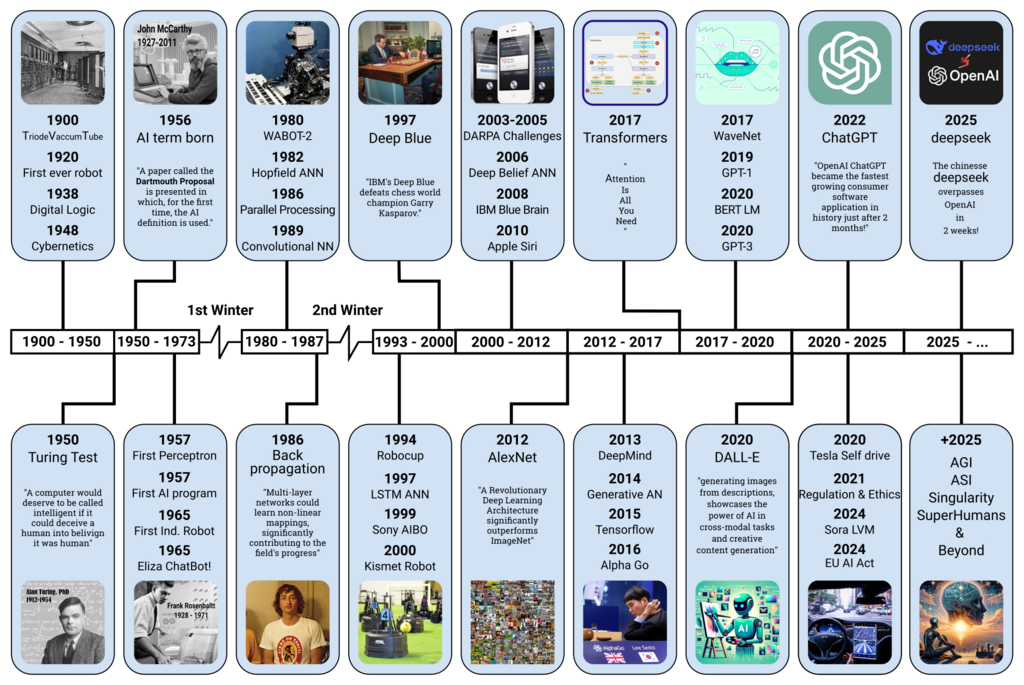
The idea of machines that create isn't new, but the technology has evolved dramatically over the decades. Early generative models in the 1950s and 60s were rule-based and produced simple, repetitive outputs like Eliza, a chatbot that could simulate a conversation.
Progress was slow until the rise of neural networks and deep learning in the 2010s. This is when things really took off. Key milestones include the development of Variational Autoencoders (VAEs) and Generative Adversarial Networks (GANs) around 2014. GANs, in particular, were a breakthrough. They use two neural networks—a generator and a discriminator—that compete against each other to produce increasingly realistic outputs.
More recently, transformer models, originally developed for language processing, have become the foundation for today's most powerful large language models (LLMs) like ChatGPT. These models can generate remarkably coherent and creative text, code, and more, pushing the boundaries of what we thought machines could do.
Core Principles
At its heart, generative AI operates on a simple but powerful principle: learning a probability distribution. That sounds technical, but the idea is straightforward. By looking at a huge dataset, the model learns how likely certain patterns are. For example, in English text, it learns that the letter 'q' is almost always followed by 'u'. In images of faces, it learns that eyes typically appear above a nose.
Once it understands these complex statistical relationships, it can sample from that learned distribution to create new artifacts. It's essentially making a series of highly educated guesses, one after another, to build a coherent output. Whether it's adding the next word to a sentence or the next pixel to an image, the model is always asking, "Given everything so far, what's the most probable thing to add next?"
The foundational idea behind generative AI is to learn the underlying patterns and structure of a given dataset to generate similar, but unique, outputs.
This ability to model the world and create from that model is what makes generative AI so versatile. It's a foundational shift in artificial intelligence, moving from systems that understand to systems that also create.
Ready to check your understanding?
What is the primary function of generative AI?
A bank uses an AI model to analyze transaction data and answer the question, "Is this transaction fraudulent or not?" What type of AI is this?
This is just the beginning. Understanding these fundamentals prepares you to explore the specific models and applications that make generative AI one of today's most exciting fields.