Introduction to Gas Chromatography-Mass Spectrometry
Introduction to Chromatography
Separating Mixtures
Most things in the world are mixtures. The air we breathe is a mix of nitrogen, oxygen, and other gases. The ink in a pen is a blend of different colored dyes. To understand what something is made of, chemists often need to take these mixtures apart. This process of separating a mixture into its individual components is a core task in chemistry, and one of the most powerful tools for the job is chromatography.
Chromatography is the separation of a mixture into individual components.
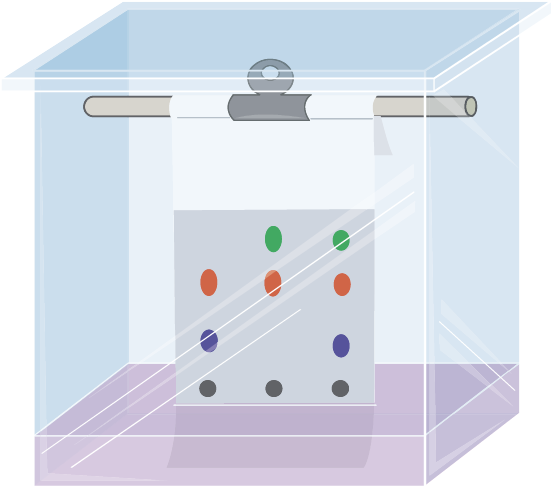
Imagine you put a dot of black ink on a strip of paper towel and then dip the bottom edge of the paper into water. As the water creeps up the paper, you’ll see the single black dot separate into a rainbow of different colors. This is chromatography in action. You've just separated the mixture (black ink) into its parts (the different colored dyes).
The Two Phases
Every form of chromatography involves two key players: a stationary phase and a mobile phase. These are just what they sound like.
The stationary phase doesn't move. In our paper towel experiment, the stationary phase is the paper itself. It's the physical medium that the separation occurs on or in.
The mobile phase does move. It's a fluid (a liquid or a gas) that flows through or over the stationary phase, carrying the mixture with it. In our experiment, the water was the mobile phase.
The entire process works because the different components in the mixture have different levels of attraction to the mobile and stationary phases.
Think of it like a race. All the components start at the same line. The mobile phase is the force pushing all the racers forward. The stationary phase is like a sticky track. Some racers (components) are barely slowed down by the stickiness and travel quickly with the mobile phase. Others get stuck more often, so they move along the track much more slowly.
Because of these different speeds, the components spread out over time. The fastest ones reach the finish line first, while the slowest ones lag far behind. This difference in travel time is what separates them.
Different Tools for Different Jobs
Chemists have developed many types of chromatography by swapping out the mobile and stationary phases. This allows them to separate a huge variety of mixtures, from simple dyes to complex proteins.
The name of the technique often tells you what kind of mobile phase is used.
| Technique | Mobile Phase | Stationary Phase | Common Use |
|---|---|---|---|
| Paper Chromatography | Liquid | Solid (Cellulose paper) | Separating pigments |
| Thin-Layer Chromatography (TLC) | Liquid | Solid (Silica gel on a plate) | Monitoring reaction progress |
| Liquid Chromatography (LC) | Liquid | Solid (Packed in a column) | Pharmaceutical analysis |
| Gas Chromatography (GC) | Gas | Liquid or Solid (Coating a column) | Analyzing volatile samples |
As you can see, the phases can be solids, liquids, or gases. The choice depends entirely on the chemical and physical properties of the mixture you want to separate.
A Closer Look at Gas Chromatography
Gas Chromatography, or GC, is a powerful technique used for separating and analyzing substances that can be turned into a gas without breaking down. This makes it perfect for analyzing things with distinct smells, like perfumes, essential oils, or air pollutants.
In GC, the mobile phase is a gas, and the stationary phase is a very thin layer of liquid inside a long, coiled tube.
Here's how it works:
- A tiny sample of the liquid mixture is injected into the machine, where it's rapidly heated and vaporized into a gas.
- This gas mixture is then pushed by an inert carrier gas (the mobile phase, usually helium or nitrogen) into a long, thin, coiled tube called a column.
- The inside of the column is coated with the stationary phase. As the gas mixture travels through the column, its components separate based on their boiling points and how they interact with this coating.
- Components with lower boiling points that don't interact much with the coating travel through the column quickly. Components with higher boiling points that tend to "stick" to the coating move much more slowly.
By the time the components exit the other end of the column, they are completely separated. A detector records when each component comes out, allowing chemists to identify and quantify the ingredients of the original mixture.
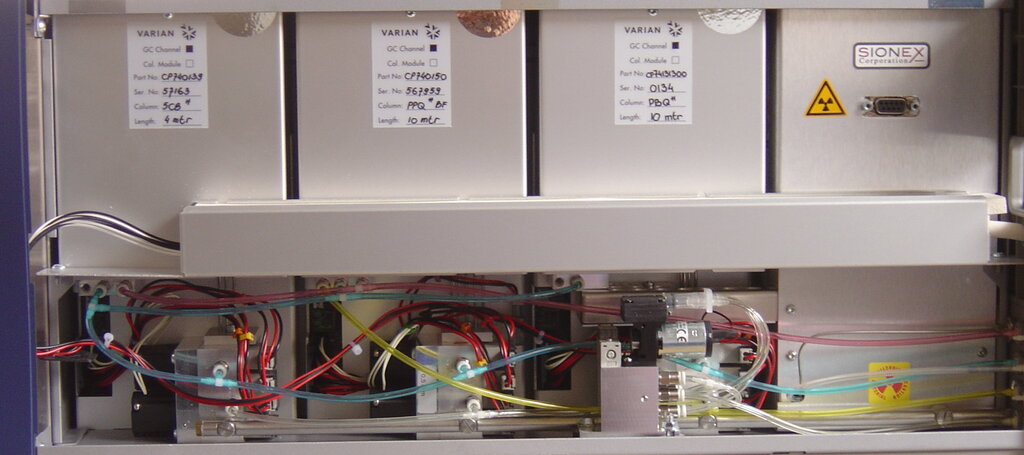
This fundamental principle of separating components based on their journey through a stationary phase is the heart of all chromatography.