Introduction to Game Theory
Introduction to Game Theory
What Is a Game?
Life is full of situations where the outcome of your choice depends on the choice of someone else. Deciding whether to lower the price of a product, making a move in chess, or even choosing which route to take in traffic are all strategic interactions. Game theory is the tool we use to study these scenarios.
Game theory is the study of strategic decision-making in situations where the outcome depends on the choices of multiple players.
In this context, a "game" isn't just about entertainment. It's any situation involving two or more decision-makers where each person's payoff is affected by the decisions of others. To analyze a game, we first need to break it down into its essential parts.
The Core Components
Every game, whether it's a simple coin toss or a complex business negotiation, has three fundamental components.
Players
noun
The decision-makers in a game. A player can be an individual, a company, a country, or any entity that makes a choice.
Next, each player has a set of possible moves they can make. This is their strategy.
Strategy
noun
A complete plan of action a player will take, given the set of circumstances that might arise within the game.
Finally, every combination of strategies from all players results in an outcome. The value each player gets from that outcome is called the payoff.
Payoffs don't have to be money. They can be anything a player values, like winning, gaining market share, or even just personal satisfaction.
The Rules of Engagement
Game theory relies on a couple of key assumptions to make predictions. The first is that players are rational.
A rational player is simply one who chooses the action that gives them the best possible payoff. They are logical, self-interested, and consistent in their choices.
The second assumption is that of common knowledge. This means that all players know the rules of the game (the players, strategies, and payoffs). But it goes deeper. Each player also knows that all the other players know the rules, and they know that the other players know that they know the rules, and so on, infinitely.
Think of it like two friends agreeing to meet at a famous landmark. For the meeting to work, you have to know the location. You also have to know that your friend knows the location. And your friend has to know that you know they know. Without this shared understanding, the plan could easily fall apart.
The Prisoner's Dilemma
One of the most famous examples in game theory is the Prisoner's Dilemma. It beautifully illustrates the conflict between individual rationality and group benefit.
Imagine two partners in crime are arrested and held in separate interrogation rooms. They can't communicate. The prosecutor offers each of them the same deal:
- If you confess and your partner stays silent, you go free, and your partner gets 10 years in prison.
- If you both stay silent, you both get a minor charge of 1 year.
- If you both confess, you both get 5 years.
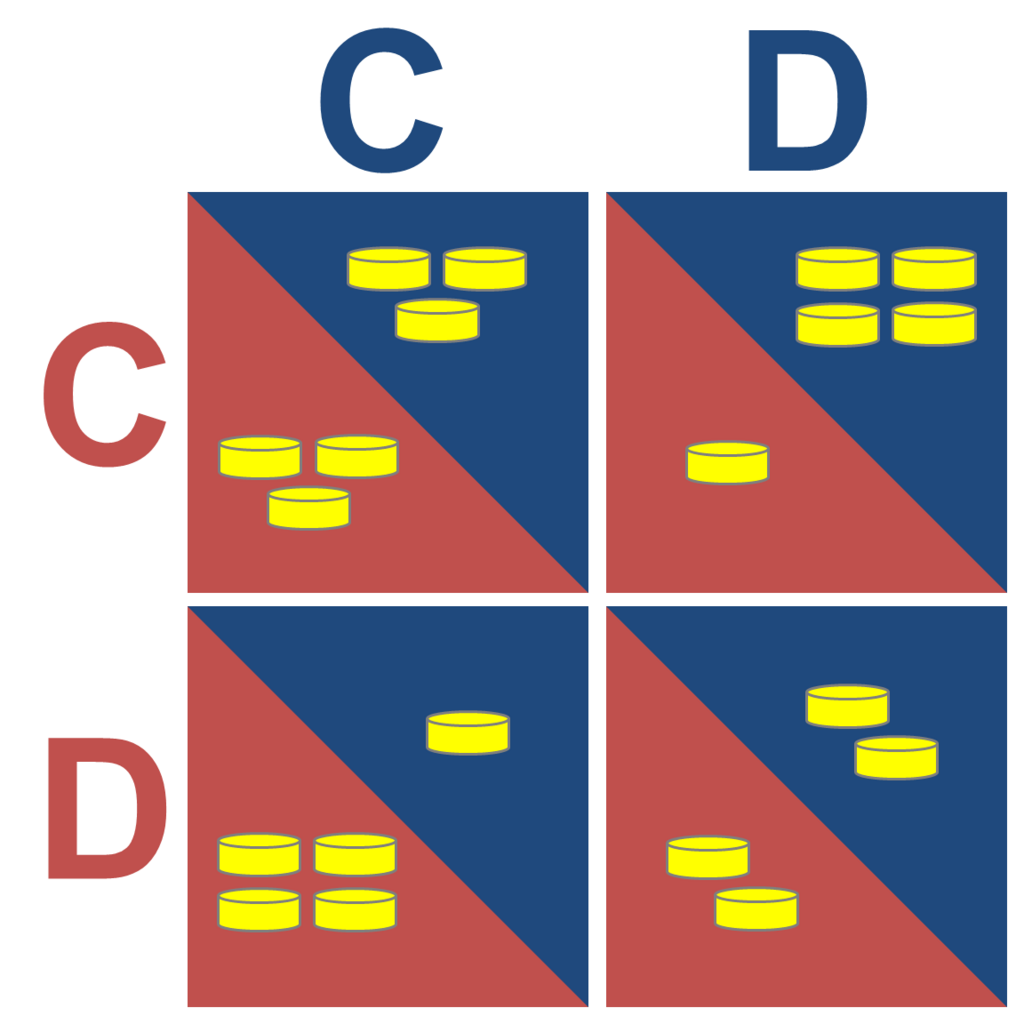
Let's look at this from Prisoner A's perspective. She doesn't know what Prisoner B will do.
- "If B stays silent, my best move is to confess (0 years is better than 1 year)."
- "If B confesses, my best move is still to confess (5 years is better than 10 years)."
No matter what her partner does, confessing seems to be her best personal choice. Prisoner B reasons the exact same way. So, two rational players will both confess and end up with 5 years each. The dilemma is that if they had both stayed silent (cooperated), they would have only served 1 year each, a much better outcome for the group.
This simple game highlights a fundamental tension. The pursuit of individual self-interest can lead to a result where everyone is worse off.