Introduction to Fluid Dynamics
Fluid Properties
What Makes a Fluid?
Anything that can flow is a fluid. This simple definition includes both liquids and gases. While they seem very different, they share this key ability to change shape and move to fill containers. A solid, like a block of wood, keeps its shape no matter where you put it.
The main difference between liquids and gases comes down to volume. A liquid has a fixed volume. If you pour one liter of water from a bottle into a bowl, it's still one liter of water. It just takes the shape of the bowl. A gas, on the other hand, has no fixed volume. It will expand to fill any container you put it in, no matter how large.
Think of it this way: a liquid fills the bottom of its container, while a gas fills the entire container.
Density and Heft
Imagine holding a small block of wood in one hand and a block of steel of the exact same size in the other. The steel block feels much heavier. This is because steel is denser than wood. Density is simply the amount of mass packed into a certain volume.
Density
noun
The mass of a substance per unit of volume. It's a measure of how tightly packed the matter is.
We calculate density () by dividing mass () by volume ():
To make comparing densities easier, scientists often use specific gravity. This is a ratio that compares a substance's density to the density of water. Since it's a ratio, it has no units. Water has a specific gravity of exactly 1. If a fluid has a specific gravity of 2, it means it's twice as dense as water. If its specific gravity is 0.5, it's half as dense.
| Substance | Density (kg/m³) | Specific Gravity |
|---|---|---|
| Water | 1000 | 1.0 |
| Gasoline | 737 | 0.74 |
| Mercury | 13600 | 13.6 |
| Air (at sea level) | 1.225 | 0.0012 |
How Fluids Flow
Think about pouring honey and then pouring water. The honey flows slowly and seems thick, while the water flows quickly and easily. This property, a fluid's resistance to flowing, is called viscosity.
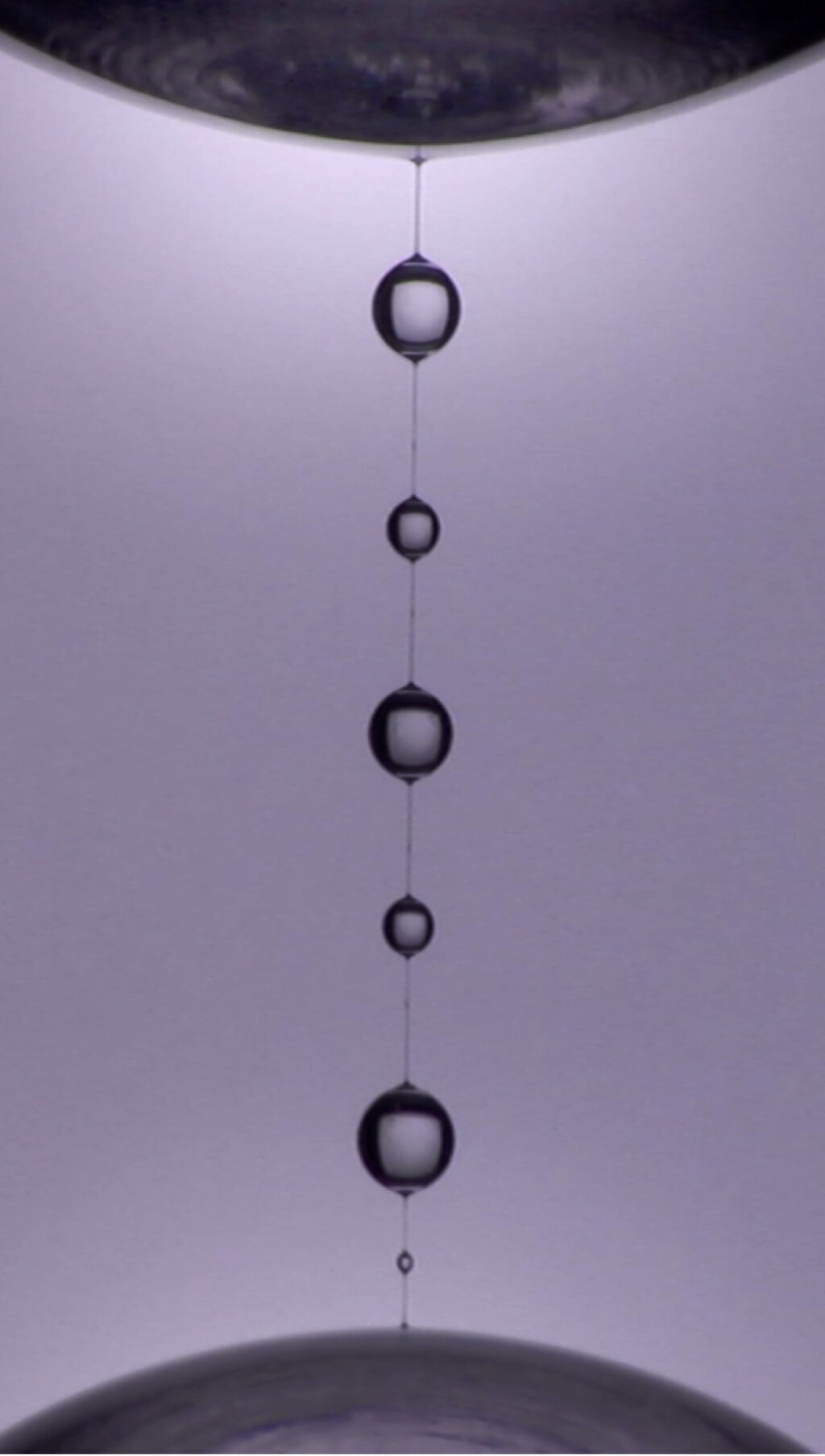
Viscosity is essentially a measure of a fluid's internal friction. In a high-viscosity fluid like honey, the molecules cling together tightly, making it harder for them to slide past one another. In a low-viscosity fluid like water, the molecules move more freely.
Temperature has a big effect on viscosity. Warming up honey makes it much runnier and easier to pour. This is because the heat gives the molecules more energy, allowing them to overcome the forces holding them together. The opposite is true for most gases; they become more viscous as they get hotter.
The Skin of a Liquid
Have you ever seen a water strider insect dart across the surface of a pond? It's not magic, it's surface tension. The molecules within a liquid are pulled equally in all directions by their neighbors. But at the surface, there are no molecules above them, so they are pulled inward by the molecules below and beside them. This inward pull creates a tight, elastic-like film on the surface.

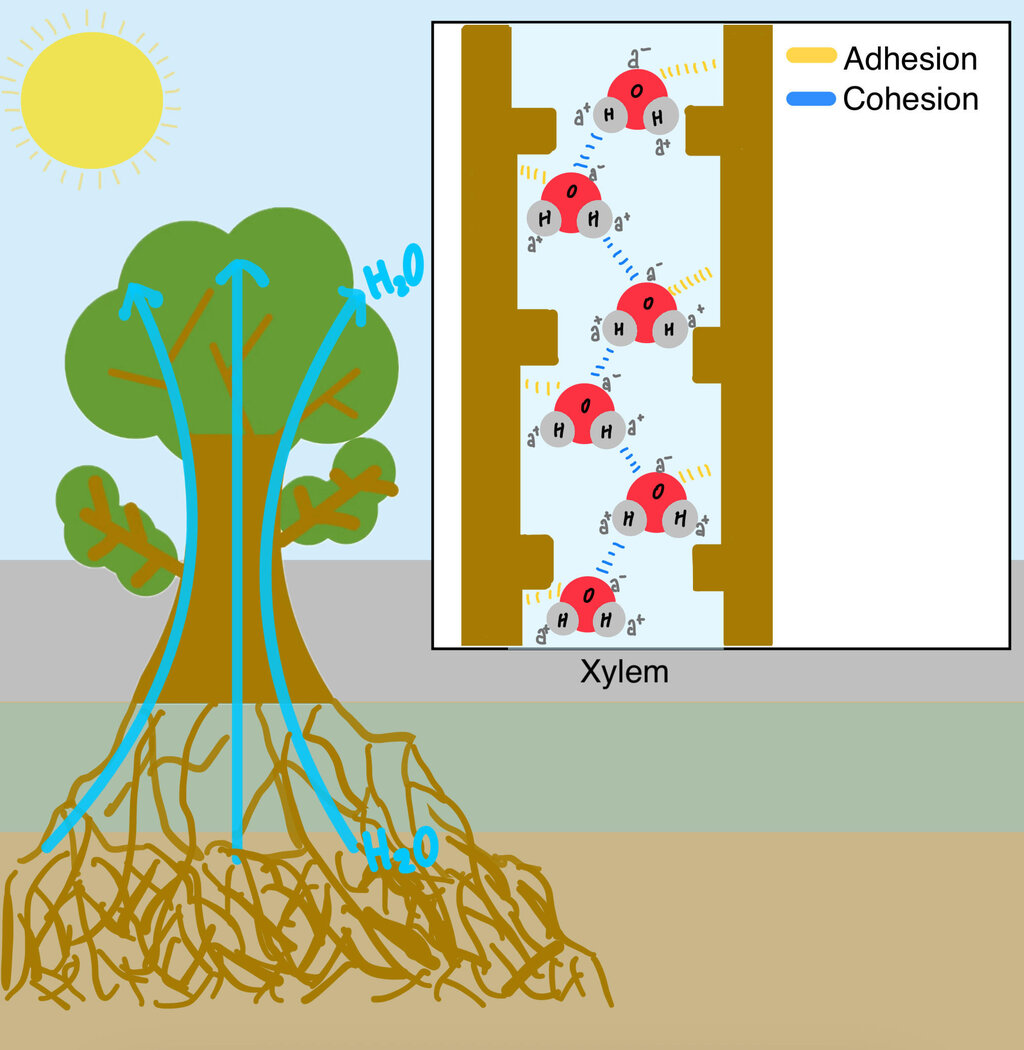
This same force is responsible for a phenomenon called capillarity, or capillary action. This is the ability of a liquid to flow in narrow spaces without the help of, or even in opposition to, external forces like gravity. It happens because of the attraction between the liquid's molecules and the molecules of the solid surface.
This is how plants pull water from the ground up to their leaves and how a paper towel soaks up a spill.
Squeezing Fluids
Compressibility measures how much a fluid's volume changes when pressure is applied. Imagine trying to squeeze a sealed water bottle—it barely gives. Now think about squeezing an inflated balloon—it's easy to compress.
Gases are highly compressible because their molecules are far apart, leaving plenty of empty space to squeeze them into. Liquids, on the other hand, are considered nearly incompressible. Their molecules are already packed closely together, so it takes an enormous amount of pressure to reduce their volume even slightly.
To quantify this, we use the bulk modulus (). It's a measure of a substance's resistance to being compressed. A higher bulk modulus means a substance is harder to compress. Liquids have a very high bulk modulus, while gases have a very low one.
For most everyday calculations, engineers treat liquids as if they are perfectly incompressible. This simplifies the math without creating significant errors.
Understanding these core properties—density, viscosity, surface tension, and compressibility—is the first step in analyzing how fluids behave, whether they're flowing through a pipe, supporting a ship, or moving through the atmosphere.