Introduction to Financial Modeling
Introduction to Financial Modeling
What Is a Financial Model?
A financial model is a tool that shows how a business might perform financially in the future. Think of it as a financial blueprint. It's usually built in a spreadsheet and uses a company's historical data along with a set of assumptions to project future income, expenses, and cash flow.
Its main purpose is to turn a business strategy into numbers. By doing this, leaders can test ideas, understand potential outcomes, and make more informed decisions without risking real money. It helps answer critical questions like, "Can we afford to hire new staff?" or "What happens to our profit if sales increase by 20%?"
In short, a financial model is a summary of a company's financial story, connecting its past, present, and projected future.
A Tool for Big Decisions
Financial models are not just for accountants. They are vital instruments for strategic decision-making across an entire organization. Entrepreneurs use them to pitch to investors, showing the potential of their business and how they plan to grow.
Managers rely on them for budgeting and forecasting, helping to allocate resources effectively and set realistic performance targets. When a company considers buying another business or launching a new product, a financial model is used to calculate the potential return on investment and assess the risks involved. It allows for scenario planning, where you can compare the financial impact of different choices, like a conservative plan versus an aggressive growth strategy.
Financial models aren’t just sheets of spreadsheets stuffed with formulas, they are instruments for strategic decision-making that are used by investors, management as well as analysts.
The Building Blocks
Every financial model, whether simple or complex, is built from three core components. Understanding these parts helps demystify how they work.
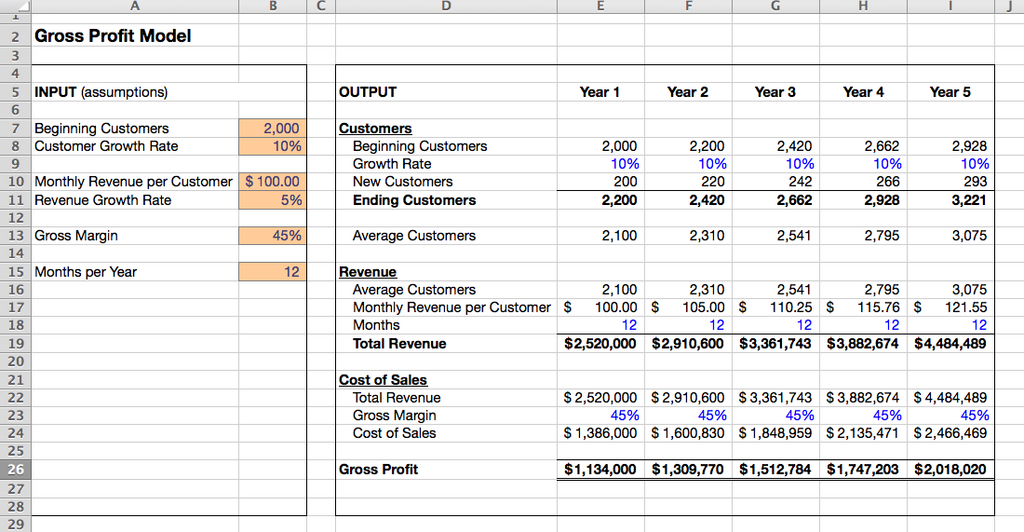
1. Assumptions (Inputs) These are the variables and starting points that drive the model's projections. Assumptions can include things like the expected sales growth rate, the cost of raw materials, or the number of new customers per month. The quality and thoughtfulness of these inputs are crucial; a model is only as reliable as its assumptions.
2. Calculations (The Engine) This is the core logic of the model. It's the web of formulas that connect the inputs to the outputs. This engine takes the assumptions and processes them to generate the financial projections. For example, it might calculate future revenue by multiplying the assumed number of customers by the assumed price per product.
3. Outputs (The Story) The outputs are the results of the model. They tell the financial story of the business based on the inputs and calculations. Typically, the primary outputs are the three core financial statements: the Income Statement (showing profitability), the Balance Sheet (showing financial position), and the Cash Flow Statement (showing cash movements).
What is the primary purpose of a financial model?
A financial model's projections are only as reliable as its ______.