Introduction to Fiber Optics
Nature of Light
A Particle and a Wave
For centuries, scientists debated a fundamental question: is light a stream of tiny particles or a continuous wave? The answer, strangely enough, is both. Light has a dual nature, behaving like a particle in some situations and a wave in others. This idea is called wave-particle duality, and it's one of the cornerstones of modern physics.
Imagine throwing pebbles into a pond. They create ripples, or waves, that spread out. Now imagine throwing tiny marbles at a wall. They hit as individual particles. Light does both.
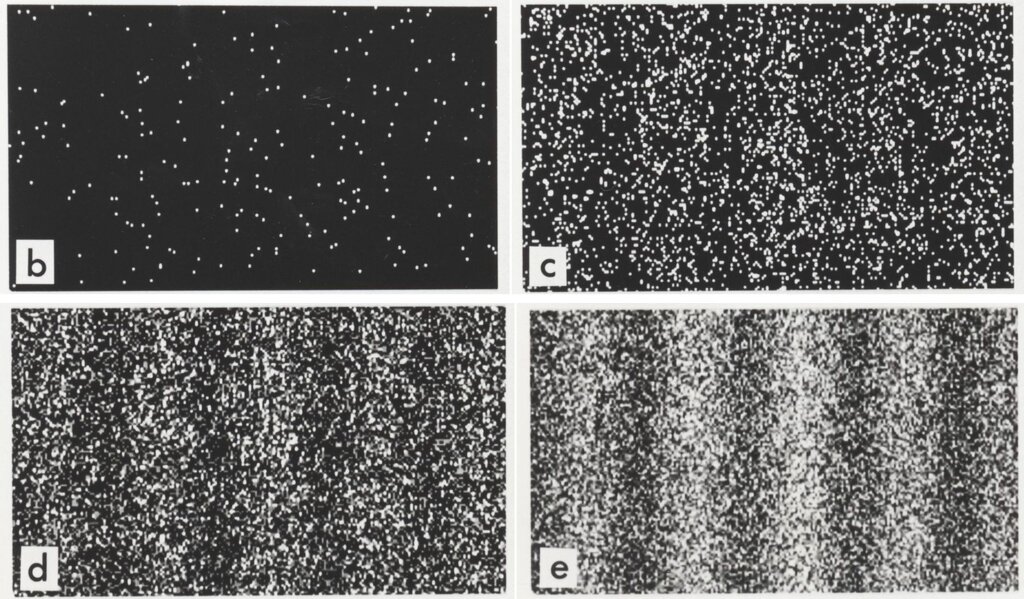
The most famous demonstration of this is the double-slit experiment. When a beam of light is shone through two narrow, parallel slits, it doesn't just create two bright lines on a screen behind them. Instead, it creates a pattern of many bright and dark bands. This interference pattern can only be explained if light acts as a wave, with the ripples from each slit interacting with each other.
But here's the strange part. If you send light particles, called photons, through the slits one at a time, each photon still lands on the screen as a single dot, like a particle. Yet, over time, these individual dots build up to form the very same wave-like interference pattern. It's as if each particle knows the path it's supposed to take to contribute to the overall wave pattern.
Photon
noun
A quantum, or the smallest discrete amount, of electromagnetic radiation. It is the basic unit of light.
Describing the Wave
When we think of light as a wave, two key properties help us describe it: wavelength and frequency. Wavelength is the distance between two consecutive peaks of the wave. Think of it as the length of one complete ripple in the pond.
Frequency is the number of waves that pass a given point in a certain amount of time. A wave with a high frequency has peaks that are close together and pass by quickly, while a low-frequency wave has peaks that are spread out and pass by more slowly.
Wavelength and frequency are inversely related. If a wave has a long wavelength, it must have a low frequency, and vice versa. Their product always equals the speed of light, a constant represented by the letter .
The Full Spectrum
The light our eyes can see is just a tiny sliver of a much broader range of light called the electromagnetic spectrum. This spectrum includes all types of electromagnetic radiation, organized by wavelength and frequency.
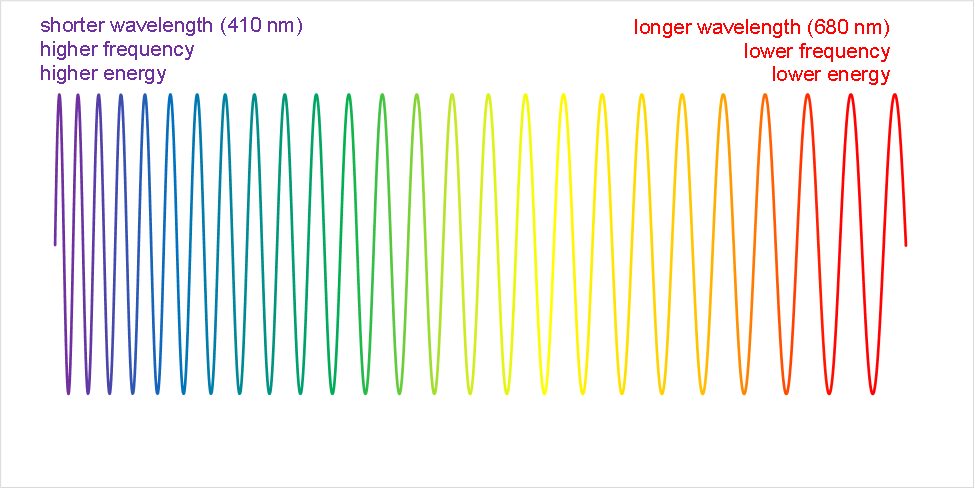
On one end of the spectrum, we have long-wavelength, low-frequency waves like radio waves, which carry signals to your car stereo, and microwaves, which heat your food. As we move up the spectrum, we pass through infrared, the visible light we see, and ultraviolet (UV) light, which gives us sunburns.
At the far end are the shortest-wavelength, highest-frequency waves: X-rays, used in medical imaging, and gamma rays, which are the most energetic of all. While they seem different, all these are forms of light, traveling at the same speed and exhibiting the same dual nature.
Understanding these basic properties of light—its duality, its wave characteristics, and its place in the electromagnetic spectrum—is the first step toward understanding how we can harness it for technologies like fiber optics.