Introduction to Emergency Medical Services
Introduction to EMS
The Front Line of Medicine
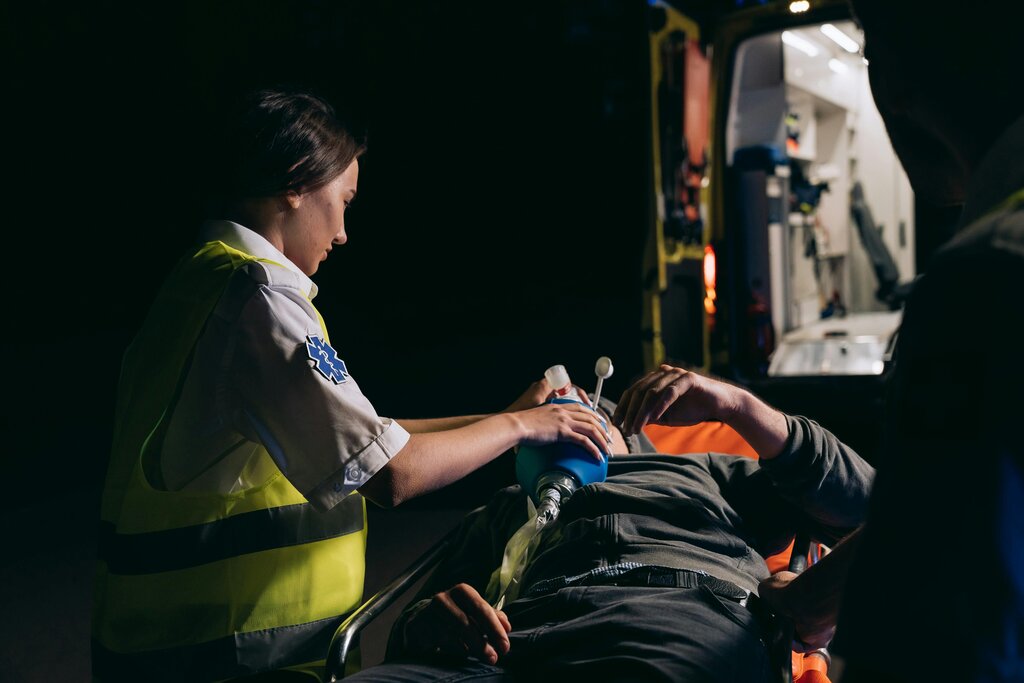
When you call for help in a medical emergency, a complex system springs into action. This is Emergency Medical Services, or EMS. It’s more than just an ambulance ride; it's a network of trained professionals who provide immediate medical care wherever it's needed—on the street, in a home, or at the scene of an accident.
Think of EMS as the crucial link between a sudden medical crisis and the definitive care of a hospital. These responders are trained to make quick, life-saving decisions under pressure, stabilizing patients and starting treatment long before they reach an emergency room.
From Battlefields to Highways
The idea of organized emergency care isn't new. Its roots trace back to the battlefields of the Napoleonic Wars, where horse-drawn “flying ambulances” first rushed wounded soldiers from the front lines. For centuries, this model of rapid transport was mostly confined to the military.
Civilian emergency care was inconsistent. In many places, the local funeral home's hearse was the only vehicle available to transport the sick and injured. Little to no medical care was provided en route.
The turning point for modern EMS in the United States came in 1966 with a landmark report titled Accidental Death and Disability: The Neglected Disease of Modern Society. This paper revealed a shocking truth: a person seriously injured in a car crash had a better chance of survival on a battlefield in Vietnam than on a typical American highway. It highlighted the lack of standards, training, and equipment for emergency care and spurred the federal government to create the organized EMS systems we have today.
How the EMS System Works
A modern EMS system is a carefully coordinated sequence of events, designed to get the right care to the patient as quickly as possible. It all starts with a single call.
This chain of survival ensures that care begins immediately, often with pre-arrival instructions from the dispatcher, and continues seamlessly until the patient is in the hands of doctors and nurses.
Levels of Care
Not all ambulance calls are the same, and neither are all EMS providers. They are trained to different levels, allowing for a tiered response that matches the provider's skills to the patient's needs. The two main categories are Basic Life Support (BLS) and Advanced Life Support (ALS).
| Level | Focus | Common Skills |
|---|---|---|
| Basic Life Support (BLS) | Non-invasive care | CPR, bleeding control, splinting, oxygen administration |
| Advanced Life Support (ALS) | Invasive & complex care | IV therapy, medication administration, advanced airway management, heart rhythm analysis |
Emergency Medical Technicians (EMTs) are the backbone of the EMS system, providing BLS care. Paramedics have more extensive training, allowing them to perform ALS skills. This structure allows EMS systems to send the most appropriate level of care for each emergency.
Patient assessment is an EMS skill, and serves as the foundation for all treatment decisionsToo many times new basic life support providers — and even seasoned EMTs frequently working with advanced life support providers as partners — eventually get complacent with ALS providers always performing the patient assessments.
Ethics and Neutrality
Beyond technical skills, EMS operates on a strong ethical foundation. A core principle is medical neutrality. This means care is provided based solely on medical need, without regard to a patient's race, religion, nationality, or any other factor. An EMS provider has a duty to treat a patient in police custody with the same dedication as the officer who was injured arresting them.
The guiding principle is simple: treat the patient, not the circumstance. Every person in need of medical care is entitled to receive it with compassion and professionalism.
This commitment ensures that EMS remains a trusted and impartial part of the healthcare continuum, focused entirely on patient outcomes. It's a critical role that forms the bridge from crisis to recovery.
Ready to check your understanding?
What landmark 1966 report exposed major deficiencies in civilian emergency care in the United States, leading to the development of modern EMS systems?
The core principle of medical neutrality means that EMS providers base their care decisions solely on...
EMS is a dynamic field that serves as the entry point to the healthcare system for millions of people each year. Understanding its structure and principles is the first step in appreciating its vital role in public health and safety.