Introduction to Electrostatics
Electric Charge
The World of Electric Charge
Everything you see is made of atoms. At the heart of these atoms are even smaller particles. Two of the most important are protons and electrons. These tiny particles carry a fundamental property of nature called electric charge.
Think of charge as coming in two 'flavours': positive and negative. Protons have a positive charge, and electrons have a negative charge. In most objects, the number of protons and electrons is perfectly balanced. This makes the object electrically neutral, with no overall charge.
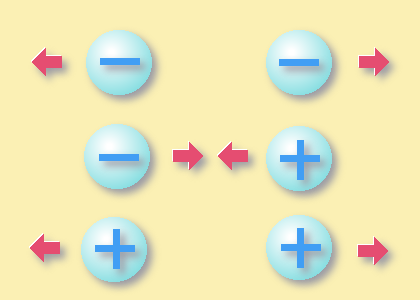
A simple rule governs how these charges interact: like charges repel, and opposite charges attract.
Creating a Spark
So how does an object become charged? It happens when the balance between protons and electrons is upset. The easiest way to do this is by rubbing two objects together. This process is called charging by friction.
When you rub a balloon on your hair, for example, some electrons from your hair jump over to the balloon. Your hair now has more protons than electrons, giving it a net positive charge. The balloon has gained extra electrons and now has a net negative charge. Because opposite charges attract, the balloon will stick to a neutral surface like a wall, and your hair might stand on end!
electron
noun
A stable subatomic particle with a negative electric charge. Electrons are found in all atoms and act as the primary carrier of electricity in solids.
Measuring and Conserving Charge
Just as we measure mass in kilograms, we measure charge in a unit called the Coulomb (C). A single proton or electron has a very tiny charge. It takes about 6.24 quintillion (a million million million) electrons to make up just one Coulomb of negative charge. In day-to-day life, we usually deal with much smaller amounts of charge.
An important rule in physics is the law of conservation of charge. It states that you can't create or destroy charge, only move it from one place to another. When you charged the balloon, no new electrons were made. They simply moved from your hair to the balloon. The total amount of charge between you and the balloon stayed the same.
Charge is not created or destroyed, only transferred.
There's one more key idea: charge is quantised. This means charge comes in discrete, indivisible units. The smallest unit of charge that can exist freely is the charge of a single electron or proton, known as the elementary charge, denoted by the symbol . Any amount of charge you find on an object will always be a whole-number multiple of this basic unit.
You can have a charge of or , but you can never have a charge of . Charge always comes in these whole-number steps.
What are the respective charges of a proton and an electron?
If you rub a balloon on your hair and the balloon gains electrons, what is the resulting charge of your hair?
You've just taken the first step into the world of electrostatics. Understanding these basic properties of charge is the foundation for everything that follows.