Introduction to Electronics
Electricity Basics
The Language of Circuits
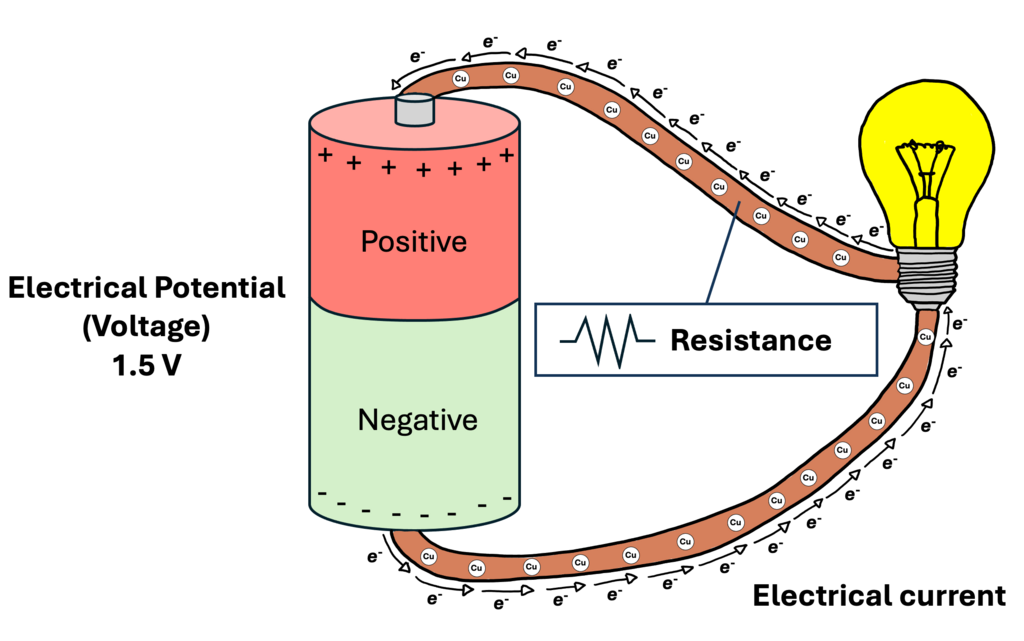
At its heart, electricity is about the movement of tiny charged particles called electrons. To control this movement and make it do useful things, like power a phone or light up a room, we need to understand a few key concepts. Think of electricity flowing through a wire like water flowing through a pipe.
Voltage
noun
The pressure or force that pushes electric charge through a circuit. It's the potential difference between two points.
Voltage, measured in volts (V), is like the water pressure in the pipe. Higher pressure means more force pushing the water along. In an electrical circuit, a battery or a power outlet provides the voltage.
Current
noun
The rate at which electric charge flows past a point in a circuit.
Current, measured in amperes or amps (A), is like the flow rate of the water. It's the amount of charge passing a point per second. More current means more electrons are flowing.
Resistance
noun
A measure of the opposition to current flow in an electrical circuit.
Resistance, measured in ohms (Ω), is like a narrowing in the pipe that restricts the water flow. Components called resistors are designed to have a specific amount of resistance. Everything in a circuit, including the wires themselves, has some resistance.
Ohm's Law
These three concepts—voltage, current, and resistance—are tied together by a fundamental rule called Ohm's Law. It states that the current flowing through a conductor is directly proportional to the voltage across it, as long as the temperature and other physical conditions remain unchanged.
This simple relationship is the key to analyzing most circuits.
Here, is voltage, is current, and is resistance. If you know any two of these values, you can find the third. For example, if a 12V car battery is connected to a headlight with a resistance of 3Ω, we can calculate the current:
A higher voltage pushes more current. A higher resistance allows less current to flow.
Power and Circuits
While voltage, current, and resistance describe the state of a circuit, power describes how quickly it does work. Electrical power is the rate at which electrical energy is converted into another form, such as light, heat, or motion. Power () is measured in watts (W).
By combining this with Ohm's Law, we can also express power in terms of resistance:
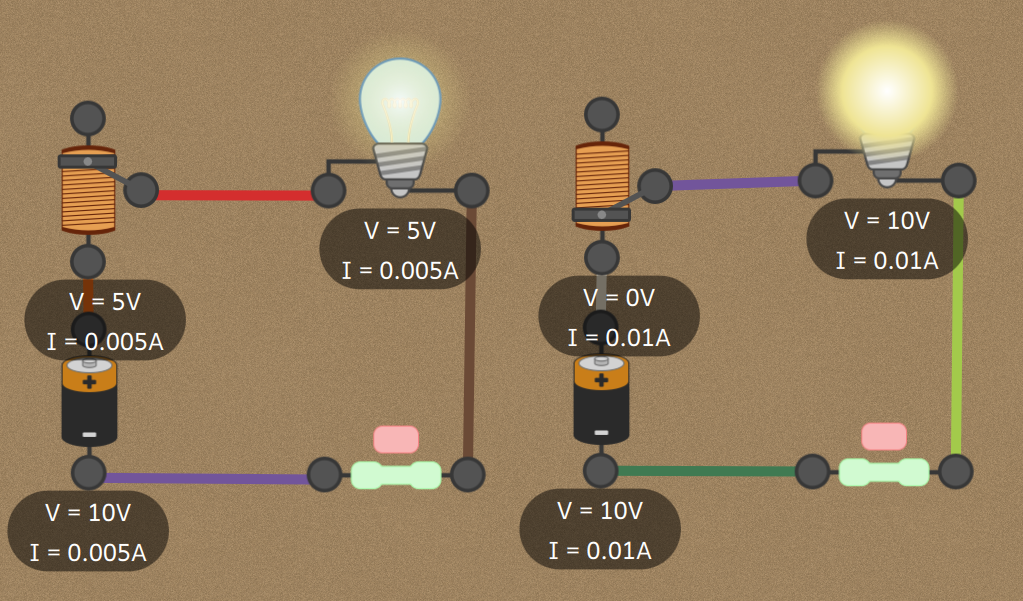
Circuits are paths for current to flow. The two basic ways to connect components are in series or in parallel.
In a series circuit, components are connected end-to-end, forming a single path for the current. The same current flows through every component. The total resistance is the sum of all individual resistances ().
In a parallel circuit, components are connected across the same two points, creating multiple paths for the current. The voltage across each component is the same. The total resistance is found using the formula .
Kirchhoff's Laws
For more complex circuits, we need two more rules, known as Kirchhoff's Laws. They help us track how current and voltage behave throughout a circuit.
Kirchhoff's Current Law (KCL): The total current entering a junction (or node) must equal the total current leaving it. This is a statement of the conservation of charge—no charge is lost at a junction.
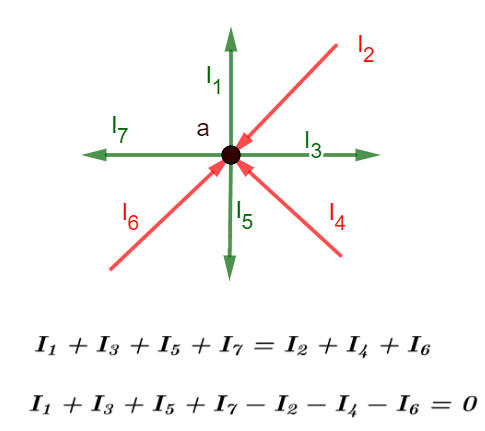
Imagine pipes of water meeting at an intersection. The total amount of water flowing in must equal the total amount flowing out.
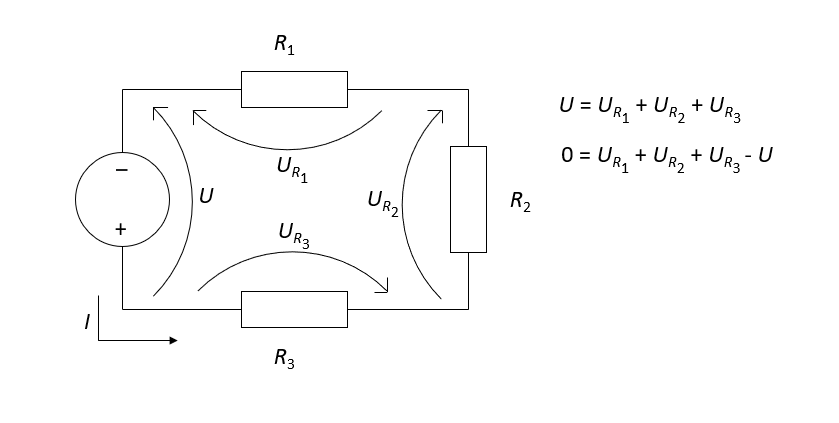
Kirchhoff's Voltage Law (KVL): The sum of all voltage drops and voltage gains around any closed loop in a circuit must be zero. This is a statement of the conservation of energy.
Think of it like walking around a mountain and returning to your starting point. The sum of your climbs (voltage gains from a battery) and descents (voltage drops across resistors) must equal zero, because you ended up at the same elevation where you started.
These foundational concepts—voltage, current, resistance, power, and the laws of Ohm and Kirchhoff—are the essential tools for understanding and working with any electrical circuit.
In the common analogy comparing electricity to water flowing through a pipe, what does electrical current (amperes) represent?
According to Ohm's Law, if you keep the resistance in a circuit constant, what happens to the current when you double the voltage?