Introduction to Electronics
Electricity Basics
The Flow of Electricity
Think of electricity flowing through a wire like water flowing in a river. This simple analogy helps make the core concepts of electricity intuitive. The amount of water flowing past a point is the current, the slope of the riverbed pushing the water along is the voltage, and the rocks and narrow passages that slow the water down are the resistance.
Current
noun
The rate at which electric charge flows past a point in a circuit.
Current is measured in amperes, or amps (A) for short. If one amp is flowing through a wire, it means a specific, large number of electrons are zooming past a single point every second. A tiny LED might use a fraction of an amp, while an electric stove can draw over 40 amps.
Voltage
noun
The pressure from an electrical circuit's power source that pushes charged electrons (current) through a conducting loop.
Voltage, also called potential difference, is measured in volts (V). It’s the driving force. Without voltage, current won't flow, just as water won't flow on a perfectly flat surface. A higher voltage provides a bigger "push" to the electrons in a circuit.
Resistance
noun
A measure of the opposition to current flow in an electrical circuit.
Resistance is measured in ohms (Ω). Every component in a circuit, including the wires themselves, has some resistance. Materials like rubber have very high resistance, which is why they are used as insulators. Materials like copper have very low resistance, making them great conductors. Resistors are components specifically designed to add a precise amount of resistance to a circuit, giving us control over the flow of current.
Ohm's Law
Voltage, current, and resistance aren't independent. They are linked by a fundamental relationship discovered by Georg Ohm in the 1820s. This relationship, known as Ohm's Law, is one of the most important principles in electronics.
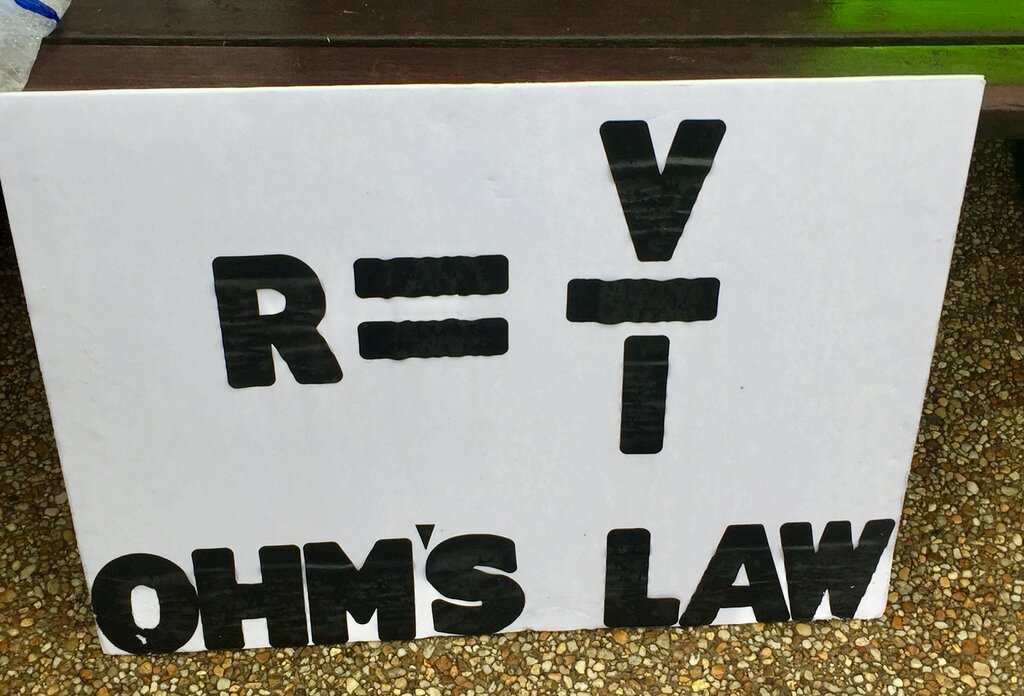
Ohm's Law states that the voltage across a conductor is directly proportional to the current flowing through it, provided the temperature and other physical conditions remain unchanged. The constant of proportionality is the resistance.
In simple terms: Voltage = Current × Resistance
Here, is voltage, is current, and is resistance. This simple equation is incredibly powerful. If you know any two of the values, you can calculate the third. For example, if you connect a 1000 Ω resistor to a 9-volt battery, you can find the current that will flow.
This means 0.009 amps, or 9 milliamps (mA), will flow through the resistor. If you were to swap in a resistor with a higher value, less current would flow. If you used a battery with a higher voltage, more current would flow. Ohm's law gives us a predictable way to control the flow of electricity.
Electrical Power
There's one more key concept: power. Power is the rate at which electrical energy is transferred or used in a circuit. Going back to our river analogy, power is like the ability of the flowing water to do work, such as turning a water wheel.
Power
noun
The rate, per unit time, at which electrical energy is transferred by an electric circuit.
Electrical power is measured in watts (W). It's calculated by multiplying voltage and current. A device that uses high voltage and high current consumes a lot of power.
Here, is power, is voltage, and is current. Let's look at our previous example with the 9V battery and 1000 Ω resistor, where we found the current was 0.009 A. The power dissipated by the resistor as heat would be:
This is a very small amount of power. An electric kettle, on the other hand, might use 120 V and draw 10 A of current, consuming 1200 W of power to heat water quickly.
Ready to test your knowledge on these fundamental concepts?
In the analogy comparing electricity to a river, what does electrical resistance represent?
A circuit has a voltage of 12V and a current of 3A. What is the resistance of the circuit?
Understanding voltage, current, resistance, and power is the first step into the world of electronics. With these concepts and Ohm's law, you have the foundational tools to analyze simple circuits.