Introduction to Electronics
Electricity Basics
The Language of Circuits
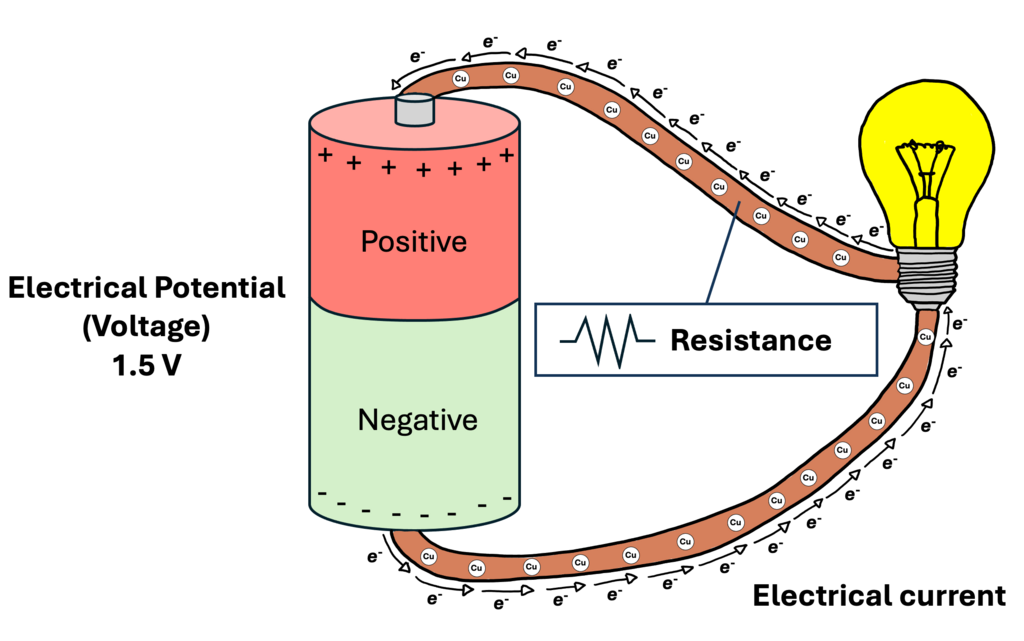
At its heart, electricity is the movement of tiny charged particles called electrons. To understand and control this movement, we need to learn its three fundamental concepts: voltage, current, and resistance. Think of electricity flowing through a wire like water flowing through a pipe. This analogy helps make these invisible forces easier to grasp.
Voltage
noun
The pressure or force that pushes electric charge forward. It's the 'push' that makes electrons move.
In our water pipe analogy, voltage is like the water pressure. More pressure means a stronger push. Voltage is measured in volts (V).
Current
noun
The rate at which electric charge flows past a point in a circuit. It’s the actual 'flow' of electrons.
In the analogy, current is the flow rate of the water, like gallons per minute. Electrical current is measured in amperes (A), often called amps for short.
Resistance
noun
A measure of the opposition to current flow in a circuit. It’s the 'friction' that slows the electrons down.
Resistance is like the width of the water pipe. A narrow pipe restricts the flow more than a wide one. Resistance is measured in ohms (Ω).
Ohm's Law
These three concepts don't exist in isolation. In the early 1800s, German physicist Georg Ohm discovered a simple and powerful relationship between them. His finding, now known as Ohm's Law, is the cornerstone of circuit analysis.
Ohm's Law states that the voltage across a conductor is directly proportional to the current flowing through it, provided all physical conditions and temperature remain constant.
This relationship is expressed with a clean, simple formula.
This formula means that if you know any two of the values, you can calculate the third. Let's try an example.
Imagine a simple circuit with a current of 2 amps (I = 2 A) flowing through a resistor with a resistance of 3 ohms (R = 3 Ω). What is the voltage?
Using Ohm's Law:
The voltage in the circuit is 6 volts.
We can also rearrange the formula to solve for current or resistance.
Let's say you have a 12-volt battery (V = 12 V) connected to a component with 4 ohms of resistance (R = 4 Ω). How much current will flow?
Exactly 3 amps of current will flow through the circuit.
Now, let's test your understanding of these core concepts.
In the common analogy of electricity flowing like water in a pipe, what does electrical current represent?
What is the standard unit of measurement for voltage?
Understanding voltage, current, resistance, and the simple math of Ohm's Law is the first and most important step in working with any electrical circuit.