Introduction to Electrical Work
Electricity Basics
The Heart of Electricity
Everything around us is made of atoms, and atoms are made of even smaller particles: protons, neutrons, and electrons. Protons have a positive charge, electrons have a negative charge, and neutrons have no charge. In most materials, these charges are balanced.
Electricity is all about making electrons move. When electrons are pushed from one atom to another in a material like a copper wire, we get an electric current. Think of it like a long line of dominoes. When you push the first one, it knocks over the next, and so on down the line. A single electron doesn't travel from the power plant to your light bulb; instead, electrons push on their neighbors, creating a flow of charge that moves almost instantly.
Materials that let electrons move easily, like copper and aluminum, are called conductors. Materials that block the flow of electrons, like rubber and plastic, are called insulators.
The Big Three
To understand and work with electricity, you need to know about three key concepts: voltage, current, and resistance. A good way to visualize them is to think of water flowing through a pipe.
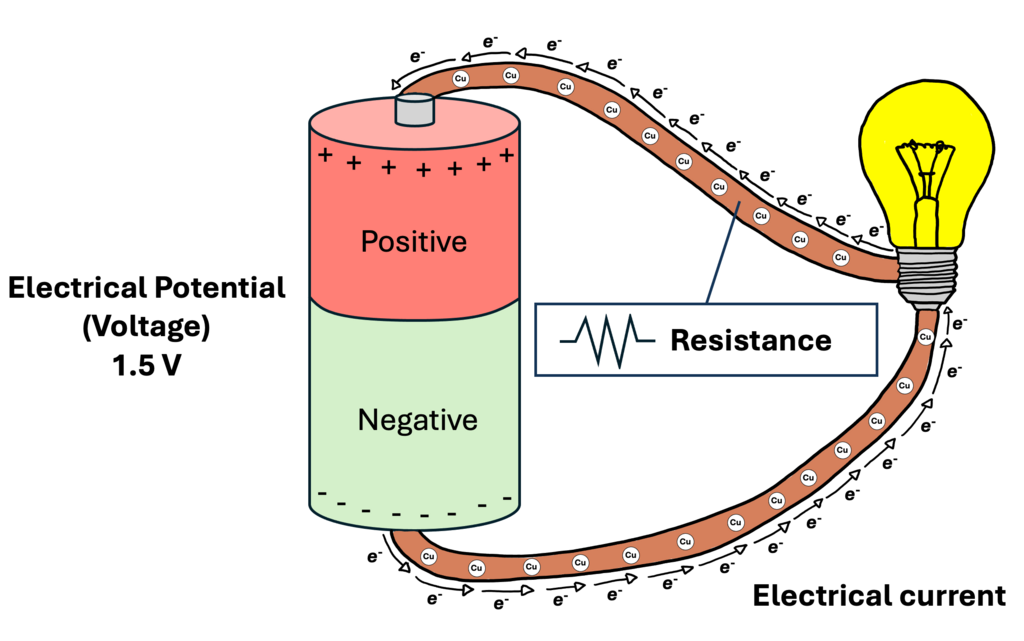
Voltage
noun
The pressure that pushes electrons through a circuit. It's the difference in electrical potential between two points.
In our water pipe analogy, voltage is like the water pressure. More pressure means more force pushing the water through the pipe. Voltage is measured in volts (V).
Current
noun
The rate at which electric charge flows past a point in a circuit.
Current is like the flow rate of the water—how many gallons are moving past a point per minute. Electrical current is the flow of electrons, measured in amperes (A), often called amps.
Resistance
noun
A measure of the opposition to current flow in an electrical circuit.
Resistance is like a narrowing of the pipe or a clog that restricts water flow. It works against the current. Everything in a circuit, including the wires themselves, has some resistance. It is measured in ohms (Ω).
The Golden Rule
These three concepts—voltage, current, and resistance—are linked by a fundamental principle called Ohm's Law. It's a simple but powerful formula that is essential for any electrician. It states that the voltage across a conductor is directly proportional to the current flowing through it, provided the temperature and other physical conditions remain unchanged.
Where:
- is voltage (in volts)
- is current (in amps)
- is resistance (in ohms)
This relationship means if you know any two of the values, you can always calculate the third. For example, if a 12-volt car battery is connected to a headlight with 3 ohms of resistance, you can calculate the current.
The headlight will draw 4 amps of current. This is a daily calculation on the job.
Two Ways to Connect
Components in a circuit, like light bulbs or outlets, can be wired together in two basic ways: in series or in parallel.
Series circuits provide only one path for the current to flow. If you think of old-fashioned holiday lights, if one bulb burns out, the entire string goes dark. That's a series circuit. The break in the path stops the flow of electricity for all the other bulbs.
In a series circuit:
- The total resistance is the sum of all individual resistances:
- The current is the same through every component.
- The total voltage is divided among the components.
Parallel circuits provide multiple paths for the current. The wiring in your home is a parallel circuit. You can turn on a lamp in the living room without affecting the toaster in the kitchen. Each appliance is on its own branch.
In a parallel circuit:
- The total resistance is less than the smallest individual resistance. The formula is $1/R_{Total} = 1/R_1 + 1/R_2 + 1/R_3 + ...$
- The total current from the source splits among the branches.
- The voltage is the same across every branch.
Power Up
The final basic concept is electrical power. Power is the rate at which electrical energy is used to do work, like lighting a bulb or turning a motor. It's measured in watts (W).
The formula for power is simple:
Where:
- is power (in watts)
- is voltage (in volts)
- is current (in amps)
Let's go back to our headlight example. We found it drew 4 amps from a 12-volt battery. To find the power it uses:
The headlight is a 48-watt bulb. Understanding power is crucial for sizing wires, breakers, and other components to handle the electrical load safely.
What particle is primarily responsible for creating an electric current in a solid conductor like a copper wire?
In the common analogy of water flowing through a pipe, what does the water pressure represent?
These fundamentals are the bedrock of all electrical work. Mastering them will prepare you for more complex systems and ensure you can work safely and effectively.