Introduction to Electrical Materials and Practices
Introduction to Electricity
The Nature of Charge
At its core, electricity is all about a fundamental property of matter called electric charge. All the physical stuff around us is made of atoms. And atoms, in turn, are made of even smaller particles: protons, neutrons, and electrons.
Protons have a positive (+) charge, and electrons have a negative (-) charge. Neutrons, as their name suggests, are neutral. In a typical atom, the number of protons and electrons is equal, so the atom's overall charge is balanced.
However, electrons in the outermost shells of an atom aren't held as tightly. With a little nudge, they can be knocked free and move from one atom to another. This movement of electrons is the essence of electricity.
Materials that allow electrons to move freely are called conductors. Metals like copper and silver are excellent conductors. Materials that hold onto their electrons tightly and prevent them from moving are called insulators. Rubber, glass, and plastic are good insulators, which is why they're often used to cover electrical wires for safety.
The Big Three
To understand how electricity works in a practical sense, we need to get familiar with three key concepts: voltage, current, and resistance. A common analogy is to think of electricity flowing through a wire like water flowing through a pipe.
Voltage
noun
The difference in electric potential energy between two points. It's the 'push' or 'pressure' that causes electric charge to flow.
Voltage (symbol: ) is like the water pressure in our pipe analogy. A water tower creates pressure that pushes water through pipes. Similarly, a battery creates a voltage that pushes electrons through a wire. The higher the voltage, the stronger the push.
Current
noun
The rate at which electric charge flows past a point in a circuit. It is measured in amperes (amps).
Current (symbol: ) is like the flow rate of the water. It’s the amount of charge moving through the wire over a period of time. A wider river carries more water per second than a small stream; similarly, a higher current means more electrons are flowing past a point each second.
Resistance
noun
A measure of the opposition to current flow in an electrical circuit. It is measured in ohms (Ω).
Resistance (symbol: ) is like friction or a narrowing in the pipe. It hinders the flow of water. In an electrical circuit, all components offer some resistance to the flow of current. A light bulb, for example, has resistance, which is what allows it to heat up and produce light.
Ohm's Law
These three concepts—voltage, current, and resistance—are not independent. They are linked by a fundamental principle discovered by Georg Ohm in 1827. Ohm's Law describes their relationship in a simple, powerful equation.
In plain English, this means the voltage across a component is equal to the current flowing through it multiplied by its resistance.
This relationship is incredibly useful. If you know any two of the values, you can always calculate the third. For example, if you have a 12-volt battery connected to a component with 4 ohms of resistance, you can find the current:
The current flowing through the circuit would be 3 amps.
Simple Circuits
For electricity to do useful work, like power a light bulb or charge a phone, it needs to flow in a complete, unbroken path called a circuit. A simple circuit has three main parts:
- A power source: Such as a battery, which provides the voltage.
- A load: A device that consumes energy, like a light bulb or a motor. The load has resistance.
- Conductors: Wires that connect the source to the load, creating a closed loop for the current to travel.
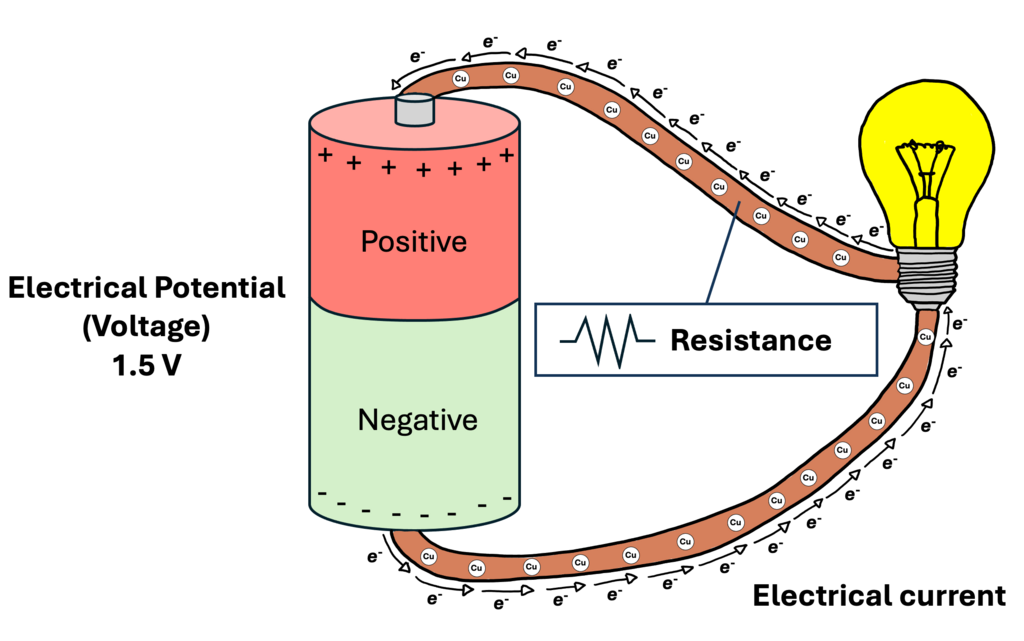
Current flows from the positive terminal of the battery, through the wire, through the light bulb (causing it to light up), and back through the other wire to the negative terminal of the battery. If you cut the wire anywhere, the path is broken, the circuit becomes 'open', and the current stops flowing—the light bulb goes out.
Ready to check your understanding?
Which subatomic particle is primarily responsible for the flow of electric current?
In the common analogy of electricity as water flowing through a pipe, what does electrical resistance (R) represent?
Understanding these basics—charge, voltage, current, resistance, and how they interact in a circuit—is the first step to mastering the world of electricity.