Introduction to Electrical Engineering
Electricity Basics
The Building Blocks of Electricity
Everything around us is made of atoms. At the center of each atom is a nucleus, containing positively charged protons and neutral neutrons. Orbiting the nucleus are tiny, negatively charged electrons. The concepts of positive and negative are just labels for two opposite types of electric charge.
A fundamental rule of electricity is that opposite charges attract, while like charges repel. A proton and an electron will pull toward each other, but two electrons will push each other away.
In many materials, electrons are tightly bound to their atoms. In others, particularly metals, the outermost electrons are held more loosely. These are called valence electrons, and their ability to move is what makes electricity possible. When these electrons are stripped away from an atom, the atom is left with a net positive charge and is called an ion.
How Materials Conduct Charge
Materials behave differently when it comes to letting electrons move. We can group them into three main categories.
Conductor
noun
A material where electric charge can flow freely. In conductors like copper and silver, the valence electrons are not strongly attached to any single atom and can move easily throughout the material.
Next, we have insulators.
Insulator
noun
A material where electric charge cannot flow freely. In insulators like rubber, glass, and plastic, electrons are held very tightly to their atoms and resist moving.
Between these two extremes lies a special category of materials.
Semiconductors, like silicon, are materials that can be made to act as either conductors or insulators. This unique property is the foundation of modern electronics, from computer chips to solar panels.
Invisible Fields
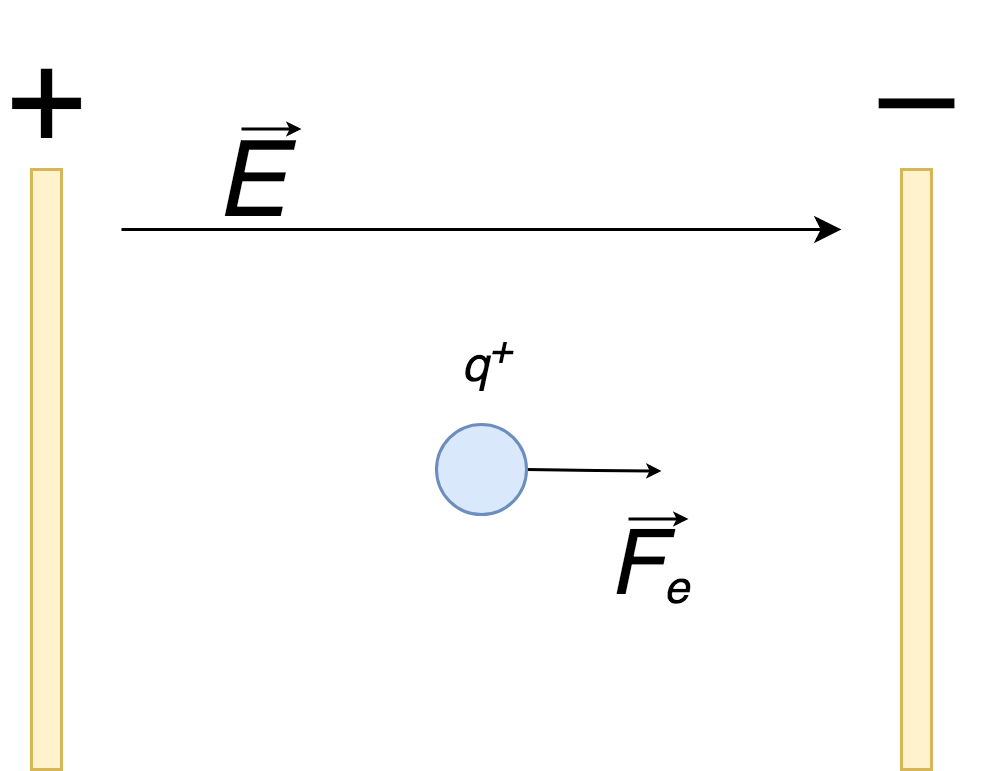
Charges don't have to touch to interact. They exert forces on each other through invisible fields. An electric charge creates an electric field in the space around it. When another charge enters this field, it feels a force. Think of it like a tiny version of gravity, but for charge instead of mass. The field tells other charges how to move.
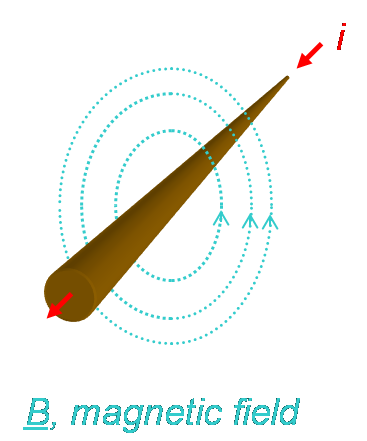
When electric charges move, they create another kind of field: a magnetic field. This is the same force that makes magnets stick to a refrigerator. A wire with electricity flowing through it generates a circular magnetic field around it. Electric and magnetic fields are deeply connected and are two aspects of the same fundamental force.
Making a Current
The flow of electric charge is called electric current. In a copper wire, this current is a river of countless electrons moving together. We measure current in amperes (A), or amps for short. A flow of one coulomb of charge (about electrons) past a point in one second is one ampere.
But what causes the charge to move? For that, you need a potential difference, more commonly known as voltage. Voltage is the 'push' or 'pressure' that drives the current through a circuit. It represents the difference in electric potential energy between two points. A battery, for example, creates a voltage between its positive and negative terminals. Voltage is measured in volts (V).
As current flows, it often encounters opposition. This opposition to the flow of current is called resistance. Think of it like friction. A wider pipe offers less resistance to water flow than a narrow one. Similarly, thick copper wires have less resistance than thin ones. Resistance is measured in ohms (Ω).
| Concept | Description | Unit |
|---|---|---|
| Current | The flow of electric charge | Ampere (A) |
| Voltage | The electrical 'pressure' that causes current to flow | Volt (V) |
| Resistance | The opposition to the flow of current | Ohm (Ω) |
These three concepts are tied together by a simple but powerful rule.
Ohm's Law
In the 1820s, German physicist Georg Ohm discovered a fundamental relationship between voltage, current, and resistance. Ohm's Law states that the current through a conductor between two points is directly proportional to the voltage across the two points. The relationship is elegantly simple.
Here, is voltage, is current, and is resistance. This means if you increase the voltage (the push), the current (the flow) will increase, as long as the resistance stays the same. If you increase the resistance (the opposition), the current will decrease for a given voltage.
For example, if you connect a 12-volt car battery to a headlight with a resistance of 4 ohms, the current flowing through it would be .
This simple formula is one of the most important tools in electrical engineering. Now, let's review these core concepts.
Time to check your understanding.
What particle is primarily responsible for the flow of electricity in a typical metal wire?
A material that strongly opposes the flow of electric current is known as a(n) __________.
These basic principles of charge, fields, and circuits are the foundation for everything from the power grid to the smartphone in your pocket.