Introduction to Electrical Engineering
Electricity Basics
The Building Blocks of Electricity
At the heart of everything, including electricity, is the atom. Atoms are made of three tiny particles: protons, neutrons, and electrons. Protons have a positive electric charge, electrons have a negative charge, and neutrons have no charge at all.
In an atom, protons and neutrons clump together in the center, called the nucleus. Electrons orbit this nucleus. Usually, an atom has the same number of electrons and protons, making it electrically neutral. But electrons can sometimes be knocked loose and move from one atom to another. This movement of electrons is the essence of electricity.
The fundamental rule of electric charge is simple: opposite charges attract, while like charges repel. A positive charge and a negative charge will pull toward each other, but two positive charges (or two negative charges) will push each other away.
Flowing and Resisting
Why do some materials let electricity pass through them while others don't? It all comes down to how tightly their atoms hold onto their electrons.
Conductors are materials that let electrons move freely. Metals like copper, silver, and gold are excellent conductors because their outermost electrons are loosely attached. This is why electrical wires are made of copper.
Insulators are the opposite. Their electrons are tightly bound to their atoms and can't move easily. Materials like rubber, glass, and plastic are good insulators, which is why they are used to cover electrical wires to keep us safe.
Semiconductors are a special case. They aren't great conductors or great insulators. Materials like silicon can be carefully engineered to control the flow of electricity, which is what makes them the foundation of all modern electronics, from your phone to your computer.
| Material Type | Electron Mobility | Examples |
|---|---|---|
| Conductor | High (Free) | Copper, Gold |
| Insulator | Low (Bound) | Rubber, Glass |
| Semiconductor | Controllable | Silicon, Germanium |
Invisible Forces
Charged particles create invisible forces around them. An electric field is the area of influence surrounding an electric charge. Think of it like the heat you feel from a campfire; you don't have to touch the fire to know it's there. Similarly, another charge entering this field will feel a push or a pull.
When electric charges start moving, they create another kind of field: a magnetic field. This is a crucial connection. A simple wire with electricity flowing through it generates a magnetic field in circles around it. This principle is what makes motors, generators, and electromagnets work.
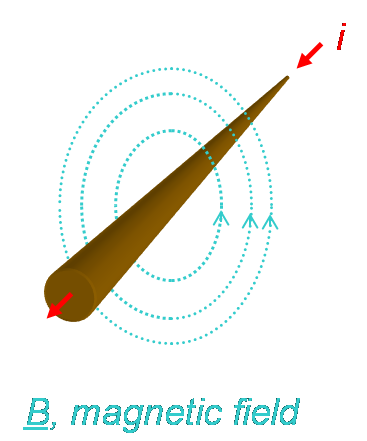
The relationship between electricity and magnetism is fundamental. One can create the other, and together they form the basis of electromagnetism.
The Rules of the Circuit
To work with electricity in a controlled way, we build circuits. To understand circuits, we need to know about three key quantities: voltage, current, and resistance. A great way to think about them is to imagine water flowing through pipes.
- Voltage () is like the water pressure. It's the force that pushes the electric charges along. It's measured in Volts (V).
- Current () is like the flow rate of the water. It's the amount of charge passing a point per second. It's measured in Amperes, or Amps (A).
- Resistance () is like the narrowness of the pipe. It's the opposition to the flow of charge. It's measured in Ohms ().
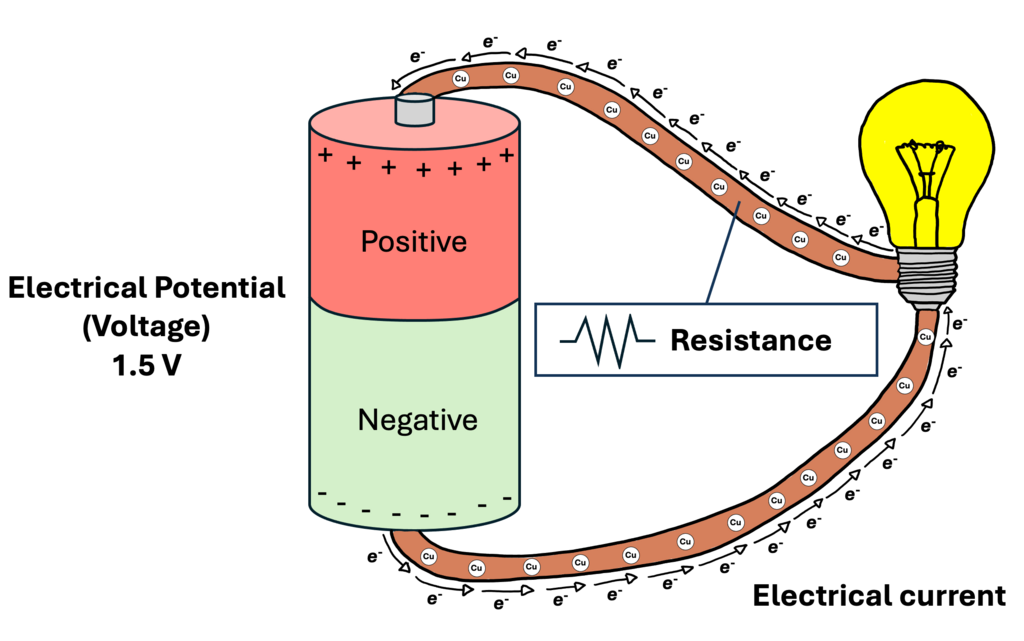
These three concepts are linked by a simple but powerful formula.
Ohm's Law states that the voltage across a conductor is directly proportional to the current flowing through it, provided the temperature and other physical conditions remain unchanged.
This means if you increase the voltage (pressure), more current (water) will flow. If you increase the resistance (make the pipe narrower), less current will flow for the same voltage.
For more complex circuits, we use two more rules called Kirchhoff's Laws. They help us figure out how current and voltage behave in different parts of a circuit.
Node
noun
A point in a circuit where two or more components connect.
Kirchhoff's Current Law (KCL) says that the total current entering a node must equal the total current leaving it. In our water analogy, this means water doesn't just disappear at a junction; the amount flowing in must equal the amount flowing out through all the pipes.
Kirchhoff's Voltage Law (KVL) applies to any closed loop in a circuit. It states that the sum of all voltages around a closed loop must equal zero. This is a bit like walking up and down a series of hills and ending up at the same elevation you started. The energy you gain going up must equal the energy you lose going down. In a circuit, the voltage supplied by the battery is "used up" by the components in the loop.