Introduction to Earth Sciences
Introduction to Geology
What is Geology?
Geology is the story of our planet. It’s the science that explores the Earth, the materials it’s made of, the processes that act on those materials, and the history of how it has changed over billions of years. Think of geologists as detectives, piecing together clues from rocks, fossils, and landscapes to understand our world from the inside out.
This field isn’t just about looking at rocks. It’s about understanding the ground beneath our feet, the mountains that tower over us, and the oceans that stretch across the globe. It asks big questions: How did our planet form? What forces shape its surface? Where do we find the resources we need to live?
Geology
noun
The scientific study of the Earth, its structure, the materials it is made from, and the processes that shape it.
A Look Inside Earth
If we could slice Earth in half, we'd see it’s made of distinct layers, much like an onion. We can't actually drill to the center of the planet, so scientists learn about these layers by studying how waves from earthquakes travel through the Earth. These vibrations, called seismic waves, change speed and direction as they pass through different materials, giving us a picture of what lies deep beneath the surface.
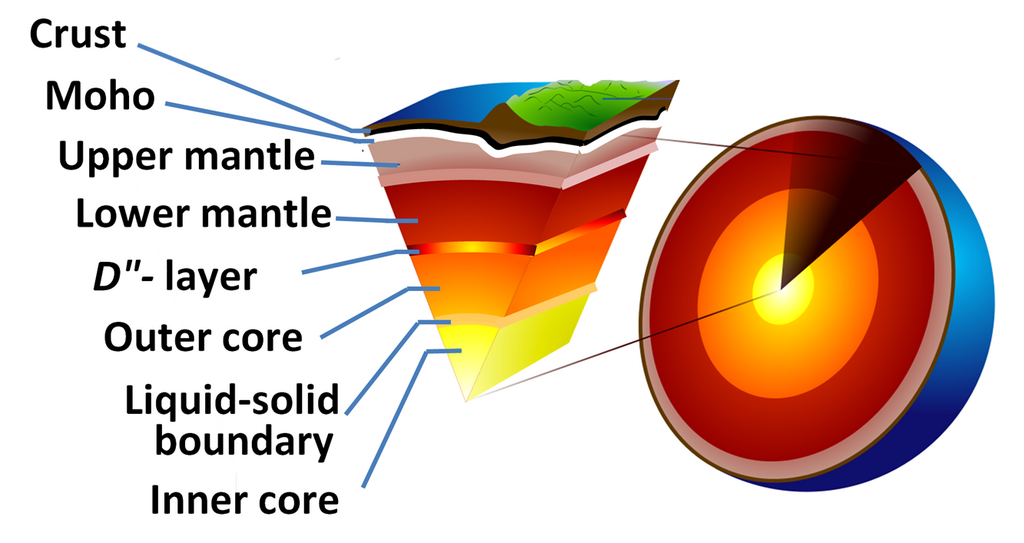
Our planet has three main layers: the crust, the mantle, and the core.
The Crust is the thin, outermost layer we live on. It's incredibly thin compared to the rest of the planet, like the skin of an apple. The crust under the oceans (oceanic crust) is thinner and denser than the crust that makes up the continents (continental crust).
The Mantle lies beneath the crust and is by far the largest layer. It’s composed of hot, dense, semi-solid rock that flows very slowly over millions of years. This slow movement is a powerful force that shapes the Earth's surface.
The Core is the very center of the Earth and is made mostly of iron and nickel. It's divided into two parts: a liquid outer core and a solid inner core. The swirling motion of the liquid outer core generates Earth's magnetic field, which protects us from harmful solar radiation.
| Layer | State | Composition | Approximate Thickness |
|---|---|---|---|
| Crust | Solid | Rock (Silicates) | 5–70 km |
| Mantle | Semi-solid | Iron & Magnesium Silicates | 2,900 km |
| Outer Core | Liquid | Iron & Nickel | 2,200 km |
| Inner Core | Solid | Iron & Nickel | 1,220 km radius |
Why Geology Matters
Geology is a crucial part of our everyday lives. Geologists help locate essential resources like clean drinking water, the minerals used in our phones and computers, and the energy sources that power our homes.
Understanding geology also helps us prepare for natural hazards. By studying the Earth's processes, we can better predict events like earthquakes, volcanic eruptions, and landslides, and build structures and communities that are more resilient to them.
Furthermore, geology plays a key role in environmental protection. It helps us understand how our climate is changing, how to safely manage waste, and how to clean up polluted land and water. From the foundation of the house you live in to the water you drink, geology is all around you.
Geology isn't just about the distant past. It's about understanding the systems that sustain us and ensuring a safe future on our dynamic planet.
Now, let's test your understanding of these core concepts.
What is the primary focus of geology?
Arrange Earth's layers from the outermost to the innermost.
This is just the beginning of the story Earth has to tell. By understanding its basic structure and importance, we've laid the foundation for exploring more of its fascinating secrets.