Introduction to Dzogchen Meditation
Introduction to Dzogchen
The Great Perfection
In the vast landscape of Tibetan Buddhism, there is a path known as Dzogchen. It’s often translated as the "Great Perfection" or "Great Completeness." This isn't about achieving perfection, but recognizing a perfection that's already here.
Great Perfection
The core idea is simple but profound: our fundamental nature, the very essence of our mind, is already pure, clear, and enlightened. It’s like the sky. The sky is always vast, open, and clear, even when clouds, storms, or fog pass through it. The clouds don't stain the sky. They are temporary events within the sky.
Dzogchen suggests that our thoughts, emotions, and perceptions are like those clouds. They arise and dissolve, but they don't alter the fundamental, sky-like nature of our mind. The practice isn't about getting rid of the clouds, but about recognizing the ever-present sky.
The Nyingthig or “Heart Essence” teachings within Dzogchen represent a profound reimagining of Buddhist cosmology, human experience, and the path to liberation, centering on the concept of Buddha Nature.
A Hidden Stream
Dzogchen's history stretches back over a thousand years. Its teachings are most prominent in the Nyingma school, the oldest of the four main schools of Tibetan Buddhism. However, its influence also reaches into the ancient, indigenous Bön tradition of Tibet, which predates the arrival of Buddhism.
Tradition holds that the first human master of Dzogchen was Garab Dorje, who lived centuries ago in a land known as Oddiyana. The teachings were then passed down through a lineage of masters, often in secret, from teacher to student. This direct transmission is a hallmark of the tradition, ensuring the teachings remain a living experience rather than just an academic subject.

Unlike some Buddhist paths that emphasize gradual stages of practice and purification, Dzogchen is considered a direct path. It's often called the pinnacle of all Buddhist teachings because it gets straight to the point: the nature of mind itself. While other practices build a ladder to reach enlightenment, Dzogchen points out that you are already on the rooftop.
Pointers to the Nature of Mind
The wisdom of Dzogchen is preserved in a remarkable body of texts. Among the most important are the Seventeen Tantras of the Great Perfection. These aren't rulebooks or philosophical treatises in the usual sense. Instead, they are collections of potent, poetic instructions designed to point the practitioner directly to their own innate awareness.
A later, highly revered collection of teachings is the Nyingthig, or "Heart Essence." These texts, revealed by masters like Longchenpa and Jigme Lingpa, distill the essence of the earlier tantras into practical advice for recognizing the nature of mind. They are cherished for their clarity and depth.
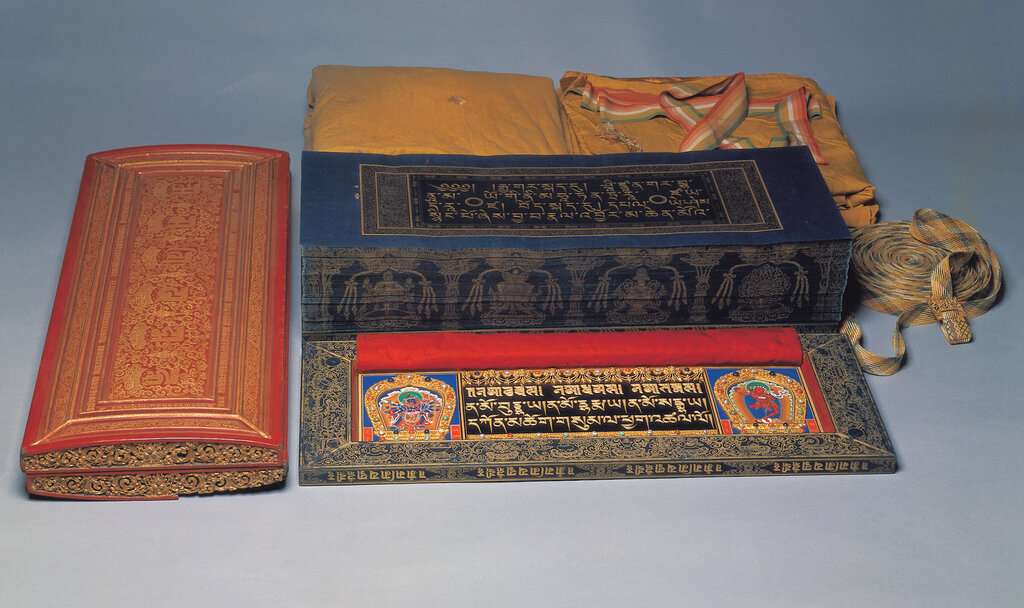
Within the broader context of Tibetan Buddhism, Dzogchen is unique. It shares the same ultimate goal—liberation from suffering—but its method is distinct. It complements, rather than contradicts, other practices. Many practitioners engage in foundational Buddhist training before receiving Dzogchen teachings, which are considered advanced and require a stable foundation.
The path begins not with changing who you are, but with discovering who you have always been. It’s a shift in perspective, from trying to fix the clouds to resting in the vast, open sky of your own true nature.
Let's review the main concepts.
According to the central metaphor in Dzogchen, if thoughts and emotions are like clouds, what is the mind's fundamental nature like?
Dzogchen is considered a "direct path" because it emphasizes a gradual, step-by-step process of purification to build a foundation for enlightenment.