Introduction to Dynamics
Kinematics
The Language of Motion
Kinematics is the branch of physics that describes how things move. It's not concerned with why they move—that's a topic for later. For now, we're just focused on creating a clear language to talk about motion itself.
Let's start with a basic idea: an object's position. If you walk from your house to a store, your position changes. The straight-line path from your starting point to your ending point is called displacement. It's different from distance. If you walk to the store and then back home, the total distance you've traveled might be two miles, but your displacement is zero because you ended up exactly where you started.
Displacement is the change in position and has a direction. Distance is the total path traveled, regardless of direction.
Next is velocity. Velocity tells us how fast an object's displacement is changing. Like displacement, it has a direction. If you say a car is moving at 60 miles per hour, you're talking about its speed. If you say it's moving 60 miles per hour east, you're describing its velocity.
Finally, we have acceleration. Acceleration describes how quickly an object's velocity changes. Most people think of acceleration as just speeding up, but in physics, it's more than that. Slowing down is a form of acceleration (sometimes called deceleration), and so is changing direction. A car turning a corner at a constant speed is still accelerating because its direction of motion—and therefore its velocity—is changing.
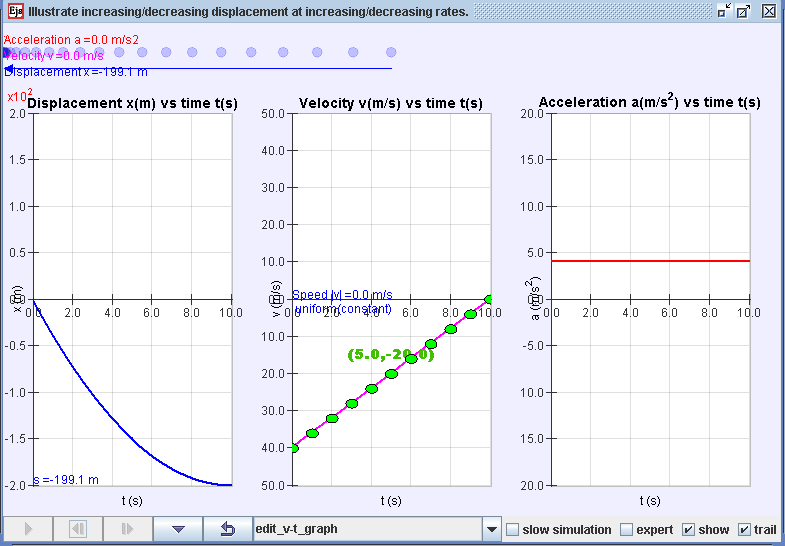
Straight-Line Motion
When an object moves in a straight line with constant acceleration, its motion is predictable. We can use a few key equations to describe it. These are often called the equations of motion.
Let's define our terms:
- = displacement
- = initial velocity
- = final velocity
- = acceleration
- = time
Here's the first equation. It connects final velocity, initial velocity, acceleration, and time. It says the final velocity is whatever you started with, plus the change caused by acceleration over time.
This next equation helps us find the displacement of an object when we know its initial velocity, acceleration, and the time it has been moving.
What if you don't know the time? This last equation is useful because it relates velocity, acceleration, and displacement without needing to know how long the motion took.
Going in Circles
Motion isn't always in a straight line. Objects can also rotate, like a spinning top or a planet on its axis. We can describe this rotational motion using concepts that are direct analogs of their straight-line counterparts.
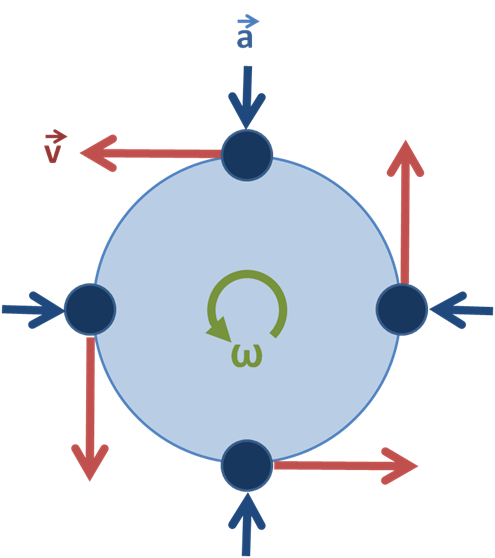
Instead of linear displacement (), we use angular displacement (), which is the angle an object has rotated through. We usually measure this in radians, not degrees.
Instead of linear velocity (), we have angular velocity (). This tells us how quickly the angular displacement is changing—basically, how fast the object is spinning.
And instead of linear acceleration (), we have angular acceleration (). This describes the rate at which the angular velocity is changing. If a spinning wheel is speeding up or slowing down, it has an angular acceleration.
The Rules of Rotation
The great thing about these angular concepts is that they follow the same mathematical rules as linear motion. We can take the equations of motion we just learned and simply swap the linear variables for the angular ones.
| Linear Motion | Rotational Motion |
|---|---|
| Displacement: | Angular Displacement: |
| Velocity: | Angular Velocity: |
| Acceleration: | Angular Acceleration: |
By replacing the variables, we get the equations of motion for rotation with constant angular acceleration.
The structure is identical. If you understand how to describe motion in a straight line, you already know how to describe motion in a circle. It's the same logic, just with a different set of symbols.
Let's check what you've learned about describing motion.
An athlete runs exactly one lap around a 400-meter circular track and stops at their starting point. What is their total displacement?
In physics, which of the following scenarios is an example of acceleration?
Mastering this vocabulary for motion is the first step in understanding the much broader field of mechanics.