Introduction to Doughnut Economics
The Doughnut Model
A New Compass for Our Times
For much of the 20th century, we had one main goal for the economy: growth. The core idea was simple. If a country's Gross Domestic Product, or GDP, went up, things were good. But this singular focus created problems. It didn't ask if wealth was shared fairly, nor did it consider the damage being done to our planet.
We need a new goal. Instead of just growing, we need to thrive. This requires a different way of thinking and a new guide to help us navigate. That guide is shaped like a doughnut.
The goal isn't to grow forever. It's to meet the needs of all people within the means of the living planet.
The Safe and Just Space
Imagine a doughnut. Not the kind you eat, but a diagram that shows us what a healthy economy looks like. This model, called Doughnut Economics, gives us a picture of success for the 21st century. The sweet spot, the actual dough of the doughnut, represents a 'safe and just space' where humanity can flourish.
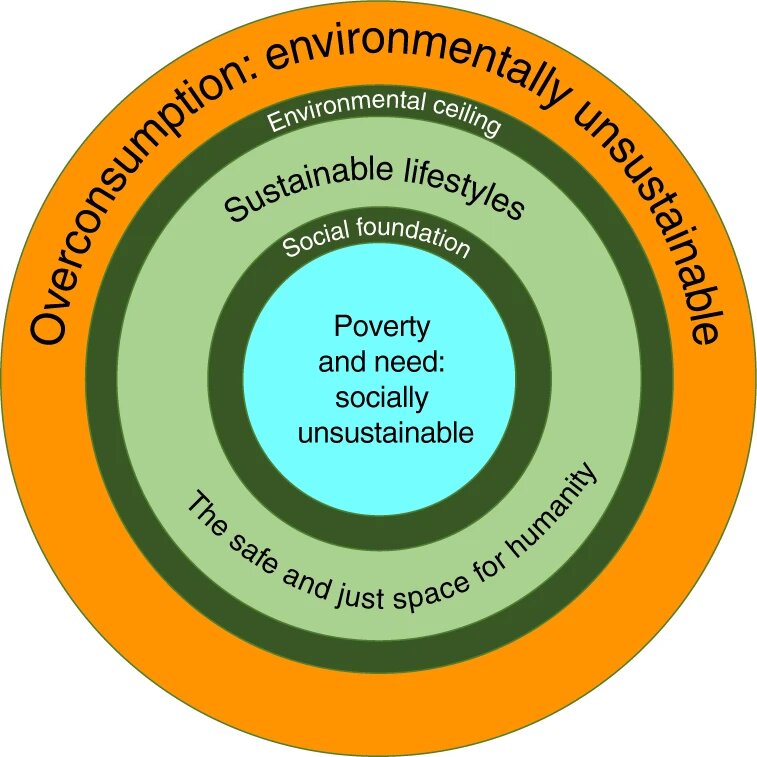
This space is defined by two boundaries: an inner ring and an outer ring.
Think of it like managing a household budget. You need to earn enough to cover all your essential needs like food, housing, and healthcare. That's your financial foundation. But you also can't spend so much that you go deep into debt, maxing out all your credit cards. That's your financial limit. A successful economy works the same way. It must provide for everyone's basic needs while not overstraining the planet's resources.
The Two Boundaries
The Doughnut's two rings clearly mark the territory we want to be in.
The Inner Ring: The Social Foundation This boundary represents the essentials of a good life that no one should fall below. It includes things like access to food, clean water, housing, education, healthcare, and political voice. When people lack these basics, they fall into the hole in the middle of the doughnut. This is called a shortfall.
The Outer Ring: The Ecological Ceiling This boundary represents Earth's life-supporting systems, like a stable climate, clean air, and healthy oceans. If our economic activity puts too much pressure on these systems, we push past the planet's limits. This is called an overshoot. It destabilizes the natural world that we all depend on.
The challenge is to get everyone out of the hole and into the doughnut itself, without pushing past the outer edge. We need to eradicate deprivation while protecting our planet.
From Growing to Thriving
A core idea of the Doughnut is shifting our goal from endless growth to thriving in balance. Think about human growth. A person grows rapidly as a child, but eventually reaches physical maturity. After that, the focus shifts from growing taller to being healthy and active.
An economy should be seen the same way. The goal isn't to expand forever, which is physically impossible on a finite planet. The goal is to reach a point where everyone's needs are met in a regenerative and fair way, and then to maintain that healthy balance. This model asks us to be economic 'gardeners,' creating the conditions for our society to thrive without destroying the garden we live in.
By providing a clear picture of what success looks like, the Doughnut gives us a new compass for the 21st century. It helps us focus on the real goal: a world where no one is left in the hole and where we don't overshoot our planetary home.