Introduction to Differential Geometry
Introduction to Differential Geometry
Geometry with Calculus
Imagine trying to describe the path of a fly buzzing around a room or the shape of a winding mountain road. The familiar tools of Euclidean geometry, with its straight lines and flat planes, aren't quite up to the task. This is where differential geometry comes in. It's a field of mathematics that uses the power of calculus to study curves, surfaces, and other complex shapes.
Instead of looking at shapes as static objects, we can think of them as being traced out by a moving point. A curve, for example, can be described by a vector function , where the parameter could represent time. As changes, the vector points to different locations, tracing out a path in space.
The Life of a Curve
Just saying a path is 'curvy' isn't very precise. How curvy is it? And does it just bend, or does it also twist? Differential geometry gives us specific tools to answer these questions.
Curvature
noun
A measure of how sharply a curve is bending at a given point. A straight line has zero curvature, while a small circle has a high curvature.
Curvature, often denoted by the Greek letter kappa (), quantifies the bend. A larger value for means a tighter turn. We can calculate it at any point on a curve using its first and second derivatives.
But curves in three-dimensional space can do more than just bend; they can also twist. Think of a spiral staircase. It curves around a central point, but it also rises, twisting out of any single flat plane. This twisting property is called torsion.
Torsion
noun
A measure of how sharply a space curve twists out of the plane in which it is locally curving.
Torsion, symbolized by the Greek letter tau (), tells us how much the curve is deviating from being planar. A curve that lies entirely in a single plane, like a circle, has zero torsion. The formula for torsion involves the first three derivatives of the curve's position vector.
Beyond Curves to Surfaces
Just as we analyzed one-dimensional curves, we can use calculus to understand two-dimensional surfaces, like the surface of a sphere or a donut. At any point on a smooth surface, we can imagine a flat plane that just 'kisses' the surface at that single point. This is the tangent plane.
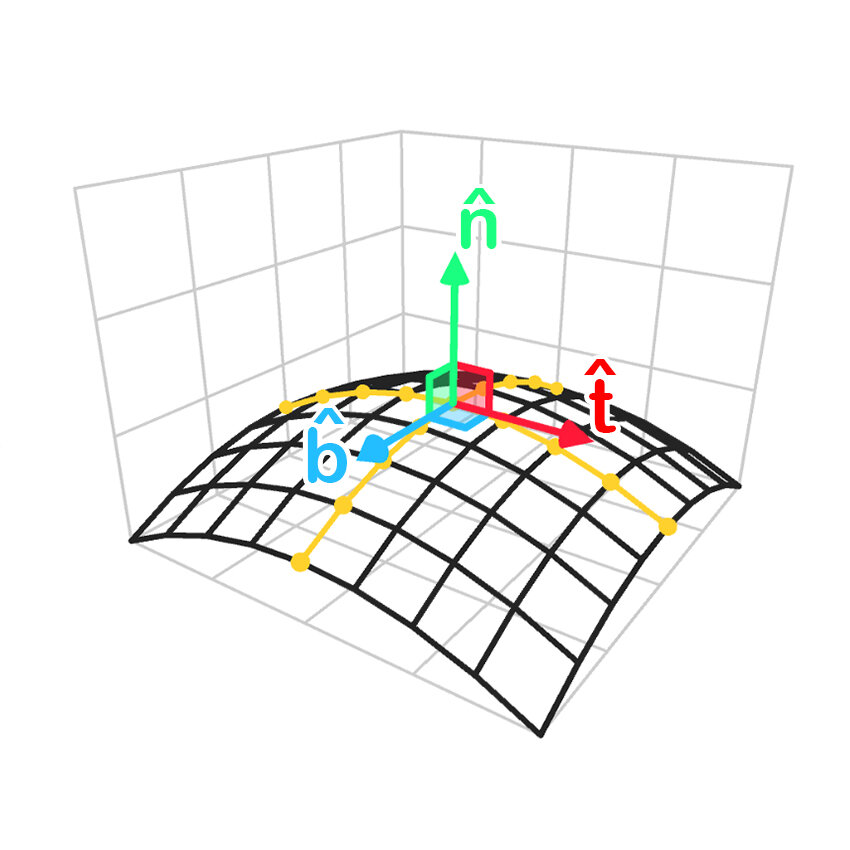
The tangent plane contains all the possible directions you could travel from that point while staying on the surface. Sticking straight out of this plane, perpendicular to it, is a line defined by the normal vector. The normal vector points directly 'away' from the surface and is crucial for understanding its orientation in space.
To get a deeper understanding of a surface's properties, we use tools called fundamental forms. These sound intimidating, but the idea is straightforward.
The first fundamental form is like a custom ruler for the surface. It tells us how to measure distances and angles along the surface itself, without considering the surrounding 3D space.
Imagine an ant walking on a bumpy leaf. The first fundamental form would allow the ant to calculate the length of its path as it walks, accounting for all the hills and valleys it crosses.
The second fundamental form measures the surface's extrinsic curvature. It describes how the surface is bending within the larger 3D space. It tells us how the normal vector changes as we move from one point to another nearby.
Together, these two forms provide a complete local description of the surface's geometry. They capture everything from how distances are warped by the surface's shape to how it bends and curves in space.
And there you have it, the basic building blocks of differential geometry. By applying calculus to curves and surfaces, we can precisely describe and analyze their shapes in ways that simple geometry never could.