Introduction to Differential Equations
Introduction to Differential Equations
The Language of Change
In algebra, we solve for unknown numbers. We might see an equation like and find that must be 3. The answer is a single value.
Differential equations are a different beast. Instead of solving for a number, we solve for an entire function. These are equations that link a function to its derivatives. Since derivatives measure rates of change, differential equations are fundamentally about describing how things change.
A differential equation is an equation that contains an unknown function and one or more of its derivatives.
Think of it this way: instead of a snapshot, a differential equation gives you the rulebook for a movie. It doesn't tell you where everything is at one moment, but it tells you how everything is moving and changing. Your job is to find the function that follows those rules.
For example, consider this simple differential equation:
This equation states a rule: find a function whose rate of change () is equal to the function's value () at any point. The solution isn't a number; it's a function that behaves this way, like .
Why They Matter
The world is in constant flux. Things grow, shrink, cool down, speed up, and fall. Differential equations are the mathematical tool we use to model these dynamic processes.
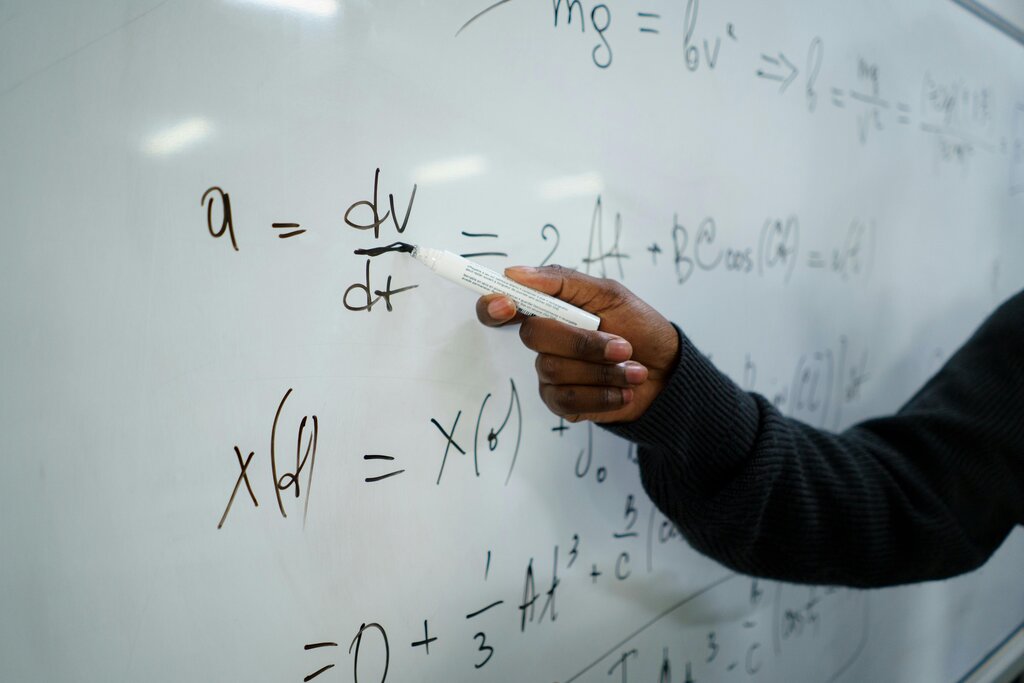
Here are just a few places they show up:
- Physics: Describing the motion of a pendulum, the flow of heat in a metal rod, or the orbit of a planet.
- Biology: Modeling population growth, the spread of a disease, or the rate of a chemical reaction in a cell.
- Finance: Calculating the continuous compounding of interest or predicting the price of stock options.
- Engineering: Designing electrical circuits, analyzing the vibration of a bridge, or modeling the flow of air over a wing.
Anytime you can describe the change in something based on its current state, you can probably write a differential equation for it. They give us the power to predict the future behavior of a system based on its current state and the rules that govern its change.
The Basic Lingo
To talk about differential equations, we need some shared vocabulary. Three of the most important terms are order, degree, and linearity.
Order
noun
The order of a differential equation is the order of the highest derivative present in the equation.
For example, is a first-order equation because the highest derivative is the first derivative, .
This equation, which describes simple harmonic motion, is second-order:
Its highest derivative is the second derivative, .
The degree of a differential equation is the power of the highest-order derivative after the equation is cleared of any radicals or fractions involving derivatives. For example, is of the third degree.
Finally, we classify equations based on whether they are linear or nonlinear. This is a crucial distinction because linear equations are generally much easier to solve. A differential equation is linear if the dependent variable (usually ) and all its derivatives appear only to the first power and are not multiplied together. Their coefficients can only depend on the independent variable (usually ).
| Type | Example | Why? |
|---|---|---|
| Linear | , , and are all to the first power. | |
| Nonlinear | The term makes it nonlinear. | |
| Nonlinear | The product of and its derivative, , makes it nonlinear. | |
| Nonlinear | The function is a nonlinear function of . |
Understanding these basic terms is the first step. It allows us to classify differential equations and choose the right tools to analyze and solve them.
Unlike a standard algebraic equation like , what is the solution to a differential equation?
What fundamental concept do differential equations describe?