Introduction to Derivatives
Limits and Continuity
Getting Infinitely Close
Calculus is the study of change, and to understand change, we first need to talk about getting incredibly close to a specific point. This is the idea of a limit. A limit tells us what value a function approaches as its input gets closer and closer to a certain number.
Imagine walking along a path toward a specific spot. A limit is like describing the location of that spot, even if there's a tiny hole right where you're supposed to stand. You can get infinitely close and know exactly where the spot should be.
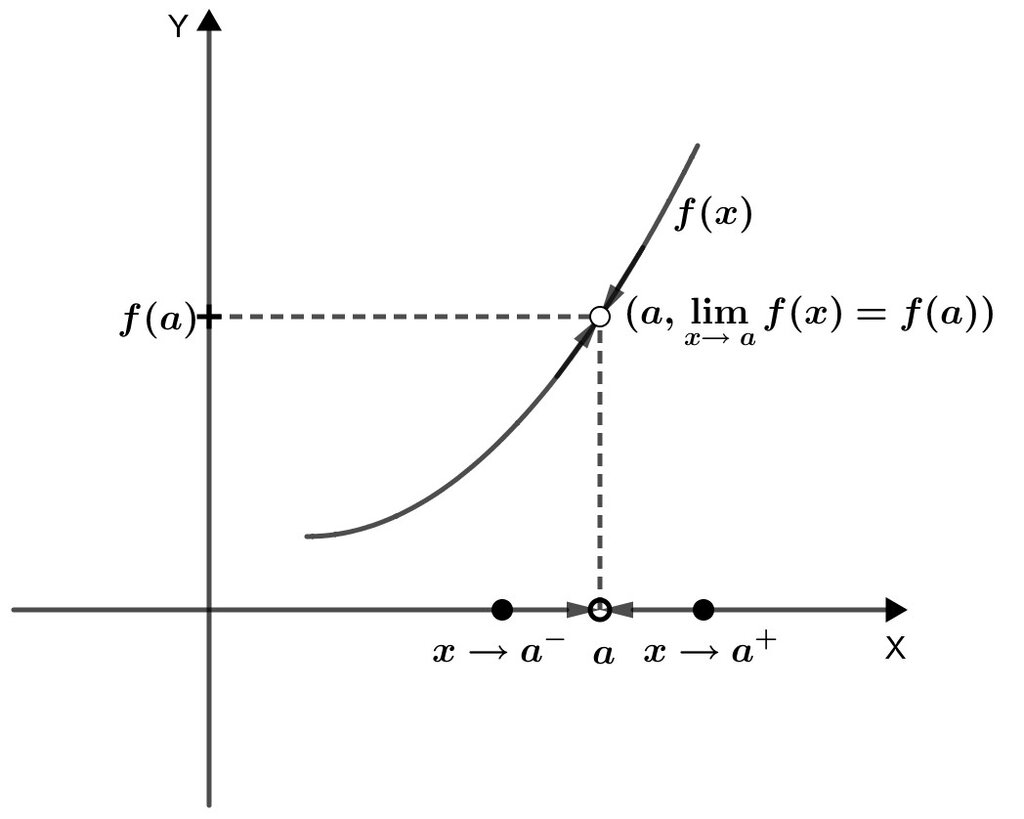
The key idea is that we don't care what happens at the exact point, only what happens in the neighborhood surrounding it. We write the limit of a function as approaches a number like this:
This means that as gets closer and closer to (from both sides), the value of gets closer and closer to .
How to Find Limits
So how do we calculate ? Sometimes, it's as simple as plugging the number in. This is called direct substitution.
For many simple functions, the limit at a point is the same as the function's value at that point.
For example, let's find the limit of as approaches 3.
Easy enough. But what about the function from our graph earlier, ? If we try to plug in , we get:
This result, , is called an indeterminate form. It's a sign that we need to do more work. It doesn't mean the limit doesn't exist. In this case, we can simplify the function by factoring.
Since we only care about what happens near , not at , we know that is not zero. That means we can safely cancel the terms.
This confirms what we saw on the graph. Even though the function is undefined at , its limit is 4.
The Idea of Continuity
Continuity is a straightforward idea. A function is continuous if you can draw its graph without lifting your pencil from the paper. There are no holes, jumps, or gaps.
This intuitive idea has a formal definition that ties directly back to limits. A function is continuous at a point if three conditions are met:
- The function is defined at . In other words, exists.
- The limit of the function exists at . So, exists.
- The limit at is equal to the function's value at .
Think back to our two examples. The function is continuous everywhere. At , the limit was 10, and the function's value is also 10.
However, the function is not continuous at . It has a limit there (which is 4), but the function itself is undefined. It fails the first condition.
Understanding limits and continuity is the first major step in calculus. These concepts allow us to handle the idea of 'instantaneous' change, which is what we will explore when we get to derivatives.
What does the limit of a function as approaches describe?
What is the value of the following limit: ?