Introduction to Data Structures
Introduction to Data Structures
Organizing Information
Imagine trying to find a specific book in a library where all the books are just thrown into one giant pile. It would be a nightmare. Libraries work because they have a system. Books are organized by genre, then alphabetically by author. This system makes finding what you need fast and predictable.
In the world of programming, data structures are the systems we use to organize information. They are formats for storing and managing data so we can access and modify it efficiently.
Data Structure
noun
A particular way of organizing, processing, retrieving, and storing data in a computer so that it can be used efficiently.
Just like a librarian chooses a shelving system, a programmer chooses a data structure. The choice depends entirely on the problem you're trying to solve. Some structures are great for keeping items in a specific order, while others are better for representing complex relationships.
Structures and Algorithms
Data structures and algorithms go hand in hand. An algorithm is a set of steps for accomplishing a task. A data structure is how you organize the data that the algorithm works with.
Think of it like cooking. Your recipe is the algorithm, and the way you arrange your ingredients on the counter is the data structure. If your ingredients are neatly organized, you can follow the recipe quickly. If they're scattered all over the kitchen, you'll waste time just trying to find the salt. The best recipe in the world won't save you from a disorganized kitchen.
Choosing the right data structure makes your algorithms faster and more efficient. A bad choice can make a program slow and difficult to use.
Ultimately, understanding data structures is about problem-solving. It gives you a toolbox of different ways to organize information, allowing you to pick the perfect tool for the job.
A Quick Tour
There are many different data structures, but most are variations on a few core concepts. They are often divided into two main categories: linear and non-linear.
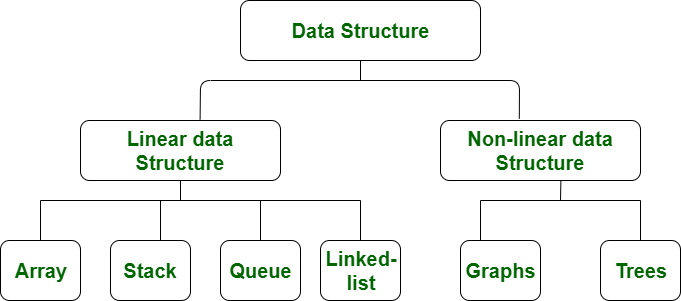
Linear structures organize data in a sequence.
-
Arrays are like a row of numbered mailboxes. Each item is stored in a slot with a unique number, or index. This makes it very fast to grab an item if you know its index.
-
Linked Lists are a series of items where each one points to the next, forming a chain. This makes it easy to add or remove items anywhere in the chain without shifting everything else around.
-
Stacks follow a Last-In, First-Out (LIFO) principle. Imagine a stack of plates: you add a new plate to the top and you also remove a plate from the top. The last plate you put on is the first one you take off.
-
Queues use a First-In, First-Out (FIFO) principle. This is just like a line at a grocery store. The first person to get in line is the first person to check out.
Non-linear structures are used for more complex relationships.
-
Trees represent hierarchical data, like a family tree or a file system on your computer. Each item can have multiple items linked below it.
-
Graphs are used to model networks. They consist of a set of nodes (or vertices) and the connections (or edges) between them. A social network or a map of airline routes are both great examples of graphs.
This is just a brief overview. Each of these structures has its own strengths and weaknesses, making them suitable for different kinds of tasks.
Ready to check your understanding?
What is the primary purpose of a data structure?
In the analogy where an algorithm is a recipe, what represents the data structure?
Learning these fundamental building blocks is the first step toward writing powerful and efficient code.